












A Dinse connector is a quick-action, twist-locking plug and socket used for transmitting high electrical currents on welding equipment. Originating from a German standard (DIN), its primary function is to provide a secure and electrically efficient connection for the welding power cable, work return (ground) lead, or torch package. The design ensures a large surface area for current transfer and a mechanical lock that prevents accidental disconnection.
Key Attributes of Dinse Connectors
The key identifiers for Dinse connectors are their size classification and corresponding amperage rating. Each size is designed to work safely within a specific current range, preventing overheating and voltage drop. Specifying the wrong size is a common failure point in both manual and automated welding setups.
The table below outlines the standard sizes and their typical applications, which we use as a baseline when designing a cobot welding cell.
| Connector Size | Maximum Continuous Current | Typical Application |
| 10-25 | ~200 A | Light-duty TIG welding, portable MMA (stick) welders |
| 35-50 | ~400 A | General workshop MIG/MAG, most cobot MIG systems |
| 50-70 | ~500 A | Heavy fabrication, high amperage power sources |
| 70-95 | ~600 A | Submerged arc welding (SAW), high-duty cycle industrial |
Source: Consolidated manufacturer data and DIN EN 60974-12 standards.
Choosing the correct size is critical; using a 10-25 connector on a 350-amp MIG application will cause it to overheat and fail.
Common Applications and Examples
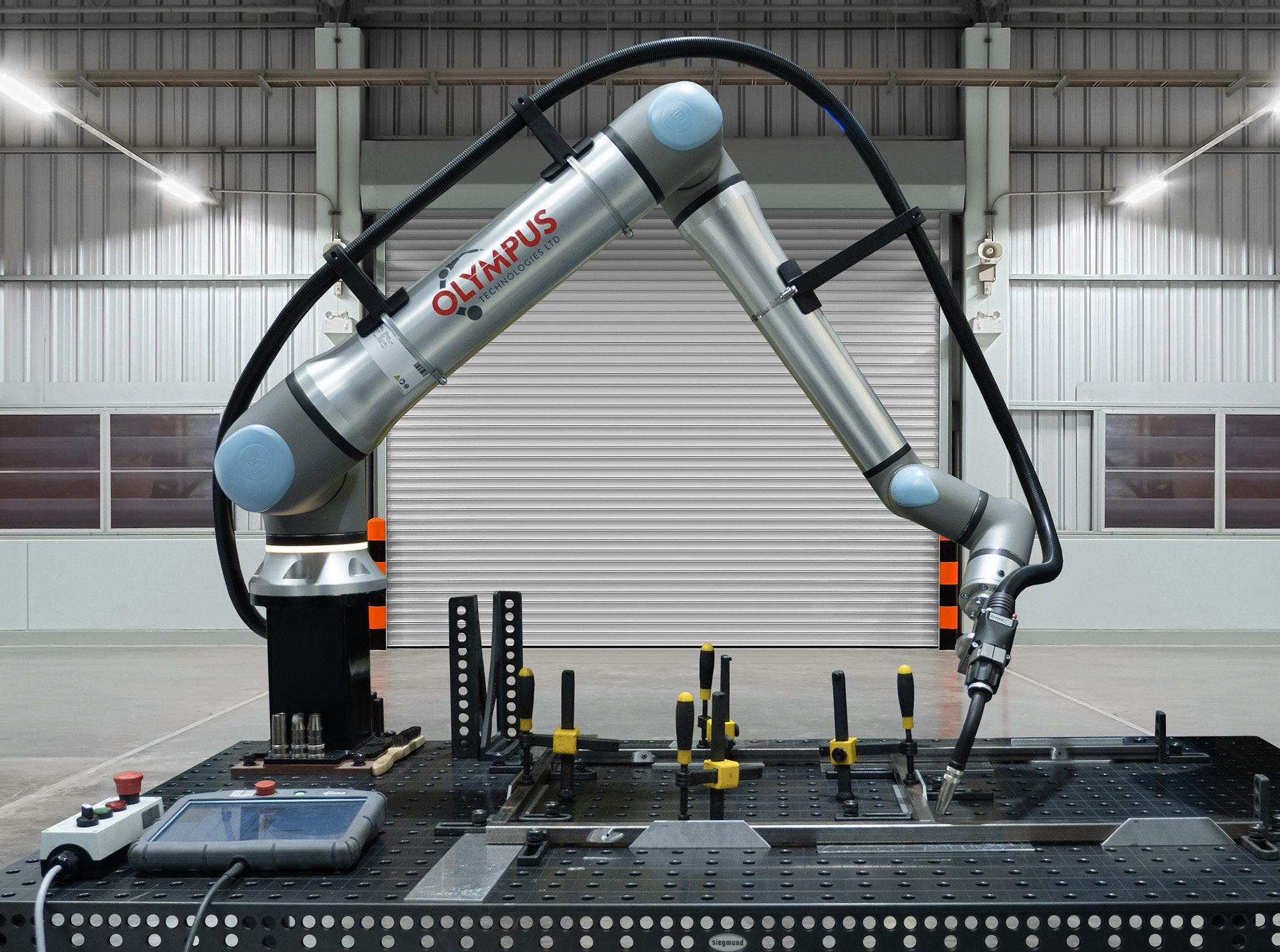
In our workshop, Dinse connectors are the standard for connecting a torch package to a power source like a Fronius TPS/i. The male plug, with its brass pin and rubberised grip, is attached to the end of the welding cable. The female socket is typically panel-mounted on the front of the welding machine.
The connection process is simple and reliable. You align the key on the male plug with the slot on the female socket, push it in fully, and then twist it clockwise about a quarter of a-turn. This action engages a cam lock, securing the plug and ensuring maximum electrical contact.
Where Confusion Arises
A frequent point of confusion is believing the Dinse connector handles all torch functions. It is exclusively for the welding power cable. Control signals for the wire feeder, gas solenoids, or arc monitoring are transmitted through a separate, multi-pin circular connector.
Assuming the Dinse connector is an all-in-one plug is a mistake we see with teams new to cobot integration. The power and signal paths are kept separate to shield sensitive control electronics from the high-current noise of the welding circuit. A robust system design respects this separation.
How Does Connector Choice Change with the Welding Process?
While the basic function of a Dinse connector remains the same, its role and the scrutiny it requires change significantly between different welding applications. For a manual welder, a slightly loose connection is a minor inconvenience fixed in seconds. For an automated cobot running a 2-metre seam on a high-value part, that same loose connection causes a catastrophic failure and costly scrap.
At Olympus Technologies, we treat the connector as a critical process variable, not just a commodity part. The stability of the connection directly impacts the stability of the arc, which is the foundation of a repeatable weld.
From Manual MMA to Cobot MIG
In a manual MMA (stick) welding scenario, the Dinse plug simply delivers current. The operator can compensate for minor voltage fluctuations by adjusting their technique. A cobot MIG system has no such luxury; it executes a program with precise parameters. An intermittent connection can introduce resistance fluctuations, causing voltage drops that lead to increased spatter or inconsistent bead profile.
During the commissioning of a new welding cell, our engineers verify the seating and integrity of every power connection with a milliohm meter. This tiny detail prevents hours of troubleshooting weld defects down the line. A stable electrical circuit is non-negotiable for consistent automated production.
High-Amperage MIG vs. Precision TIG
A Dinse 35-50 connector is perfectly adequate for a cobot cell running MIG at 350 amps on structural steel. The primary concern is thermal management and ensuring the connector can handle the duty cycle without overheating. Its job is to deliver raw power efficiently.
With precision TIG welding on aerospace components, the demands are different. Here, the electrical integrity of the connection is paramount for arc starting and stability, even at lower amperages. Any micro-arcing within a poorly-seated Dinse connector can introduce electrical noise that disrupts the high-frequency arc start sequence, leading to contamination and failed welds. For these applications, we ensure the fit is perfect, as it's a key factor in achieving a 99.8% first-pass quality rate.
Frequently Asked Questions (FAQs)
What do the numbers '35-50' on a Dinse connector mean? The numbers refer to the acceptable range of the cable's cross-sectional area in square millimetres (mm²) that the connector is designed for. It is a size classification that corresponds to a specific pin diameter and current-carrying capacity.
Can I connect a Dinse plug to a Tweco socket? No, the two standards are mechanically and electrically incompatible. Dinse uses a smooth pin with a twist-lock, while Tweco uses a tapered pin with a different locking mechanism. Attempting to force them will result in a poor electrical connection, overheating, and damage.
Is a bigger Dinse connector always better? Not necessarily. Using a grossly oversized connector, such as a 70-95 for a 200A process, adds unnecessary weight, cost, and stiffness to the cable assembly. The correct approach is to match the connector size to your power source's maximum rated output and expected duty cycle.
How often should Dinse connectors be inspected in a cobot cell? For automated systems, we recommend a visual and physical check during scheduled maintenance, typically every six months or 2,000 hours of operation. Look for signs of overheating (discoloured brass or melted insulation), carbon build-up, and ensure the locking mechanism is still tight. A loose fit is an early warning of a future failure.
Related Welding System Components
Specifying the right connector is just one part of building a reliable automated welding system. The entire torch package must work in concert.
- Go deeper on selecting the right connector for your specific amperage and duty cycle in our guide to Dinse connector sizing for Cobot MIG and TIG.
- Understand the differences between the main connector types in our Dinse vs Tweco vs Euro torch connections.
- The torch itself must provide clear access to the weld joint. Learn about options in our overview of special torch necks for cobot welding.
- A high-amperage robotic cell creates significant heat and spatter. Discover how to protect your automation investment by understanding what cobot welding covers are.
Integrate Your Welding Process with Olympus Technologies
Choosing the right Dinse connector is a foundational detail in a much larger system. The power source, torch, wire feeder, and robot must all be specified and integrated to deliver consistent, high-quality welds. Getting one detail wrong can compromise the entire cell's performance.
If you are exploring a move to automated welding, our engineers are ready to help you navigate these technical decisions. We design, build, and commission complete turnkey systems tailored to your specific parts and production goals.
Book a no-obligation consultation today to discuss your application with an automation expert.