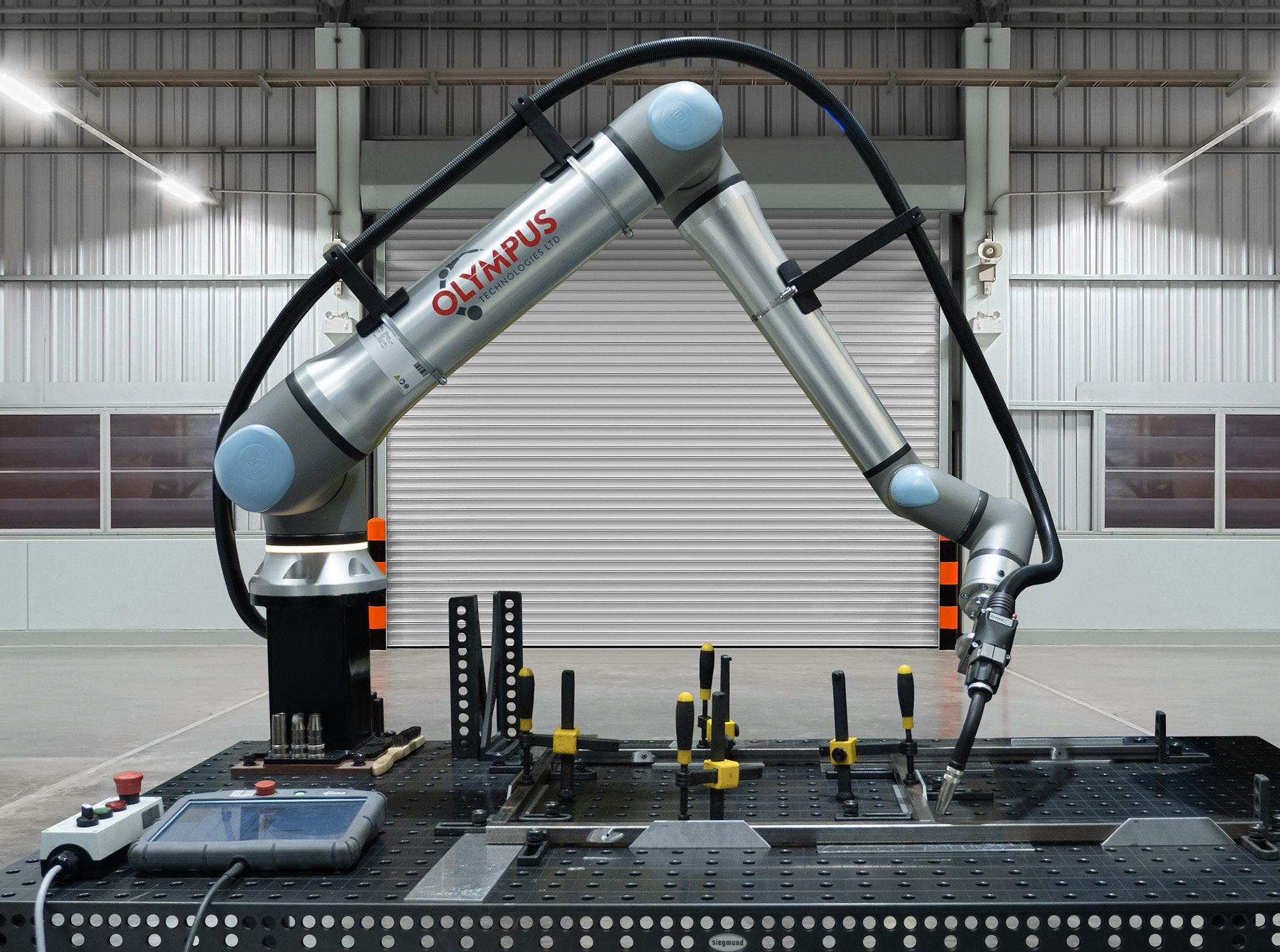














The choice between a collaborative robot and an industrial robot for press brake tending hinges on one trade-off: flexible production versus raw throughput. A cobot excels in high-mix, low-volume environments where its redeployability and lack of hard guarding deliver an ROI in 10 to 16 months. An industrial robot is built for dedicated, high-speed lines, processing heavy parts at a pace a cobot cannot match.
The fundamental difference lies in safety and footprint. Cobots like the Universal Robots UR20 operate safely alongside staff with the correct compact guarding and a risk assessment. This typically halves the required floor space and makes the cell portable, a key advantage for workshops running varied jobs on multiple presses.
In contrast, an industrial robot's speed and power mandate permanent hard guarding, creating a large, inflexible work cell locked into a single process and location. At Olympus Technologies, we guide fabricators through this decision by focusing first on part geometry, batch size, and existing workshop layout.
Key differences
A cobot-based system is designed for agility. Because it can be moved between press brakes, it does not need to be 100% utilised on one machine to be profitable. Its value comes from automating the most repetitive, low-to-medium volume jobs across your entire fabrication department.
An industrial robot system is a capital asset tied to a specific, high-volume production run. It must achieve maximum utilisation to justify the significant investment in guarding, footprint, and complex integration. This makes it ideal for Tier 1 automotive suppliers or similar environments where the same part is bent thousands of times per day.
Attribute comparison
The technical specifications reveal the distinct applications for each technology. Cobots offer enough payload and reach for the majority of sheet metal work, while industrial robots target the upper limits of part weight and size.
| Attribute | Collaborative robot cell (e.g. UR20) | Industrial robot cell |
|---|---|---|
| Typical payload | 10 to 30 kg | 50 to 500 kg+ |
| Part size envelope | Up to ~1800 mm (limited by reach) | Virtually unlimited (robot dependent) |
| Cycle time | 15 to 45 seconds per bend | Under 10 seconds per bend (press-limited) |
| Safety guarding | Force-limited; no physical fences | Mandatory hard guarding and interlocks |
| Footprint | Small, often on a mobile base (2 to 4 m²) | Large, fixed installation (10 to 25 m²) |
| Redeployability | High; moved between presses in hours | None; permanently installed |
| Turnkey capex | £55,000 to £95,000 | £120,000 to £250,000+ |
| Integration time | 2 to 4 weeks | 8 to 16 weeks |
Data based on typical Olympus Technologies projects and industry benchmarks.
It is worth noting that the cycle time for a cobot cell is often dictated by the press brake itself, not the robot's maximum speed. An operator can rarely outpace a robot once you account for setup, breaks, and fatigue over a full shift.
When to choose a cobot system
A cobot is the right choice for most UK fabrication job shops facing labour shortages and the need for more adaptable automation. Our project data shows this is the correct path for a fast, practical return. Specify a cobot tending cell if:
- Your parts weigh less than 30 kg.
- You run batch sizes from 10 to 1,000.
- Changeovers happen multiple times per day or week.
- You need to move the automation between different press brakes.
- Floor space is constrained and a large safety cage is not feasible.
When to choose an industrial robot system
An industrial robot is a powerful but specialised tool. It excels where a cobot's flexibility becomes a limitation against the demands of extreme volume or weight. Specify a hard-guarded industrial robot if:
- Your parts consistently weigh over 30 kg.
- You are running a single part number for weeks or months at a time.
- The product lifecycle is years long and the process is stable.
- Every second of cycle time is critical for meeting targets.
- You have the floor space and capital for a large, permanent installation.
When the standard rules do not apply
The decision is not always as simple as payload and batch size. We have seen many projects where specific part characteristics or facility constraints make the choice less obvious, and these edge cases need deeper engineering analysis. For example, a large, flimsy aluminium sheet might weigh only 8 kg, well within a cobot's payload, but its 2000 mm length makes it difficult for a single arm with a 1750 mm reach to handle without flexing or losing grip.
What if parts are large but lightweight?
This scenario challenges a cobot's reach and stability, not its lifting power. A standard magnetic or vacuum gripper may not support a large, thin sheet, causing it to droop or vibrate during movement. The robot can handle the weight but not the geometry. Our solution is often a bespoke gripper with multiple suction points across a wider frame, acting like a pair of hands to stabilise the sheet. This adds cost but unlocks automation for parts that would otherwise seem impossible for a cobot.
How do you integrate with older press brakes?
Many shops run perfectly good press brakes that are 10 to 20 years old and lack modern PLC interfaces like EtherNet/IP or PROFINET. Traditional integrators often quote for a new press brake as part of the project, which is rarely necessary. We have extensive experience connecting cobots to legacy machinery: using simple digital I/O signals from the press's foot-pedal circuit, or adding a few non-invasive sensors, we establish the handshake the robot needs. The cobot waits for a ready signal from the press and sends a cycle-start signal back, mimicking a human operator precisely.
Can you combine both types of robot?
In very high-throughput environments, a hybrid cell offers a powerful but complex solution. A cobot might perform de-palletising and orientation of blanks, placing them onto a buffer conveyor, using its flexibility and vision capabilities to pick from a stack. From the conveyor, a high-speed industrial robot, hard-guarded around the press brake, takes over the rapid bending sequence. The cobot handles the variable front-end task while the industrial robot performs the repetitive, high-force back-end task. We design these systems for clients scaling towards mass production but still needing upstream flexibility.
Frequently asked questions
What is the real-world footprint difference?
A typical mobile cobot cell for press brake tending, including the robot base and part trolleys, occupies about 3 to 4 square metres, and as it needs no physical fences the surrounding area stays open. A comparable industrial robot cell needs a minimum of 10 to 15 square metres for the robot, press, and mandatory perimeter guarding.
Can a cobot handle the same parts a human can?
A cobot can handle any part within its payload and reach. A Universal Robots UR20 handles parts up to 20 kg with a 1750 mm reach, covering a significant share of tasks done manually. For heavier or larger parts, a UR30 with a 30 kg payload may be specified, or an industrial robot becomes the necessary choice.
Is it difficult to program a cobot for a new press brake job?
No. An experienced operator can teach a cobot a new multi-bend sequence in 15 to 30 minutes using the graphical teach pendant, manually guiding the arm to the pick-up, insertion, and re-grip points without writing code.
Can you use a cobot for part inspection after bending?
Yes. By integrating a 2D vision system, the cobot can present the finished part to a camera to verify features like hole presence or bend-angle accuracy, combining tending and quality control in one automated sequence. We frequently implement this for aerospace and automotive clients.
Discuss your press brake application
The best way to determine the right solution is to analyse your specific parts and process. Our engineers can provide a data-driven recommendation based on your throughput goals, part mix, and existing equipment.
Contact us to book a free, no-obligation consultation and automation audit. We will help you build the business case for the right type of press brake automation.