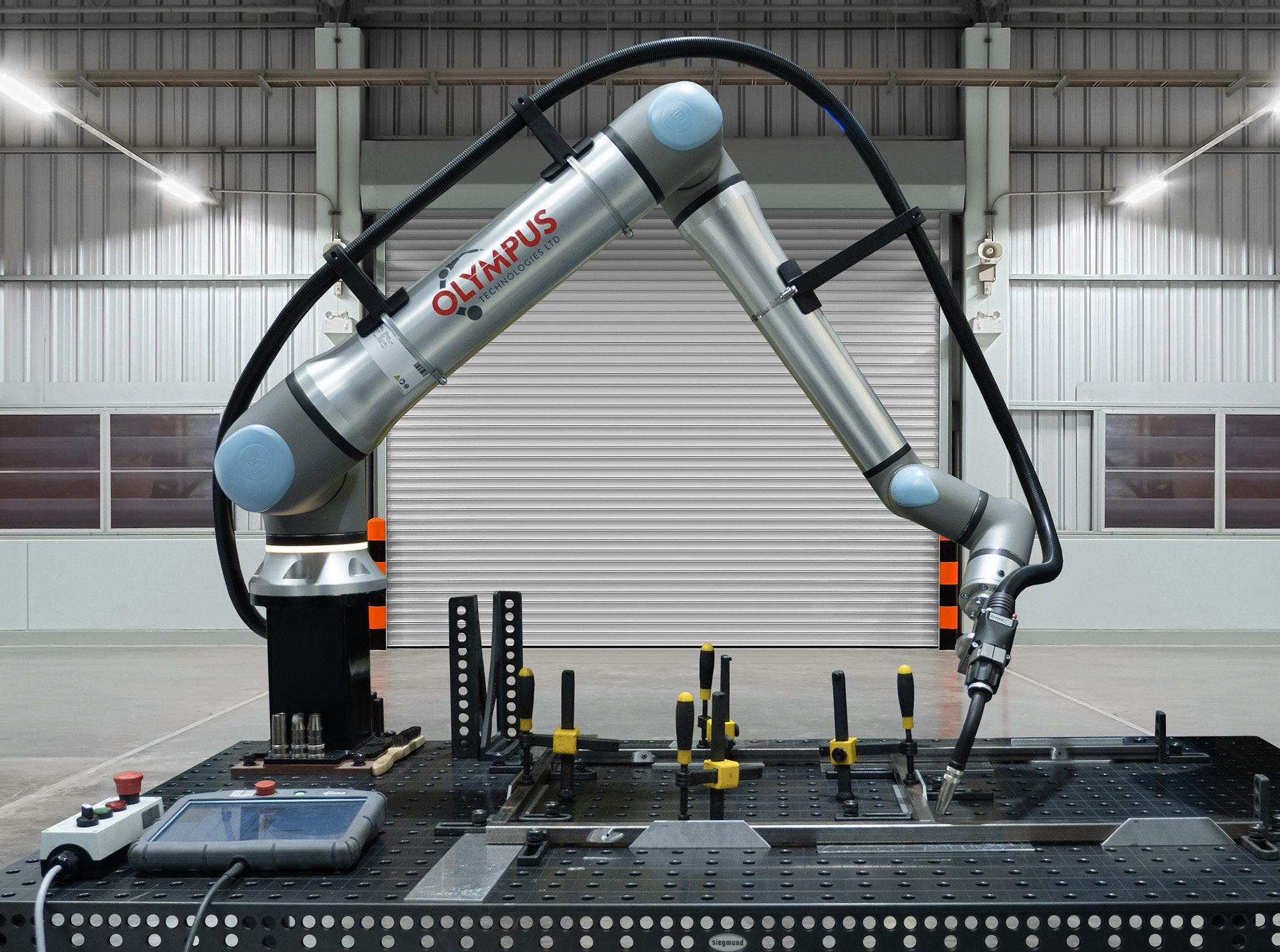













A standard straight torch neck can't reach every joint, especially on complex parts. Special torch necks, defined by their non-standard geometry, are the tools we use to position the wire and gas shield perfectly in difficult-to-access locations. These components are critical for automating welds inside channels, around corners, or deep within a fabrication.
What is a Special Torch Neck?
A special torch neck is any variation from the standard straight or slightly angled torch supplied with a cobot welding package. These include necks with sharp bends (like 45° or 90°), extended lengths (over 300mm), or unique shapes like S-bends. We specify these when the cobot arm's articulation alone is insufficient to achieve the correct torch angle and standoff distance for a quality weld.
The goal is to place the Tool Centre Point (TCP), the very tip of the welding wire, at a precise location and angle relative to the weld seam. A special neck makes this possible without the robot colliding with the part, fixture, or itself. This is a fundamental part of weld cell design that prevents costly rework and programming limitations down the line.
Key Geometries and Their Impact
The geometry of the torch neck directly influences programming, reach, and joint access. Choosing the right one is a balance between reaching the weld and maintaining cell efficiency. Each type presents a specific solution and a corresponding set of physical constraints.
At Olympus Technologies, our integration process involves simulating the entire weld path with the chosen neck to verify clearance before we ever build the cell. This digital twin approach avoids discovering collision issues during on-site commissioning.
Common Special Torch Neck Geometries
This table outlines the most common special necks we deploy for our clients' cobot welding cells, detailing their primary function and the key trade-offs we consider during system design.
| Geometry | Primary Use Case | Key Consideration |
| 22° / 45° Bent Neck | Accessing fillet welds inside tight corners or channels. | Improves torch angle without major TCP offset. Our default for many structural jobs. |
| 90° Bent Neck | Welding internal seams inside a box section or circumferential welds on the inside of a tube. | Requires careful programming to avoid collisions with the torch body. |
| 180° 'J' Neck | Welding on the reverse side of a flange or feature the robot cannot reach from behind. | Drastically changes the TCP and can limit the usable work envelope. |
| Extended Reach (>300mm) | Reaching deep inside large fabrications or chassis. | Risk of wire feed friction and voltage drop. We pair this with higher-rated wire feeders. |
| Water-Cooled Neck | High-amperage, high duty-cycle applications (>350A at 60%+). | Adds weight and complexity. Can reduce the net payload available for other sensors. |
Source: Internal Olympus Technologies engineering project data.
Use Case Examples
In practice, the part dictates the torch. A simple flat-plate weld rarely needs more than a standard torch. The need for a special neck becomes apparent when dealing with three-dimensional assemblies.
Deep Fillet Welds: For a fillet deep inside a C-channel, a 22° or 45° neck allows the torch body to remain outside the channel while the gas nozzle reaches the joint. This maintains the necessary travel and work angles without the torch body colliding with the part.
Tube-in-Tube Assembly: Welding a smaller tube inside a larger one requires a 90° neck. The cobot positions the torch body parallel to the tube's axis, and the 90° bend places the wire correctly for the internal circumferential seam. A straight torch would simply collide with the outer tube wall.
Box Section Corners: Welding the internal corner of a fully fabricated box frame presents a clearance challenge. A 90° neck can often reach these, but the TCP offset requires careful path planning. The robot's wrist must be positioned well outside the box, using the neck to reach in, which can limit movement in tight spaces.
What Changes When You Use a Non-Standard Torch Neck?
Adding a special torch neck is not a simple swap; it changes the physics of the entire end-of-arm tool. A longer or heavier neck alters the robot's dynamics, influencing payload capacity, potential cycle time, and even the weld parameters themselves. These factors must be accounted for in the initial system design.
For instance, a standard UR10e has a 12.5 kg payload. A lightweight air-cooled torch might weigh 2-3 kg, leaving ample capacity. A heavy-duty, water-cooled extended neck can weigh over 5 kg, consuming nearly half the available payload and requiring the robot to move at slower accelerations to stay within its operational limits.
How Does Neck Length Affect Welding Performance?
The length and geometry of the neck directly impact wire feeding and electrical delivery. A long neck, particularly one with multiple bends, increases friction on the wire as it travels through the liner. This can lead to inconsistent wire feed speed at the arc, causing defects like stubbing or burn-back, which we eliminate by specifying a higher-torque, 4-roll wire feeder.
Furthermore, a longer cable run from the power source to an extended neck can introduce a subtle voltage drop. A drop of even 0.5V can alter the arc characteristics enough to compromise a precisely tuned MIG welding procedure. Our engineers measure voltage at the torch, not just the power source, to ensure the parameters are correct at the point of welding.
When Is a Custom-Fabricated Neck the Only Option?
Off-the-shelf 22°, 45°, and 90° necks solve about 80% of access problems. The remaining 20% involve such unique part geometry that a standard special neck won't work. We encounter this in applications like welding brackets inside complex automotive chassis or reaching past clamps on an intricate aerospace fixture.
In these cases, a fully custom-fabricated neck is the solution. Our team designs S-bends or multi-angle necks using 3D CAD to weave around obstacles while presenting the torch at the perfect angle. This process ensures accessibility and is a core part of our expertise at Olympus Technologies, as we detail in our guide on when to specify a custom torch neck on a welding cobot.
Related Welding Resources
For a deeper understanding of cobot welding system components and setup, explore these related guides from our engineering team.
- Learn when to specify a custom torch neck for truly unique applications.
- Understand the importance of the torch connection in our guide, What Is a Dinse Connector?.
- See how we protect the cobot arm and cabling from spatter and heat with cobot welding covers.
Frequently Asked Questions (FAQs)
1. Do you need to recalibrate the Tool Centre Point (TCP) when changing necks? Yes, every time. The TCP is the exact point of the welding wire, and its position relative to the robot's mounting flange changes with every neck geometry. Accurate TCP calibration is essential for program accuracy; an error of even 2mm can cause the weld to miss the joint entirely.
2. Can a special torch neck cause weld quality issues? It can if the system isn't designed correctly. The two main risks are inconsistent wire feeding due to friction in long or bent liners, and voltage drop over extended cables. We mitigate these risks by using high-torque wire feeders, correctly sized power cables, and verifying voltage at the torch during commissioning.
3. Are special necks compatible with any welding power source? Compatibility is determined by the connection style (Euro, Dinse, Tweco) and the amperage rating, not the neck geometry itself. As long as the special neck uses the same connection system as your power source's torch, it will fit. Our engineers at Olympus Technologies ensure the entire package, from power source to contact tip, is correctly matched.
Talk to a Welding Automation Expert
If you're facing a welding challenge where access is the primary barrier to automation, a special torch neck is likely part of the solution. Our engineers can assess your parts and process to determine the optimal configuration.
Book a no-obligation site visit or a consultation to discuss your project in detail. We'll help you find the most reliable and efficient way to automate your difficult welds.