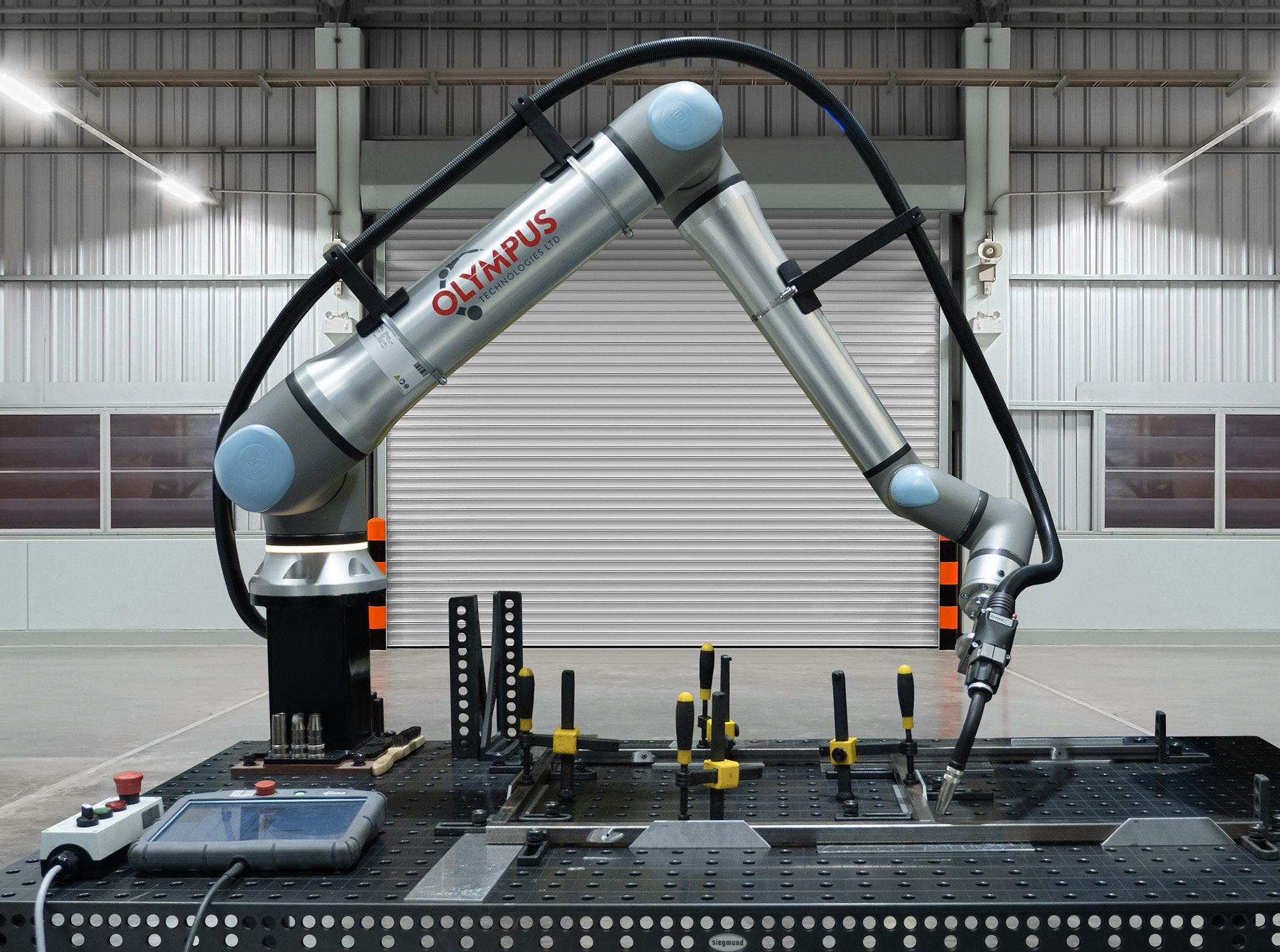













When specifying a welding torch for a cobot welding system, the connector type is often treated as a minor detail. In practice, it directly affects current delivery, voltage stability, maintenance frequency, and long-term reliability.
While Euro and Tweco torch connections remain common in fabrication workshops, DINSE connectors are increasingly becoming the preferred choice for high-performance automated welding systems. Their superior current handling, lower resistance, and secure locking mechanism make them the most robust option for demanding industrial applications.
At Olympus Technologies, we routinely specify DINSE connections for automated welding cells where uptime, duty cycle, and weld consistency matter more than installation convenience. Although Euro and Tweco connectors still have valid use cases, DINSE offers clear engineering advantages in high-output and production-critical environments.
Why DINSE Connections Are Superior
The biggest advantage of a DINSE connector is electrical performance under load. DINSE systems use a twist-lock bayonet design that creates a highly secure, low-resistance connection between the power source and the torch.
Compared to Euro and Tweco fittings, this delivers several practical benefits:
- Lower voltage drop over long duty cycles
- Reduced heat generation at the connector
- Greater resistance to loosening from robotic arm movement
- Higher continuous amperage capability
- Longer connector lifespan in industrial environments
In automated welding, even minor electrical instability can lead to inconsistent arc characteristics, increased spatter, and premature wear on consumables. DINSE connectors minimise these risks by maintaining a more stable electrical path.
For cobot welding systems operating on double shifts or handling thick-section fabrication, this reliability becomes critical.
DINSE vs Tweco vs Euro: Key Differences
Although all three connector types achieve the same basic goal, they are designed around different priorities.
| Attribute | DINSE Connection | Tweco Connection | Euro Connection |
|---|---|---|---|
| Current Rating | High (200A – 600A+) | Medium (200A – 500A) | Medium (150A – 400A) |
| Connection Type | Twist-lock bayonet | Tapered pin & cam-lock | Integrated nut & pin array |
| Regional Standard | Global industrial standard | North America | UK & Europe |
| Gas Line | Separate hose required | Separate hose required | Integrated into connector |
| Primary Advantage | Maximum electrical efficiency & security | Simplicity | Installation convenience |
| Best Application | Automated & high-duty-cycle welding | Existing US equipment fleets | General fabrication & turnkey MIG systems |
Note: Always verify connector ratings against the manufacturer’s datasheet.
Why DINSE Is Better for Automated Welding
In manual welding, a slightly loose or inefficient connector may go unnoticed. In robotic or cobot welding, that same issue becomes amplified over thousands of cycles.
A DINSE connection is mechanically stronger than both Euro and Tweco systems because the locking mechanism resists vibration and repeated movement from the robot arm. This matters particularly in:
- High-duty-cycle MIG welding
- Thick-section fabrication
- Multi-shift production
- Long torch cable runs
- High-amperage pulse welding
We generally specify DINSE connections for any automated welding process above 400A, especially where reliability is prioritised over quick torch swapping convenience.
The lower resistance of a DINSE connector also reduces heat build-up at the connection point. Over time, this improves component life and reduces the risk of intermittent welding faults.
The Limitations of Euro Connectors
Euro connectors dominate the UK and European welding market because they combine power, gas, and trigger signals into one convenient fitting.
For light-to-medium fabrication work, this simplicity is valuable. Installation is quick, torch replacement is straightforward, and compatibility with major European power sources is excellent.
However, the convenience comes with trade-offs.
The integrated design introduces additional internal interfaces that can become failure points under high current loads. Euro connectors also typically operate within a lower continuous amperage range than heavy-duty DINSE systems.
For general fabrication under 350A, this is rarely an issue. For industrial automation running continuously near maximum output, the limitations become more noticeable.
This is why many high-performance automated welding systems separate the power and gas systems entirely and use DINSE-style power connections.
Adapters: Useful but Not Ideal
Adapters can bridge DINSE, Tweco, and Euro systems when integrating existing equipment. While this is often unavoidable in retrofit projects, adapters introduce additional electrical interfaces into the circuit.
Each interface creates potential for:
- Heat generation
- Voltage loss
- Connection loosening
- Gas leakage
- Long-term reliability issues
For low-amperage welding, this compromise is usually acceptable.
For high-duty-cycle automated welding, we strongly recommend using a native DINSE connection wherever possible rather than relying on adapter chains.
Why We Recommend DINSE at Olympus Technologies
At Olympus Technologies, DINSE is our preferred specification for:
- High-amperage MIG welding
- Automated welding cells
- Thick-section fabrication
- Multi-shift production environments
- Systems requiring maximum uptime
- Long cable runs between power source and torch
When the priority is weld stability, electrical efficiency, and long-term robustness, DINSE is typically the superior engineering choice.
Frequently Asked Questions
What is a DINSE connector?
A DINSE connector is a high-current welding connector that uses a twist-lock mechanism to create a secure, low-resistance electrical connection. It is widely used in industrial welding systems due to its reliability and high amperage capability.
Is DINSE better than Euro?
For high-duty-cycle and high-amperage welding, yes. DINSE connectors generally provide better electrical efficiency, greater durability, and a more secure mechanical connection than Euro torch connectors.
Why are Euro connectors still common?
Euro connectors combine power, gas, and trigger signals into one fitting, making installation and torch replacement faster and simpler. This convenience makes them popular for general fabrication work.
Can you convert Euro to DINSE?
Yes. Adapters are available to convert between Euro, Tweco, and DINSE systems. However, for demanding industrial welding applications, a native DINSE setup is preferable to minimise resistance and heat build-up.
Further Reading
- What is a DINSE Connector?
- DINSE Connector Sizing for Cobot MIG & TIG
- When to Specify a Custom Torch Neck on a Welding Cobot
- Cobot Welding Covers vs Hard Guarding
If you are planning a cobot welding cell, Olympus Technologies can help specify the correct torch, connector, and welding package for your application. Our engineers design systems around duty cycle, material thickness, and production throughput to ensure long-term reliability.