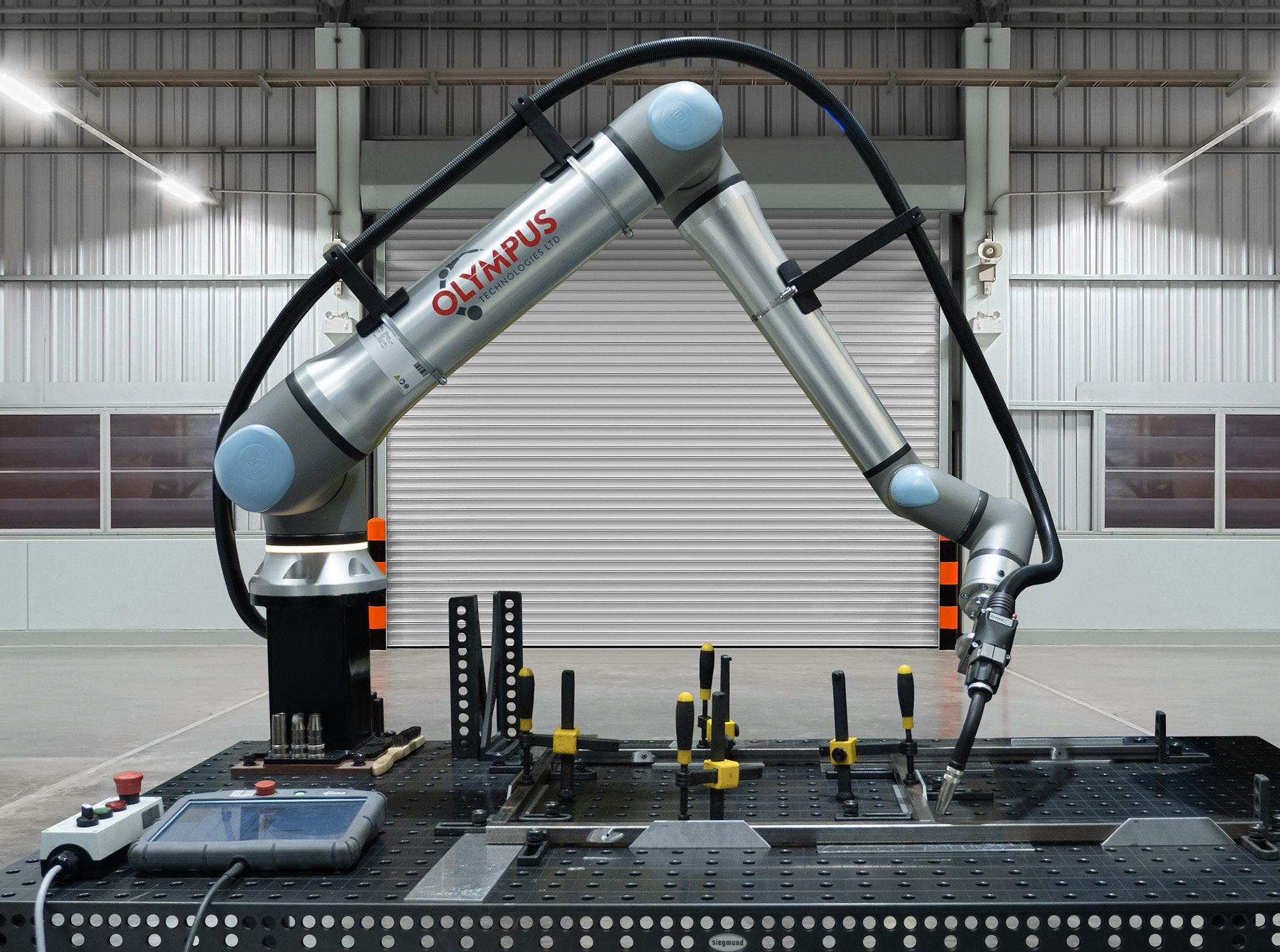














A properly configured press brake tending cobot achieves a positive return on investment even for low-volume, high-mix work, with payback periods between 10 and 16 months. The key is not running massive batches; it is enabling a single skilled operator to run two machines at once and reducing changeover times to under 15 minutes. This model decouples profitability from part volume.
At Olympus Technologies, we find the break-even point is typically reached on batches of 15 to 25 parts. This is possible because modern URCap software and quick-change tooling virtually eliminate the time penalty of switching between jobs. The cobot's value comes from increasing machine uptime and operator productivity, not just raw bending speed.
The payback model for low-volume press bending
For a typical turnkey, payback is driven by three main factors: labour redeployment value, increased machine utilisation, and reduced scrap. Below are the inputs we use to calculate ROI for our clients.
| ROI factor | Typical value / impact | Notes |
|---|---|---|
| Batch-size break-even | 15 to 25 parts | Below this, manual changeover time is often faster. |
| Operator labour redeployment | 0.8 to 1.0 FTE | One operator can manage the cobot cell plus a second manual task. |
| Machine uptime (OEE) | +20% to +40% | The cobot runs consistently through breaks, shift changes, and lulls. |
| Changeover time (cobot) | 10 to 15 minutes | Using offline programming and quick-change EOAT. |
| Scrap and rework reduction | -50% to -90% | Eliminates handling errors, incorrect bends, and fatigue-based mistakes. |
| Payback period | 10 to 16 months | Assuming two-shift operation and a fully loaded UK labour rate. |
Source: Olympus Technologies project data, 2023 to 2024.
These figures assume a standard UR10e or UR20 cobot integrated with your existing press brake's control system. The most significant financial gain is almost always the ability to redeploy a skilled operator to a higher-value task, like programming a new job or running a second machine that was previously idle.
Where ROI is proven on the shop floor
Consider a common scenario: a sheet metal shop running batches of 30 to 100 parts across a double shift. Manually, one operator is tied to one press brake, achieving perhaps 65% uptime due to part handling, fatigue, and breaks, with a scrap rate on complex parts of around 4% to 5%.
By introducing a cobot cell, the operator now oversees the automated press brake while setting up or running shorter jobs on an adjacent machine. The cobot runs continuously, pushing machine uptime toward 85% to 90% and cutting the scrap rate below 1%. This dual-machine productivity, combined with reduced waste, is what delivers the 12-month payback we consistently see in these environments.
What changes the financial viability?
The model above holds for most job shops, but it is not universal. The case weakens under specific constraints. A payback period can stretch beyond 24 months if batch sizes are consistently in the single digits, or if part geometry creates handling challenges that slow the cobot more than a human.
At Olympus Technologies we are upfront about when automation is not the right fit. If your typical job is five identical parts that are never repeated, manual bending is faster. Similarly, if your shop has only one press brake and no other value-add process for a redeployed operator, you lose the single biggest financial benefit of automation.
Does part size and weight alter the equation?
Yes, dramatically. The standard model assumes parts are within the payload and reach of a cobot like the UR10e (12.5 kg) or UR20 (20 kg), and that a single magnetic or vacuum gripper can handle them. When parts become very large, heavy, or flimsy, the cost and complexity of the EOAT rises.
A large, flexible stainless steel sheet might need a custom multi-cup vacuum gripper spanning over a metre. This bespoke tooling can add £5,000 to £10,000 to the project cost and extends commissioning time. While still automatable, the higher initial investment pushes the break-even point to a higher batch quantity or a longer payback period.
How does re-gripping impact cycle time?
Many complex parts need re-gripping mid-process to complete a sequence of bends. A simple part might be picked, bent three times, and placed in 45 seconds. A part that must be placed on a re-gripping table after the second bend can see its cycle time increase to 70 seconds.
For high-volume runs this extra time is a simple throughput calculation. For low-volume work it adds a crucial variable: does the increased cycle time negate the benefits of unmanned running? In our experience, if a part needs more than one re-grip, a batch size of at least 40 to 50 units is needed for a clear ROI. This is where a system with quick-change tool changers becomes critical to minimise downtime.
Related guides and resources
- Cost breakdown: the Press Brake Tending Cost UK guide.
- Cell selection: How to Choose a Press Brake Cobot Cell.
- Robot comparison: the Cobot vs Industrial Robot analysis.
Frequently asked questions
What is the absolute minimum batch size for a positive ROI?
It depends on your labour costs, part complexity, and changeover speed. In practice, we rarely see a positive ROI on batches below 10 to 12 parts unless the job repeats frequently. The sweet spot for low-volume ROI begins with batches of 15 to 25 units.
Can one cobot tend multiple press brakes?
Yes, by mounting the cobot on a mobile base or a linear rail, though this adds cost and complexity around safety, calibration, and machine interfacing. A more common and cost-effective solution is to use one static cobot to automate one press brake, freeing the operator to run a second machine manually.
How are complex bend sequences programmed for small batches?
This is handled by offline programming (OLP) software. The programmer imports a 3D CAD model of the finished part, and the software generates the robot's motion path, gripper commands, and press-brake signals. A new program can be created and validated virtually in under 30 minutes, without taking the machine offline.
Calculate your specific ROI
The figures here are based on typical UK manufacturing environments. The only way to get a precise number for your operation is to analyse your specific parts, processes, and costs.
Our team can provide a complimentary, no-obligation ROI assessment based on your production data. We will map out your expected payback period and identify the best configuration for your needs. Contact us to schedule a site visit or a virtual consultation.