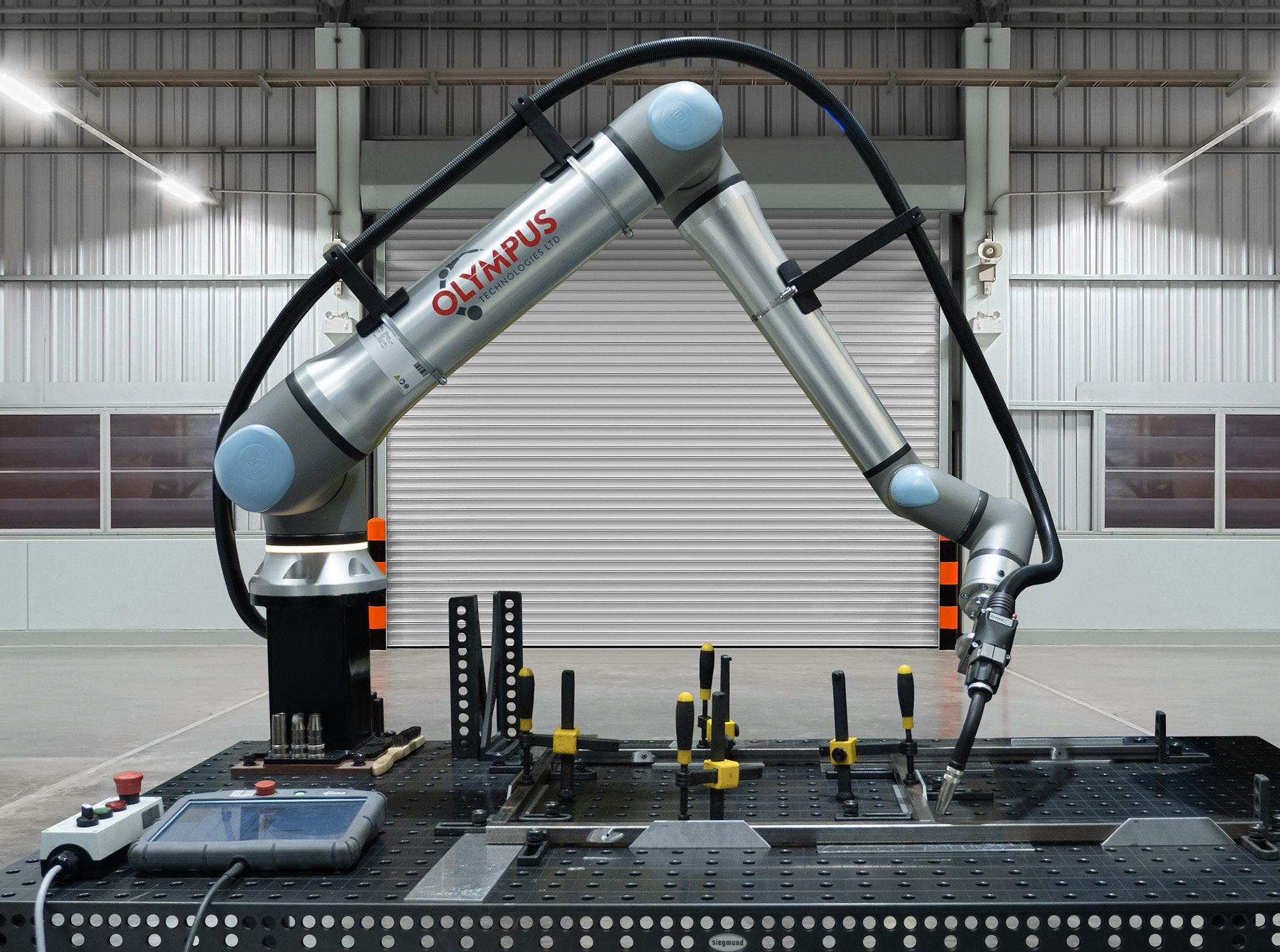














A fully installed collaborative robot press brake tending cell costs between £55,000 and £95,000 in the UK. This price delivers a turnkey solution including the cobot, safety systems, end-of-arm tooling, and integration. For most single-shift operations, this investment achieves a full return within 10 to 16 months.
This pricing covers a standard cell designed for parts up to 10 kg. It assumes a Universal Robots cobot, which we specify for over 90% of these applications because of its safety features and ease of use. The final figure depends entirely on part weight, size, and the complexity of the bending sequence.
Full cost breakdown
The total investment is not just the price of the robot arm. A production-ready system includes four key cost areas: the cobot hardware, the end-of-arm tooling, the cell infrastructure, and the specialist integration labour required to make it all work safely and efficiently.
At Olympus Technologies, we provide a fixed, fully costed proposal that covers all these elements. This prevents scope creep and ensures the system you get is the one specified, commissioned, and ready for production on day one. Every component is line-itemised so you can see exactly where the investment goes.
Key cost drivers
Four main variables determine where your project falls within the £55k to £95k range. The most significant is the part itself: its weight, material, and size dictate the robot payload, reach, and gripper type required.
1. Cobot model and payload. A cell for small, light parts under 10 kg uses a Universal Robots UR10e. Tending heavier parts, or those needing a longer reach to clear the press brake, demands a UR20, which increases hardware cost by roughly £10,000 to £15,000.
2. End-of-arm tooling. A simple magnetic gripper for ferrous sheets costs between £2,000 and £6,000. Handling aluminium, perforated sheets, or complex geometries needs a more expensive vacuum gripper or a custom mechanical gripper, which can cost from £4,000 to over £15,000.
3. Process complexity. A simple pick-and-place cycle is straightforward. If the cobot must re-grip the part between bends, use a force sensor for precise placement, or integrate with CNC backgauges, programming and commissioning time increases.
4. Cell infrastructure. The baseline includes standard safety scanners and a basic infeed/outfeed solution. Automated sheet de-stackers, precision part-locating jigs, or bespoke outfeed conveyors add to the total but are essential for high-throughput applications.
Turnkey press brake cell cost example
This table provides a typical cost breakdown for a standard UR10e-based press brake tending cell, designed for mild steel sheets up to 5 kg, which covers a significant portion of UK sheet metal fabrication work.
| Component | Typical cost band | Notes |
|---|---|---|
| UR10e cobot arm and controller | £28,000 to £35,000 | Includes teach pendant and control box. |
| Magnetic gripper (EOAT) | £2,500 to £4,500 | For ferrous sheets. Assumes no re-gripping station. |
| Safety system | £4,000 to £7,000 | Laser scanners, controller, and physical E-stops. |
| Cell mounting and peripherals | £3,000 to £6,000 | Pedestal for cobot, basic infeed and outfeed tables. |
| Integration and commissioning | £17,500 to £30,000 | Design, build, programming, risk assessment, FAT/SAT, training. |
| Total turnkey system | £55,000 to £82,500 | A complete, production-ready solution. |
Figures are 2024 estimates for budgeting and exclude VAT. The Olympus Technologies engineering team provides a firm, fixed-price quote after a site assessment.
What changes when you move beyond standard parts?
The £55k to £95k range holds for the majority of sheet metal applications, specifically parts under 10 kg with straightforward bend sequences. The equation changes once you introduce heavy-gauge materials, large surface areas, or non-ferrous metals. These factors do not just increase the cost; they alter the fundamental engineering of the cell. A system designed for 3 mm mild steel cannot simply be reprogrammed to handle 8 mm stainless steel; the payload, gripper force, and even the robot's mounting stability must be re-evaluated.
When do you need more than a magnetic gripper?
A magnetic gripper is the default for its simplicity and reliability, but it only works with ferrous materials. If your workshop processes aluminium, stainless steel, or composites, a vacuum gripper is essential, which adds complexity in the form of vacuum generators, filtration, and specific suction-cup arrangements. Thin sheets under 1 mm often stick together due to oil or static, a problem magnetic grippers can struggle with; a multi-zone vacuum system can activate specific cups to peel a single sheet reliably. For very large or flimsy sheets, a bespoke gripper combining vacuum cups with supporting mechanical forks stops the part sagging or deforming during transfer.
At what point is a UR10e insufficient?
The UR10e has a 12.5 kg payload and a 1300 mm reach, ample for many press brake tasks. However, this capacity includes the weight of the gripper itself: a 4 kg vacuum gripper for large sheets leaves only 8.5 kg for the part, a limit quickly met. If your parts exceed this combined weight, or need a long reach to be placed deep inside a large press brake, upgrading to a UR20 is necessary. The UR20 offers a 20 kg payload and 1750 mm reach. This moves the project into a higher cost bracket but is non-negotiable for safe, reliable operation.
Related guides
- How to Choose a Press Brake Cobot Cell: key technical specifications beyond cost.
- Cobot vs Industrial Robot for Press Brake Tending.
- Press Brake Cobot ROI for Low-Mix, Low-Volume: the payback and financial justification.
Frequently asked questions
What is the typical ROI for a press brake cobot?
For a single-shift operation, the typical payback we see across UK clients is 10 to 16 months, calculated by comparing the total investment against the annual cost of a skilled operator. Running the cell on a second shift can reduce the ROI period to under 8 months.
Does the quoted price include installation and training?
Yes. Every turnkey system includes full mechanical and electrical installation, programming, commissioning, and a comprehensive risk assessment compliant with UKCA and CE standards. We also provide on-site training for your operators and maintenance team.
Can a press brake tending cell be financed?
Yes. We work with asset-finance partners who specialise in manufacturing technology, allowing you to acquire the system with a predictable monthly payment. A lease or hire-purchase agreement can often be structured to be cash-flow positive from day one.
Get a bespoke cost for your application
The figures on this page are a reliable guide for budgeting. The only way to get a fixed price for your specific parts and process is to have our engineers conduct a review.
We can provide a detailed proposal and an accurate ROI calculation, often within 48 hours of an initial consultation. Contact us to schedule a free, no-obligation site survey or video call.