













A week-by-week engineering guide to deploying turnkey robot cells in the UK, from site survey to production handover within a 42-day window.
Week 1: Application Finalisation and Site Survey
Successful 6-week deployment cycles define clear technical bounds for the automation cell initial project scope. We perform a physical site survey to document layout constraints, electrical power availability (single or three-phase 415V), and compressed air provision at the intended cell location. Safety engineers evaluate the floor surface for flatness and load-bearing capacity to ensure stability for high-speed robotic movements.
Risk assessments under BS EN ISO 10218-2 start immediately to determine whether the cell requires full physical guarding or can operate as a collaborative application with laser scanners. We confirm the cycle time requirements based on your current manual production rates to establish a benchmark for the robotic system. Procurement of long-lead items such as the robot arm (Universal Robots UR10e or FANUC CRX) and specific end-of-arm tooling occurs before the end of day five.
Week 2: Mechanical Design and Fixturing Strategy
Engineering teams focus on the fixture design during the second week to ensure repeatable part positioning. Robot accuracy depends entirely on the stability of the workpiece, particularly in MIG or TIG welding where tolerances are often sub-millimetre. We design jigs that provide clear access for the robot torch or gripper while maintaining the required clamping force.
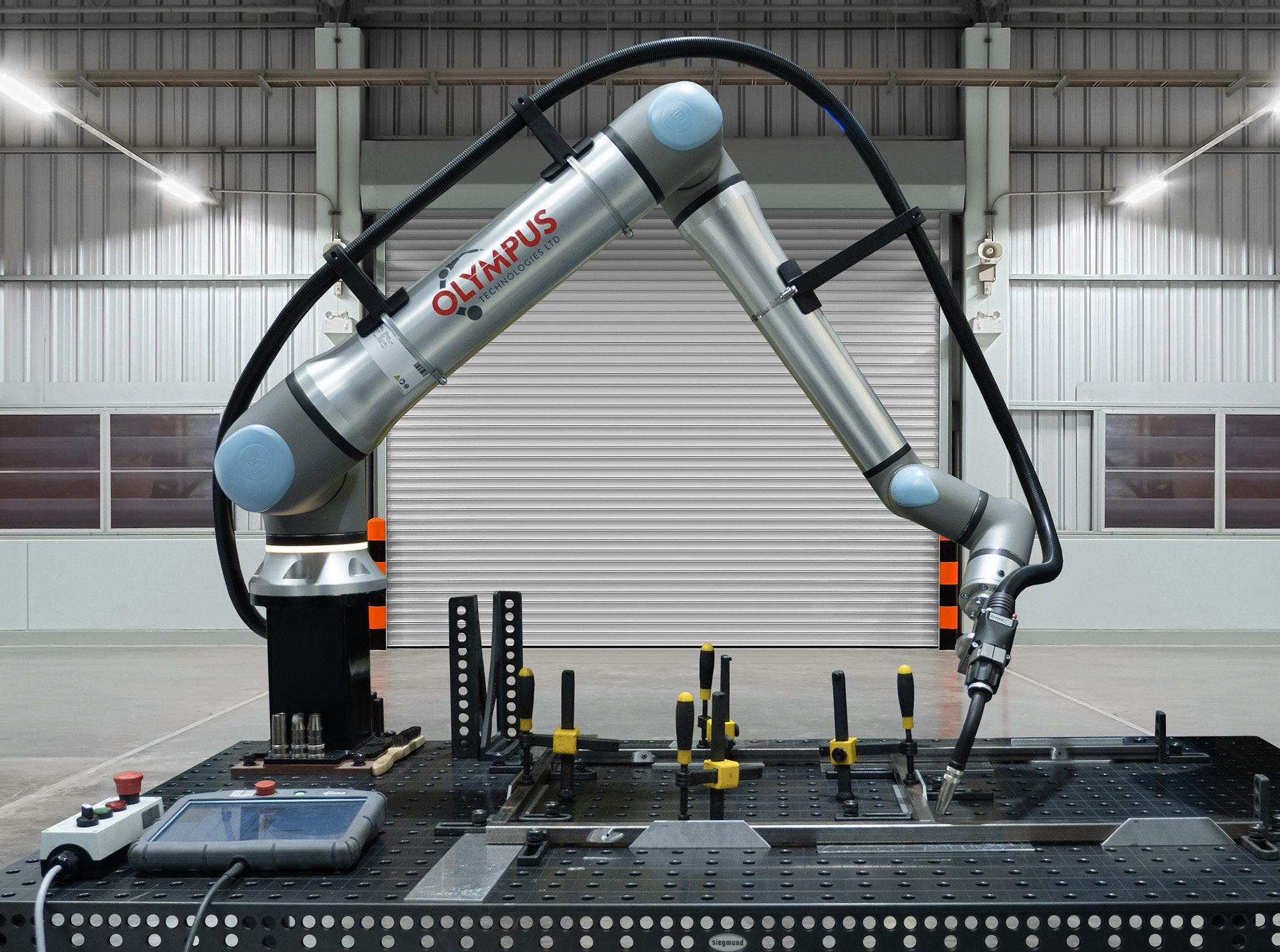
Offline programming begins in parallel with physical CAD design to simulate reachability and collision detection. This digital twin approach identifies potential interference issues between the robot arm and the cell guarding before any steel is cut. Any requirement for special torch necks or custom vacuum manifolds is finalised here to avoid bottlenecks during the assembly phase.
Week 3: Component Assembly and Control Integration
Assembly of the base frame or mobile pedestal takes place at our Leeds facility. We integrate the robot controller, teach pendant, and auxiliary interfaces into the main control cabinet. For welding applications, the power source is interfaced via professional protocols like EtherNet/IP or PROFINET to allow the robot to adjust welding parameters dynamically during the cycle.
Electricians wire the safety circuits, including E-stop buttons, light curtains, and door interlocks, ensuring compliance with PUWER regulations. We install the fluid systems for pneumatic grippers or gas lines for welding torches. Every cable is labelled and routed through energy chains to prevent fatigue failure during the millions of cycles the robot will perform over its lifespan.
Week 4: Internal Programming and Fatiguing
The fourth week involves dry-run testing where the robot follows the programmed paths without active tools or workpieces. This stage validates the logic of the PLC (Programmable Logic Controller) and the handshaking between the robot and external sensors. We stress-test the system by running continuous cycles at 100% velocity to observe thermal stability and repeatability.
If the cell is designed for MIG welding, we perform sample welds on customer-supplied materials to verify penetration and bead appearance. Adjustments to the torch angle or travel speed are made in the software to optimise the process. We encourage clients to visit our facility during this week for a pre-delivery inspection to verify that the cell meets the agreed functional specification.
Week 5: Site Installation and Safety Validation
Shipment to the customer site occurs at the start of week five, followed by mechanical anchoring to the factory floor. We reconnect the primary power and pneumatic lines previously identified during the site survey. The robot is recalibrated to the physical fixtures to account for any minute shifts during transport.
Safety validation is the critical path in the fifth week. We conduct stop-distance testing to ensure the robot ceases motion before a human operator can reach the hazard zone. This data forms part of the final CE/UKCA marking technical file. Operators receive introductory training on basic pendant navigation and start/stop procedures to build familiarity with the interface.
Bridging Engineering Design and Shop Floor Reality
The transition from a controlled integration environment to a live production floor involves managing variables such as ambient dust, fluctuating air pressure, and operator skill levels. While the first five weeks focus on the technical build, the final week shifts toward human-machine synchronisation to ensure the investment delivers the projected ROI from the first shift.
We move from the macro perspective of system architecture to the micro details of production throughput and preventative maintenance schedules. This ensures that the cell functions not just as a piece of equipment, but as a reliable member of the fabrication or palletising team.
Frequently Asked Questions
What are the power requirements for a standard cobot cell?
Most collaborative robot cells for welding or small-scale palletising require a standard 230V 13A or 16A single-phase supply. Larger industrial robots or high-power laser welding systems typically require a 415V three-phase connection. We specify these exact requirements during the Week 1 site survey.
How much space is needed for a 6-week deployment?
A typical cobot welding cell requires a footprint of approximately 2.5m x 2.5m, including the operator access area. Palletising cells usually require more floor space, often 4m x 3m, to accommodate pallet positions and forklift access.
Who is responsible for PUWER compliance?
Under UK law, the end-user is ultimately responsible for the safety of equipment in the workplace, but as the integrator, we provide the technical file, declaration of incorporation, and safety testing data required to make that assessment straightforward. We ensure the cell meets BS EN ISO 10218-2 standards before handover.
Related Engineering Concepts
- Cycle Time Optimisation: Reducing non-value-added movement between welds or picks to increase parts per hour.
- Tool Centre Point (TCP) Calibration: The process of defining the exact position and orientation of the tool (e.g., a welding wire tip or suction cup) relative to the robot flange.
- Off-Line Programming (OLP): Creating robot programmes in a virtual environment to minimise downtime on the physical production line.
Further Reading for Operations Directors
To understand the financial implications of these timelines, consider our guide on the cost per metre of MIG welding or evaluate the ROI for low-volume press brake tending. For those considering different joining technologies, our comparison of laser vs TIG welding provides data on post-process grinding reductions.