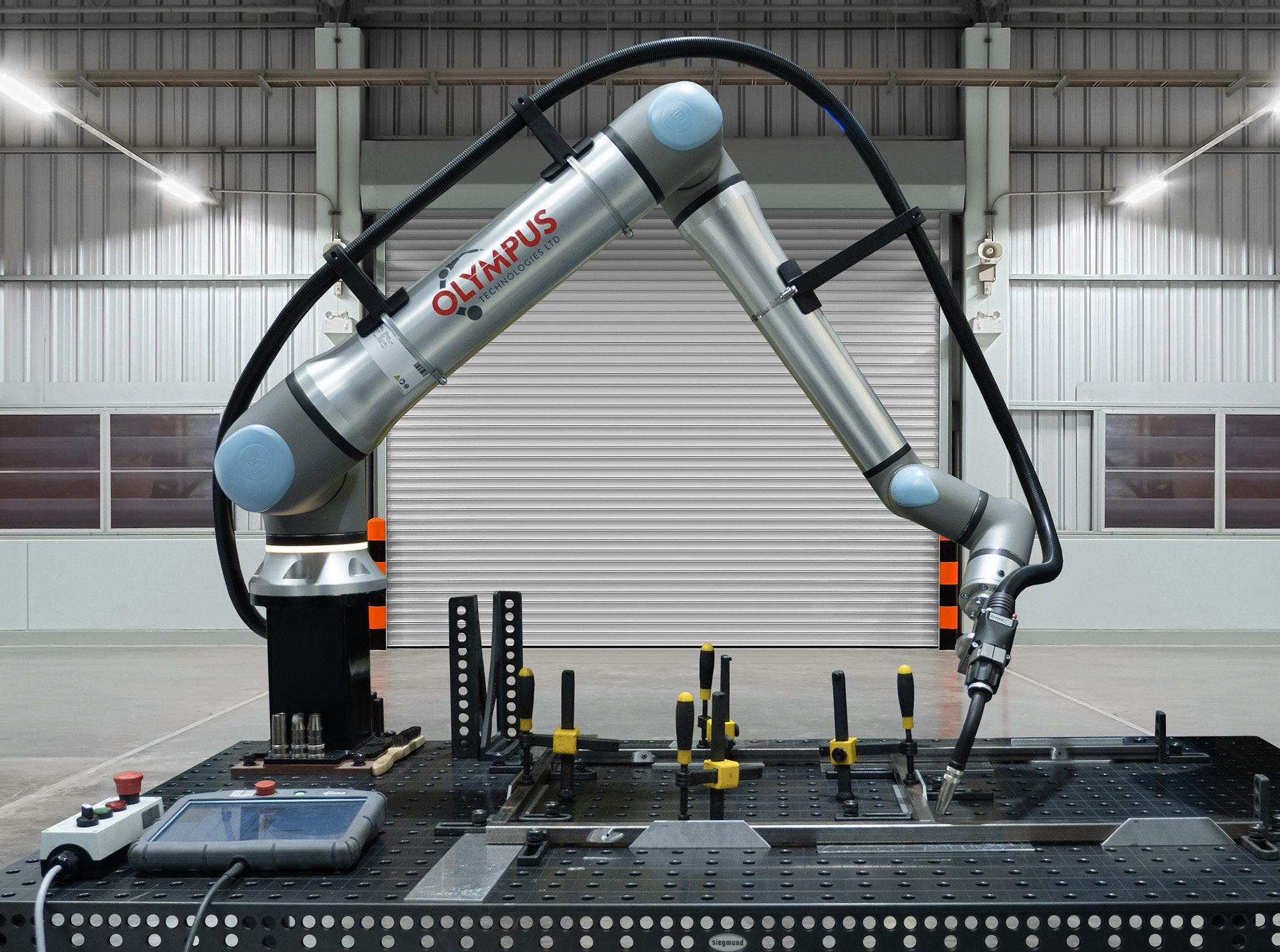














For fabricating thin-gauge stainless steel parts, cobot laser welding delivers a finished component five times faster than cobot TIG. This acceleration comes from two sources: raw weld speed and the complete elimination of post-weld grinding and polishing. The result is a dramatic reduction in cost-per-part and a significant increase in daily throughput.
A typical cobot TIG process on 1.5mm stainless steel moves at around 400 mm/minute, producing a quality weld that then requires manual cleaning and finishing. A comparable laser welding cell runs the same seam at over 2,000 mm/minute. Because the laser imparts extremely focused energy, it leaves behind a small, clean, autogenous weld that is immediately ready for the next production step. For more details on robotic welding, visit the Cobot Welding Solutions page.
Post-Weld Finishing: The Hidden Cost TIG Can't Escape
The primary benefit of laser welding is not just speed, but the removal of an entire process step. TIG welds on aesthetic parts require grinding, sanding, and often polishing to meet client standards, adding 5-10 minutes of skilled labour per part. This downstream bottleneck often dictates the real output of a factory, not the welding speed itself.
Laser welding collapses this entire workflow. By creating a near-perfect seam with a minimal heat-affected zone (HAZ), the part coming out of the cell is the final part. At Olympus Technologies, we see clients re-assign entire teams of grinders to higher-value tasks after commissioning a laser welding system.
Laser vs. TIG: Cost-Per-Part Breakdown
Consider a standard stainless steel enclosure with 2 meters of linear welds on 1.5mm material. A TIG process requires extensive manual finishing, while laser does not. The comparison shows how labour costs quickly shift the ROI calculation.
| Process Variable | Cobot TIG Welding | Cobot Laser Welding |
| Weld Speed | ~400 mm/min | ~2,000 mm/min |
| Weld Time / Part | 5 minutes | 1 minute |
| HAZ Size | Large, visible discolouration | Minimal, almost invisible line |
| Post-Weld Process | Grind, Sand, Polish | None |
| Finishing Time / Part | 7 minutes | 0 minutes |
| Total Cycle Time | 12 minutes | 1 minute |
| Capital Expenditure | £80k - £150k | £120k - £200k |
Estimates based on a typical 1.5mm stainless steel application. Labour time for finishing is the key driver.
Four Rules for Choosing Your Process
Your application's specific needs dictate the correct technology. While the numbers favour laser for 5 modern applications, TIG remains the right choice in specific scenarios.
1. Choose Laser for high-volume, thin-gauge (<6mm) stainless or mild steel parts where aesthetic finish and throughput are the primary business drivers.
2. Choose TIG for thick sections (>6mm) or when joining materials like aluminium where part fit-up is inconsistent and filler wire is necessary to bridge gaps.
3. Choose Laser when post-weld finishing is your single biggest labour cost or production bottleneck. The ROI is realised not in welding, but in removing the need to grind.
4. Choose TIG when capital expenditure is the number one constraint and your production volumes do not yet justify the higher initial investment of a laser system.
When Does Traditional TIG Still Outperform Laser?
The business case for laser is compelling, but it operates on the assumption of controlled, repeatable parts. When production variables like material thickness and joint fit-up become unpredictable, the operational flexibility of TIG provides a more resilient process. Our engineering team has found that the decision pivots on these two factors.
This is because the physics of each process handle imperfections differently. Laser welding's high energy density and small spot size are assets for speed but liabilities when faced with gaps or thick materials that dissipate heat too quickly.
How does material thickness change the equation?
For steel sections thicker than 6mm, the power density required for a single-pass laser weld increases substantially. This drives up the cost and complexity of the laser source needed. A multi-pass TIG weld, while slower, can achieve full penetration on thick plate with standard, lower-cost equipment.
The ability to add filler wire allows TIG to build up the weld seam pass by pass, a technique that is fundamental to heavy fabrication and structural work. Most cobot laser welding is autogenous (no filler), limiting it to applications where the two parent materials are fused directly. This is why you see TIG and MIG processes dominate in structural steel and pressure vessel fabrication.
What if your part fit-up isn't perfect?
Laser welding demands high-quality, precise part preparation. A typical laser process can only tolerate a joint gap of 0.1-0.2mm before weld quality degrades rapidly. Ensuring this level of fit-up requires accurate upstream processes like laser cutting and press brake forming.
TIG welding is significantly more forgiving. Our welders can manually or automatically feed filler wire into the weld pool to bridge gaps of 1-2mm without issue. This makes TIG a more reliable choice for applications with inherent variability, such as welding cast components or manually-formed assemblies where perfect alignment isn't guaranteed. Designing a process around TIG allows for looser tolerances in your fixtures and cutting, which can reduce costs elsewhere in the line.
Frequently Asked Questions
What is the typical capital expenditure difference?
A turnkey cobot TIG welding cell from Olympus Technologies typically costs between £80,000 and £150,000. A comparable cobot laser welding cell, including the mandatory Class 4 laser safety enclosure, starts at £120,000 and can go up to £200,000 depending on laser power and features. The higher cost for laser is offset by eliminating post-weld labour costs, leading to a faster ROI in high-volume settings.
How does operator training differ for laser vs. TIG?
Cobot TIG training focuses on welding principles: setting parameters for amperage, travel speed, and gas flow, plus troubleshooting weld defects. It builds on existing welding knowledge. Laser welding training, in contrast, prioritises safety and system operation. Operators learn how to manage the Class 4 enclosure, select pre-programmed weld recipes from the HMI, and perform basic maintenance. The skill is engineered into the system, not reliant on the operator.
Are the fumes and safety requirements different?
Both processes generate hazardous fumes and require effective fume extraction compliant with COSHH regulations. The key safety difference is the light hazard. TIG welding produces intense UV light requiring standard PPE. Laser welding uses a coherent beam of light that is an extreme eye and skin hazard, mandating the use of a certified, interlocked Class 4 safety enclosure that fully contains the beam.
Can I use one cobot arm for both TIG and laser welding?
Yes, a Universal Robot arm like the UR10e can run either process by swapping the end-of-arm-tooling (the TIG torch or laser head) and connecting to the appropriate power source. However, this is not a quick-change process. It involves re-cabling, mounting a new tool, and loading different software programs, taking 3 hours. We generally recommend dedicated cells for each process to maximise uptime and avoid cross-contamination.
Take the Next Step
- Explore Welding Solutions: See how we apply automation to TIG, MIG, and laser applications on our main Cobot Welding services page.
- Analyse Your Parts: Unsure which process fits best? Contact our team to book a no-cost welding feasibility study for your components.