













Manufacturers often face a critical decision: continue with manual machine tending or invest in collaborative robotics.
At Olympus Technologies, this choice is driven by 3 factors, primarily throughput demands, labour availability, and product consistency. Manual loading relies on human operators to feed parts into CNC machines, press brakes, or other production equipment, often involving repetitive, sometimes strenuous, tasks.
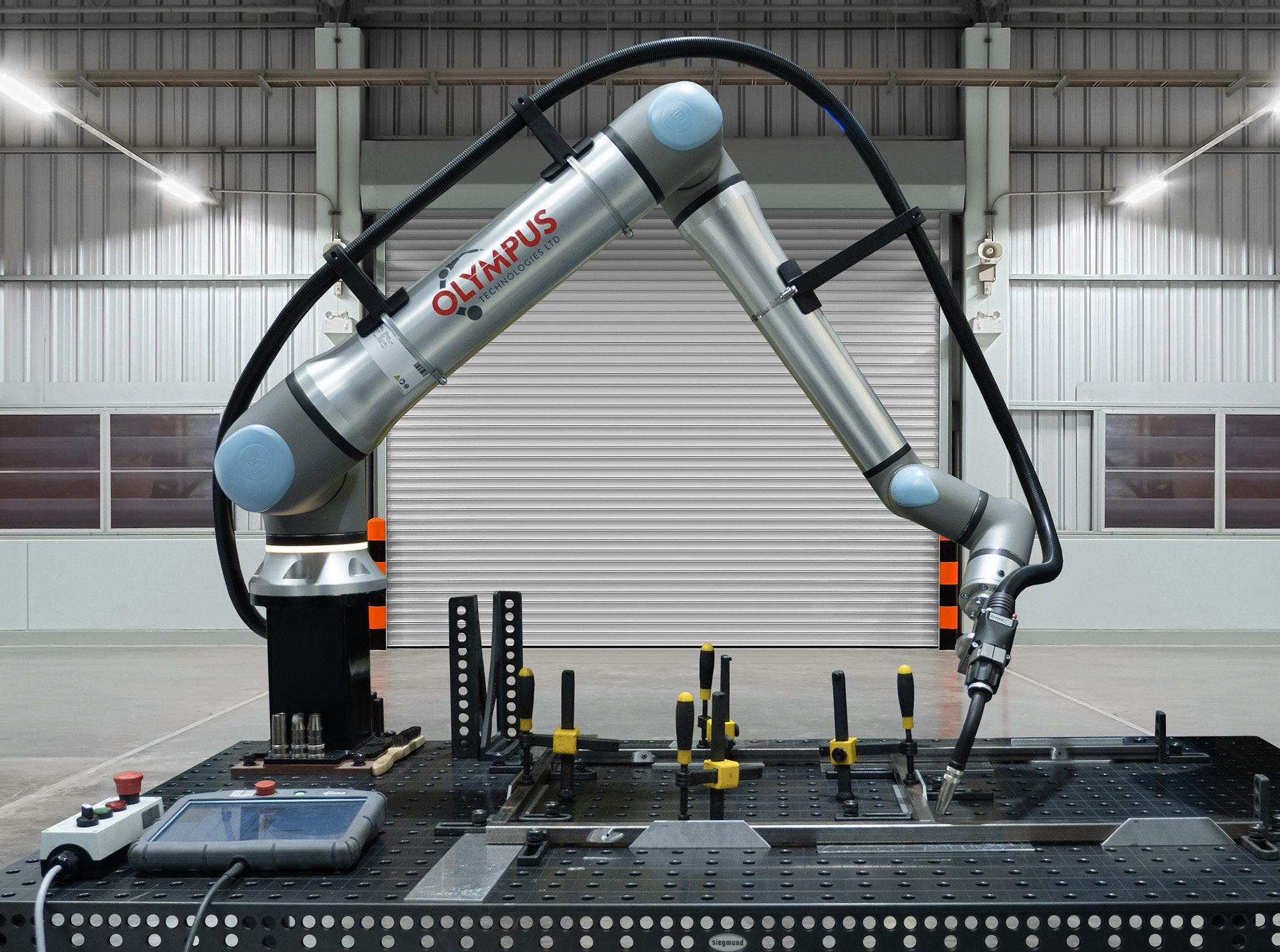
A machine tending cobot, conversely, automates this same process, using a programmable robotic arm to load and unload parts with precision and without interruption.
Key Differences
The fundamental difference lies in capacity and consistency. A human operator typically manages one, possibly two, machines, working within shift patterns and requiring breaks. Their performance varies due to fatigue or other human factors.
A cobot, such as a Universal Robots UR10e or UR20, operates continuously, 24/7, maintaining a consistent cycle time. We regularly achieve load/unload cycle times of 15 to 45 seconds with our machine tending cobot deployments, depending on part geometry and gripper complexity.
This contrasts sharply with manual operations where variables like part presentation and operator experience introduce variability.
Another distinction emerges in the work environment. Manual machine tending often involves operators physically interacting with machinery, subjecting them to repetitive strain injuries or exposure to coolant and chips.
Cobots, designed for human-robot interaction, perform these tasks safely alongside personnel after a thorough risk assessment, freeing staff for higher-value activities like quality control or process improvement. The initial investment for a turnkey machine tending cobot system typically ranges from £45,000 to £90,000, with an ROI period generally observed between 8 and 14 months, significantly faster than 3 other automation projects due to immediate labour cost displacement and increased uptime.
Attribute Comparison
The operational attributes between cobot and manual machine tending diverge significantly when we look at performance metrics and demands. This table highlights those distinctions, derived from our project experience in aerospace, automotive, precision engineering, and medical device sectors.
| Attribute | Machine Tending Cobot | Manual Loading |
| Operational Hours | 24/7 continuous operation | Single or double shift, with breaks |
| Consistency | High, <1mm positional repeatability | Variable, depends on operator |
| Cycle Time | 15–45 seconds per load/unload (part dependent) | 20–60 seconds, varies significantly |
| Throughput | Consistent, predictable output | Fluctuates with operator availability & fatigue |
| Labour Impact | Frees staff for higher-value tasks, addresses shortages | Requires constant operator presence |
| Safety | Controlled, repeatable movements; reduces exposure | Human interaction with machinery; injury risk |
| ROI Period | 8–14 months | Immediate labour cost, no capital ROI |
| Price Range | £45,000–£90,000 (turnkey) | Hourly wage + overheads |
Source: Olympus Technologies project data and industry benchmarks.
Choose a Machine Tending Cobot If:
You choose a machine tending cobot if your production involves repetitive loading and unloading tasks that bottleneck your operations or consume significant labour resources.
Manufacturers struggling with staff shortages for these roles find cobots provide a reliable solution. Our clients in medical devices, for instance, deploy cobots where precision and repeatable cycle times are non-negotiable for regulatory compliance and product quality.
You are also an ideal candidate if you seek to redeploy your skilled workforce from monotonous tasks to more complex activities, enhancing overall job satisfaction and productivity.
Choose Manual Loading If
Manual loading remains appropriate for low-volume production runs, highly variable part geometries, or R&D environments where production processes are still being finalised.
If your machines operate only a few hours per week, the capital expenditure for a cobot system does not deliver the necessary ROI swiftly enough.
We often advise manual tending if parts are extremely delicate, require subjective quality checks at each stage, or if the overall process is so infrequent that automation simply complicates more than it simplifies.
In these scenarios, the inherent flexibility of a human operator outweighs the benefits of automation.
Integrators Overlook 3 Variables
The choice between a machine tending cobot and manual loading is rarely as simple as comparing throughput numbers on a spreadsheet.
We find manufacturers focus solely on the immediate labour cost savings, overlooking crucial variables that dictate long-term success. For instance, while a cobot’s cycle time is impressive, a poorly designed end effector or an inefficient part presentation system negates those gains entirely. The actual bottleneck often shifts from the human operator to the material handling upstream or downstream.
Moreover, the complexity of machine communication protocol is never underestimated. Integrating a cobot effectively requires reliable communication with the CNC machine's controller, typically via M-code or Modbus.
If the existing machine lacks the appropriate digital I/O or an accessible communication port, the integration cost and timeline increase.
Our team at Olympus Technologies always conducts a detailed site survey to identify these potential hurdles upfront, ensuring our quoted ROI periods of 8-14 months are realistic.
Beyond the Initial Setup
Thinking past the initial deployment, consider how each approach scales and adapts to demand fluctuations. Manual operations offer immediate, albeit limited, flexibility in scaling output by simply assigning more or fewer operators.
A cobot system, however, delivers predictable, incremental scalability once integrated. For example, a manufacturer operating 2 shifts with manual loading struggles to secure staff for a third night shift.
A cobot, operating continuously, immediately provides that additional shift’s capacity without further labour costs, a critical advantage in industries like aerospace with high-precision, long-cycle components. We find this shift to 24/7 operation is where the true competitive edge emerges for our clients.
Alternatives
While machine tending cobots and manual processes cover most scenarios, there are other solutions depending on specific needs. For extremely high-volume, continuous production where parts are uniform and the environment is highly structured, a traditional industrial robot offers faster cycle times than a collaborative setup. However, industrial robots require extensive guarding and are typically isolated from human workers, increasing footprint and complexity.
Additionally, for tasks involving complex assembly or intricate deburring after machining, automated vision systems combined with force/torque sensors offer capabilities that neither pure manual nor simple cobot tending can match. These technologies allow for adaptive processing, handling slight variations in 2 parts.
Deeper Guides
To help you explore automation further, we have developed 2 resources addressing specific considerations for collaborative robot implementation.
- Learn more about the economic drivers behind automation decisions: CNC Machine Tending Automation Guide
- Explore the broader applications of cobots in manufacturing: Machine Tending with Cobots
Have specific questions about your machine tending operation? We offer a free consultation to assess your current processes and identify the most effective automation path for your facility. Contact Olympus Technologies today to discuss your project requirements.