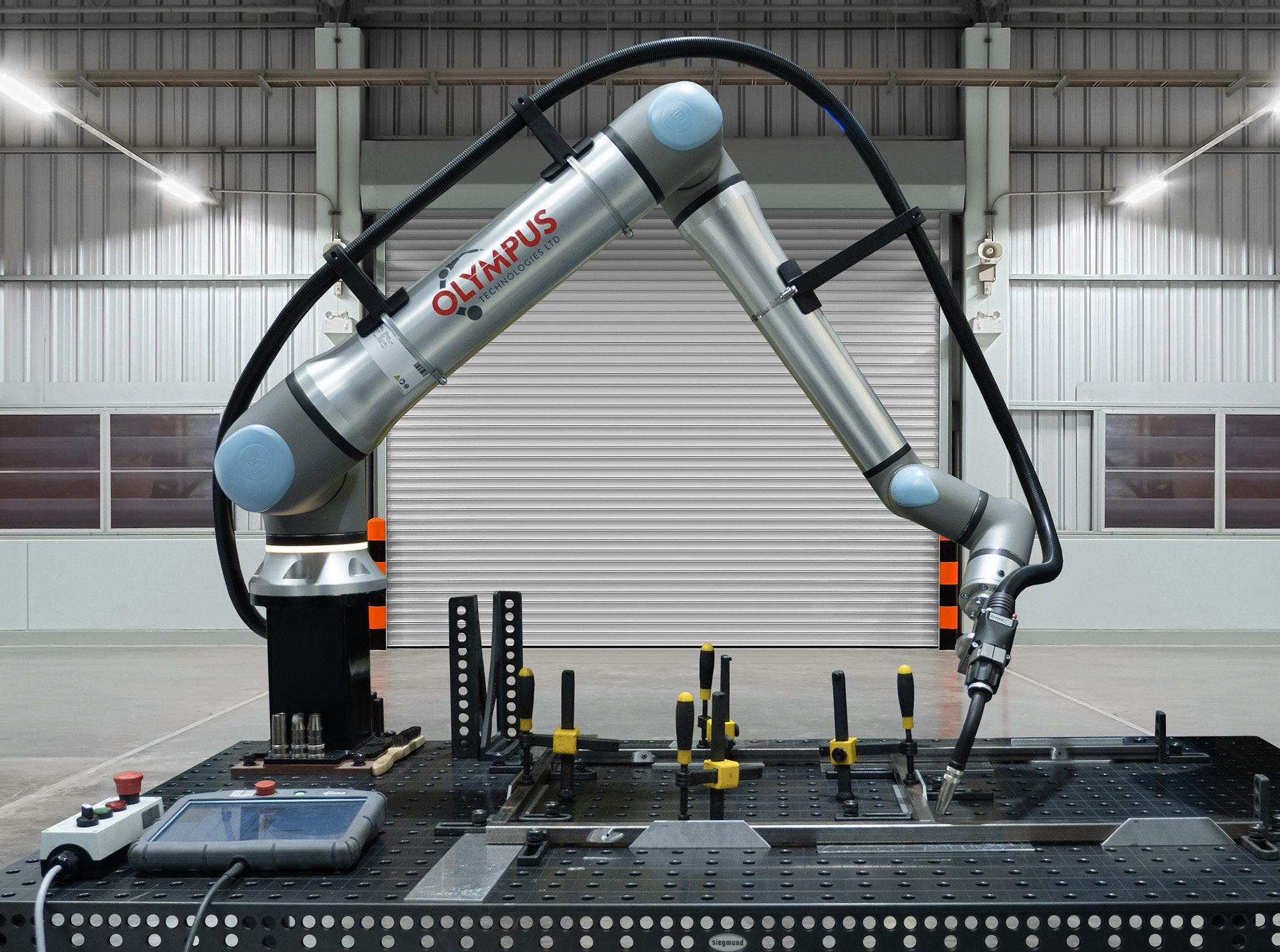














The most significant advantage of cobot laser welding over traditional TIG welding is the drastic reduction in heat input. For a typical autogenous butt weld on 1.5mm stainless steel, a TIG process creates a heat-affected zone (HAZ) of around 5mm. Our automated laser welding cells reduce that HAZ to under 0.5mm, a 90% reduction that fundamentally changes what's possible in thin-gauge fabrication.
This precision comes from concentrating a high-energy beam on a tiny spot, melting the material before significant thermal energy can conduct into the surrounding parent metal. The result is a fast, clean weld with minimal distortion and metallurgical change. Achieving this level of control depends entirely on mastering the relationship between six core process parameters.
The 6 Parameters That Dictate HAZ Width
The interplay between laser power, travel speed, and spot size forms the foundation of thermal management. Increasing travel speed while maintaining sufficient power for fusion directly lowers the joules of energy delivered per millimetre of weld, shrinking the HAZ. We configure our cobot systems to weld at speeds up to 60 mm/s, a rate that is impossible to sustain manually while maintaining path accuracy.
Next, we control the beam's characteristics through pulse shaping and focus position. Using a Quasi-Continuous Wave (QCW) laser allows us to create custom pulse shapes that deliver peak power for penetration followed by a lower-energy 'tail' to control cooling. Shifting the focal point of the laser slightly above or below the material surface also changes how energy is distributed, allowing us to fine-tune the weld profile.
Finally, the choice of shielding gas influences the weld pool and surrounding area. While pure Argon is common, a Helium/Argon mix increases thermal conductivity within the plasma, creating a hotter, more fluid weld pool that solidifies faster. This rapid solidification further limits the time available for heat to spread into the parent material, contributing to a narrower HAZ.
Measuring Heat Input: Cross-Sectional Microhardness Testing
Verifying the HAZ isn't a simple visual inspection; it requires empirical proof. After welding, we cut a cross-section of the weld, mount it in resin, and polish it to a mirror finish. Using a Vickers microhardness tester, we then map the hardness at precise intervals moving away from the fusion line.
The HAZ is officially defined as the zone where the material's hardness has changed due to thermal exposure. This test gives us a precise measurement, in microns, of the true extent of the heat's influence. For aerospace, medical, and other regulated industries, this data is essential for process validation and quality assurance. At Olympus Technologies, this is a standard part of our application development process.
Parameter Examples for 304 Stainless Steel
The settings below show typical starting points for achieving different HAZ profiles on 304 stainless steel. Final parameters are always optimised based on the specific joint design, material batch, and desired mechanical properties.
| Material | Target HAZ | Laser Power | Travel Speed | Spot Size | Pulse Mode |
| 1mm 304 SS | < 0.5 mm | 1.0 kW | 60 mm/s | 0.2 mm | QCW (Pulsed) |
| 1mm 304 SS | ~ 1.0 mm | 1.5 kW | 30 mm/s | 0.5 mm | CW (Continuous) |
| 3mm 304 SS | < 0.8 mm | 2.0 kW | 40 mm/s | 0.4 mm | QCW (Pulsed) |
| 3mm 304 SS | ~ 1.5 mm | 2.5 kW | 25 mm/s | 0.6 mm | CW (Continuous) |
Source: Olympus Technologies internal R&D weld logs.
Note the trade-offs. Using Continuous Wave (CW) mode increases travel speed and deposition for deeper penetration but at the cost of a slightly wider HAZ. The optimal choice always depends on the application's primary requirement: is it minimal distortion or maximum penetration depth?
When Minimal HAZ Isn't the Primary Objective
The intense focus on minimising HAZ is critical for thin-gauge fabrication where distortion is the primary concern. However, for heavier structural components or joining dissimilar materials, a slightly wider fusion zone and deeper penetration become the non-negotiable requirements. This forces a deliberate shift in welding strategy away from minimum heat input.
For example, a full-penetration weld on an 8mm thick base plate requires significantly more thermal energy to ensure proper root fusion than a cosmetic weld on sheet metal. In these scenarios, our goal is not the absolute minimum HAZ, but rather the optimal HAZ that guarantees the weld's mechanical strength meets the required structural codes. This is a calculated engineering decision, not a process flaw.
How does weld strategy change for dissimilar materials?
Joining materials with different thermal properties, such as copper to stainless steel, is a significant challenge. A minimal-HAZ approach would likely fail, creating brittle intermetallic compounds at the weld boundary. To prevent this, we use techniques like beam wobbling or oscillation.
This technique uses mirrors to move the laser beam in a circular or infantry-8 pattern as it travels along the joint. This effectively stirs the molten metals in the weld pool, promoting a more homogenous mixture and preventing the formation of weak, crack-prone structures. This process intentionally creates a larger melt zone and a wider HAZ as a trade-off for a mechanically sound bond.
What is the real impact on weld distortion?
The primary commercial benefit of a minimal HAZ is distortion control. On long seam welds, the cumulative heat from a MIG or TIG process causes panels to bow and warp, which often requires a secondary straightening process. This adds an entire step, labour cost, and potential for rework to the production line.
By keeping the HAZ under 1mm with a cobot laser, we frequently eliminate the need for post-weld straightening entirely. We have implemented systems for clients making stainless steel enclosures and tanks where panel flatness is the most important quality metric. The part leaves the automated cell flat, dimensionally accurate, and ready for the next stage of assembly, which is a significant competitive advantage.
Frequently Asked Questions about Laser Welding Control
How critical is part fit-up for low-HAZ laser welding?
Part fit-up is absolutely critical. Laser welding is typically an autogenous process (no filler wire) using a beam spot size often smaller than 0.5mm. Any gap in the joint larger than 0.1-0.2mm becomes a serious process inhibitor. Attempting to weld over larger gaps forces the operator to defocus the beam or add wire, both of which increase heat input and negate the primary benefit of the process.
What kind of fixturing is needed for laser welding?
Because the heat input is so low and localised, the heavy-duty fixtures required to resist thermal distortion in MIG welding are rarely necessary. We typically design simple toggle clamps or machined nests to hold parts in place. This simplification of tooling is a major, often overlooked, cost saving when migrating from arc welding to a laser process. Designing lean and effective fixtures is a core part of the service Olympus Technologies provides.
Is a Class 4 laser enclosure always required?
Yes, for any fibre laser welding system with power exceeding 0.5W, a Class 4 light-tight enclosure with safety-interlocked access doors is a legal requirement. This is governed by UK and EU laser safety standards to protect personnel from direct or scattered laser radiation. All our turnkey cobot laser welding cells are designed and built as fully compliant Class 4 systems.
Related Engineering Guides & Services
We apply these principles daily when building production systems for UK manufacturers. The next step is to see how they apply to your specific parts and processes.
- Engineering Expertise: Discover our turnkey Cobot Laser Welding Solutions.
- Process Comparison: Read our technical guide on Cobot Laser Welding vs. TIG Welding.
Validate Your Application
The best way to confirm the benefits for your components is to see the results first-hand. Send us your parts, and our applications team will perform test welds in our lab, providing you with a full report including cross-sectional analysis to demonstrate the precise weld quality and HAZ control you can expect.
Ready to see the difference? Request your free consultation and sample weld analysis today.