













Automate press brake tending to reduce cycle times and de-risk capex for low-volume metal fabrication. UK engineering guide on cobot integration.
Direct Economic Value of Collaborative Press Brake Tending
Automated press brake tending reduces cycle times by 15% to 30% through consistent stroke synchronisation and the elimination of manual plate handling fatigue. UK fabricators typically face a 70% direct labour cost component in brake operations. Shifting from manual loading to a collaborative robot (cobot) system enables a single operator to manage two or three machines simultaneously. This shift moves the financial burden from variable labour costs to predictable fixed asset depreciation.
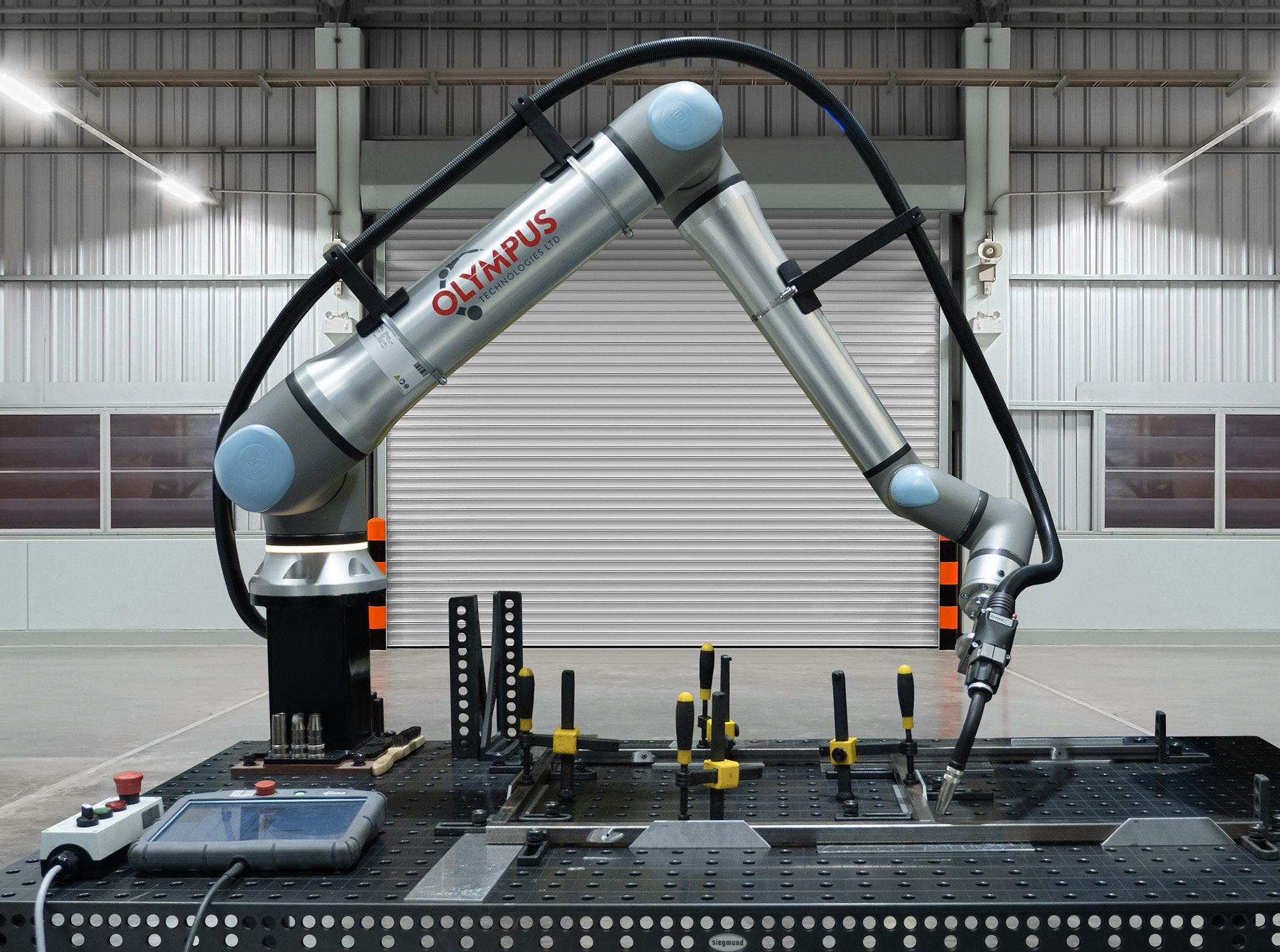
Industrial robots traditionally required high-volume batches (5,000+ units) to justify the complex programming and safety guarding costs. Modern cobots, such as the Universal Robots UR10e allow for profitable automation of batches as small as 50 units. We install systems that integrate directly with the press brake NC controller through a digital I/O interface or dedicated software plugins. This allows the cobot to trigger the foot pedal signal and receive ‘bend complete’ feedback without manual intervention.
Machine Interface and Synchronisation Protocol
Successful deployment relies on the protocol between the cobot and the press brake controller. We utilise the RS-232 or Ethernet/IP interface to handshake signals such as ‘gripper closed’, ‘tooling clear’, and ‘ram at Top Dead Centre’ (TDC). For older machines lacking digital interfaces, we implement physical solenoid actuators to simulate foot pedal presses safely. This ensures the cobot maintains a duty cycle of nearly 100% during the shift.
Positioning accuracy is critical for high-tolerance folding. A cobot maintains repeatability to within ±0.03mm, which is often more precise than manual positioning against backgouges. The use of a visual reference or ‘part flip’ station allows the cobot to re-orient the workpiece for multi-stage bends without human assistance. This process removes the risk of ‘scrap-making’ mistakes that occur when an operator misaligns a part after five hours on a shift.
Technical Attributes of the Bending Cell
Gripper Technology for Sheet Metal
Vacuum-based End of Arm Tooling (EoAT) is the standard for most UK sheet metal applications. These systems utilise Bernoulli or venturi-driven suction cups to lift mild steel or stainless steel sheets without marking the surface. For perforated or non-porous materials, mechanical grippers or magnetic tools are integrated. We often specify multi-zone vacuum arrays, allowing the cobot to handle various part geometries without requiring a tool change.
Backgauge Integration and Squaring Stations
The cobot does not simply place the part in the air. It pushes the material into the press brake backgauges with a programmed force, ensuring the part is square before the ram descends. We recommend a dedicated ‘squaring station’ or ‘gravity nest’ where the cobot releases the part briefly to let it settle into a known reference corner. This 2-3 second step prevents cumulative errors across complex 6-bend sequences.
Payload and Reach Requirements
UK fabricators typically require a reach of 1300mm to 1700mm to service a standard 3-metre press brake. A UR20 provides the 20kg to 25kg payload capacity necessary for both the sheet weight and the weight of the vacuum manifold. When calculating payload, we include a 25% safety margin to account for the dynamic forces applied during the bending motion as the sheet kicks up.
Reducing Capital Risk Through Modular Flexibility
Capital risk in manual fabrication environments often stems from ‘dead-end’ automation that cannot adapt to changing product lines. Collaborative systems mitigate this through portability. Most of our press brake cells are mounted on a mobile plinth or floor-plate system. If a specific contract ends, the cobot can be wheeled to a different press brake or repurposed for a different application.
Programming time is the second-largest risk factor. Traditional G-code style programming for industrial robots can take 8-16 hours for a complex part. We use ‘lead-through’ teaching and graphical tablets, reducing programming time to under 30 minutes for an experienced operator. This low barrier to entry ensures the machine spends more hours in production than in setup, which is vital for the low-mix, high-volume reality of UK subcontractors.
Bridging Shop Floor Operations and Financial Recovery
Transitioning from manual bending to autonomous cells requires a shift in how factory managers view the production schedule. While the cobot moves at a speed comparable to a human to maintain ISO 15066 safety standards, its lack of breaks and consistent performance creates a stable throughput. This stability allows for precise lean manufacturing planning that manual stations cannot match.
Our experience across 200+ deployments shows that the most successful installations start with a focus on the most common 20% of parts that account for 80% of volume. By automating the ‘boring’ repeat work, you free up your skilled press brake operators to handle the complex, low-volume prototypes that require human intuition and expert adjustment of the bend allowance.
Frequently Asked Questions
Does the cobot need to be fixed to the floor?
While permanent floor mounting provides the highest level of repeatability, mobile base units are common. If the cobot is moved, a ‘re-zeroing’ procedure using a reference pin on the press brake ensures the 3D coordinate system is aligned within 0.1mm of the previous setup.
How is safety handled without a cage?
We conduct a full PUWER assessment for every deployment. Under BS EN ISO 10218-1/2, the cobot can operate without a cage if the force and speed are limited. However, because the sheet metal edges are sharp and the press brake ram is a trapping hazard, we often integrate area scanners that slow or stop the robot if a human enters the work zone.
What happens with different material thicknesses?
Variations in sheet thickness (e.g., ±0.2mm in mild steel) can affect the bend angle. We integrate with the press brake’s active angle measurement systems (like LVD’s Easy-Form or Amada’s Bi-S) to ensure the cobot adjusts its ‘follow’ movement in real-time as the angle is corrected.
Related Automation Topics
- ROI Calculations: For a detailed breakdown of payback periods, visit our guide on press brake tending ROI for low-mix production.
- Tooling Decisions: Understanding the choice between suction and friction is covered in our vacuum vs mechanical grippers comparison.
- Investment Costs: View typical UK implementation costs on our automated press brake cost page.