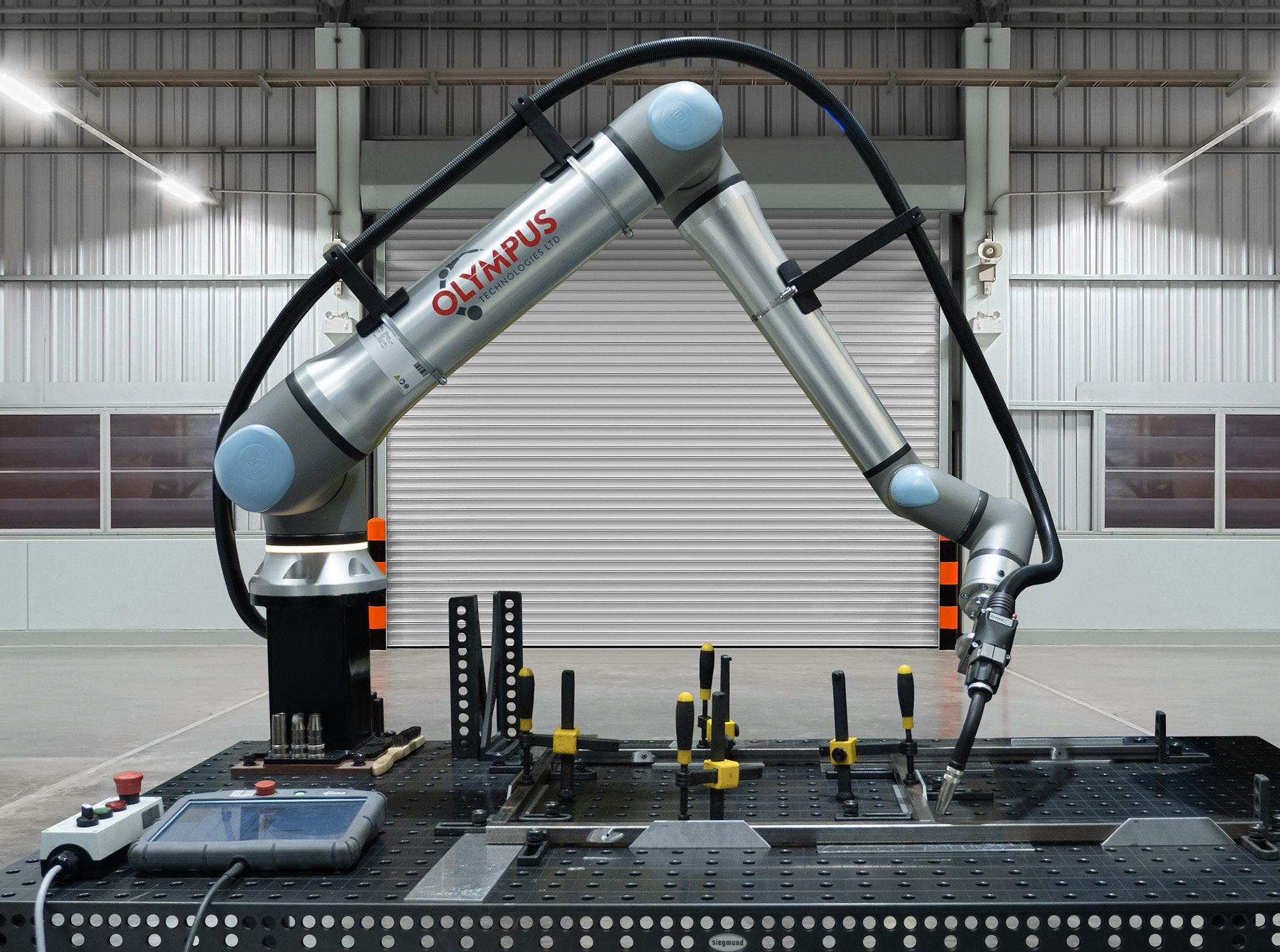













You specify a custom DINSE torch neck when a standard 22° or 45° neck physically cannot reach a joint without a collision. This happens most often inside complex assemblies like chassis or on tightly curved surfaces like pressure vessels. A purpose-built neck simplifies the toolpath, improves weld start-point accuracy, and can shave hours off programming for a single difficult part.
Summary
A custom torch neck is not a default option; it's an engineered solution to a specific geometric problem. Our team at Olympus Technologies typically reserves this for situations where standard off-the-shelf necks force excessively complex programming or risk fouling the part or fixture. The right custom neck makes an 'impossible' automated weld possible and repeatable.
The return on investment comes from reduced programming time and eliminated collisions. It also improves the consistency of the Tool Centre Point (TCP), which is vital for maintaining weld quality across a production run.
Key Factors for Specifying a Custom Neck
The decision to commission a special torch neck by DINSE rests on a clear set of engineering trade-offs. It is a balance between part access, programming simplicity, and the non-recurring engineering cost. We evaluate these four factors before recommending a custom solution to our clients.
The table below outlines our primary decision-making criteria.
| Factor | Criteria for a Custom Neck | Why It Matters |
| **Joint Accessibility** | A standard neck collides with the part or fixture before the wire can reach the weld joint. | This is the most common and compelling reason; a custom neck provides the required clearance. |
| **TCP Repeatability** | The path required for a standard neck is long and indirect, introducing potential motion error. | A simpler, direct path from a custom neck improves weld start-point accuracy to under 0.5mm. |
| **Collision Clearance** | The cobot's wrist or torch body gets within 10mm of a surface, risking false collision alerts. | A custom neck creates a safer standoff, preventing nuisance stops and improving uptime. |
| **Programming Complexity** | It takes longer to program a single weld path due to constant angle adjustments. | A custom neck simplifies the approach, reducing programming time to a matter of minutes. |
*Source: Olympus Technologies internal engineering framework.*
Examples of Custom Neck Applications
Certain part geometries are immediate candidates for a custom torch neck. In these cases, attempting to use a standard neck results in wasted time and sub-optimal welds.
Internal Chassis Brackets: For welding inside a box section or frame, a standard 45° neck forces the entire cobot arm to tilt at an extreme angle. A custom long, straight (0°) or slight-angle (10°) neck can reach deep inside the assembly. This keeps the cobot's wrist joint safely outside the frame, preventing collision.
Pressure Vessel Nozzles: When welding a nozzle onto the curved surface of a tank, maintaining a consistent torch angle is critical. We design custom curved necks that match the vessel's radius. This allows the cobot to follow a simple circular path while the neck itself maintains the perfect perpendicular angle to the tangent of the surface.
Tubular Frameworks: On agricultural machinery or furniture with clustered tubes, standard necks lack the clearance to navigate between them. A longer, thinner neck, sometimes with a specific S-bend, can snake between obstructions to access a joint that would otherwise be impossible to reach robotically. This is a common requirement in our [cobot welding](/cobot-welding-pillar) solutions.
What Changes When You Weld for Different Production Models?
The decision framework above holds true for a single part, but the economic justification shifts entirely when you compare a job shop to a high-volume production line. The ideal solution depends on whether you are amortising the engineering cost over ten parts or ten thousand. A custom neck is a significant cost for a small batch, but trivial if it cuts three seconds from a 60-second cycle time in automotive production.
At Olympus Technologies, we model this payback period as part of our initial consultation. The key is to distinguish between a temporary workaround and a permanent, optimised process. A custom neck can be either, depending on the context.
How does batch size impact the decision?
For job shops focused on high-mix, low-volume production, the non-recurring engineering (NRE) cost is the main barrier. If a custom neck saves 30 minutes of setup on a batch of 10 identical parts, that's five hours of saved technician time. This saving often justifies the cost of the neck itself.
This calculation is central to making automation viable for smaller runs. The goal is to reduce the time from part-in-hand to first-arc. A well-designed neck contributes directly to this by simplifying the programming task for every subsequent batch of that same part.
What if the fixture is the problem, not the torch?
Sometimes, the root cause of poor access is not the torch but the fixture holding the part. A bulky or poorly planned fixture can create access problems that a custom torch neck can solve, but it's a compromised solution. The fixture may be blocking access for manual loading or inspection as well.
In these situations, our analysis compares the cost and benefit of two options: a custom neck as a workaround versus a full fixture redesign. A fixture redesign is more expensive upfront but often yields greater benefits in overall cycle time and manual handling efficiency. A custom neck can be a fast, effective fix, but it's crucial to confirm you're solving the right problem.
Related Pages
Our engineering team often consults these resources when developing a complete cobot welding cell.
- Special Torch Necks for Cobot Welding - A primer on the types of custom necks available, from simple extensions to multi-angle S-bends.
- Dinse Connector Sizing for Cobot MIG and TIG - Understand how extended torch cables can affect electrical resistance and require a correctly sized Dinse connector to prevent voltage drop.
- What Are Cobot Welding Covers? - Learn how protective covers for the cobot arm and torch prevent damage from spatter and heat, especially in confined spaces.
Frequently Asked Questions
What is the typical cost of a custom torch neck? A bespoke torch neck can significantly improve accessibility, weld quality, and overall production efficiency. While each project is tailored to the application, the gains in throughput and reduced downtime usually provide a strong return on investment. Typical lead time is approximately three weeks from final design sign-off.
Does a custom neck affect the equipment warranty? No. When the neck is specified, engineered, and installed by a certified integrator like Olympus Technologies, it does not void the warranty on your cobot or welding power source. We ensure the final assembly remains within the robot's payload and motion limits.
Can I use one custom torch neck for all my jobs? It is highly unlikely. Custom necks are purpose-built to solve a specific geometric access problem for a particular part or family of parts. Using it on a different application for which it wasn't designed will likely create new collision issues or poor weld angles.
How does a custom neck affect the Tool Centre Point (TCP)? A custom neck requires a new, precise TCP to be defined in the robot's software. We use a laser pointer or a physical jig to measure this point accurately. An accurate TCP is fundamental for the robot to move the wire tip along the programmed path correctly.
Next Steps
If a standard torch is preventing you from automating a key welding process, a custom solution from DINSE might be the answer. Our team can help you analyse the part geometry, simulate the toolpath, and calculate the return on investment. Book a free, no-obligation consultation with one of our welding automation engineers to discuss your specific application. We can quickly determine if a bespoke neck is the right path forward.