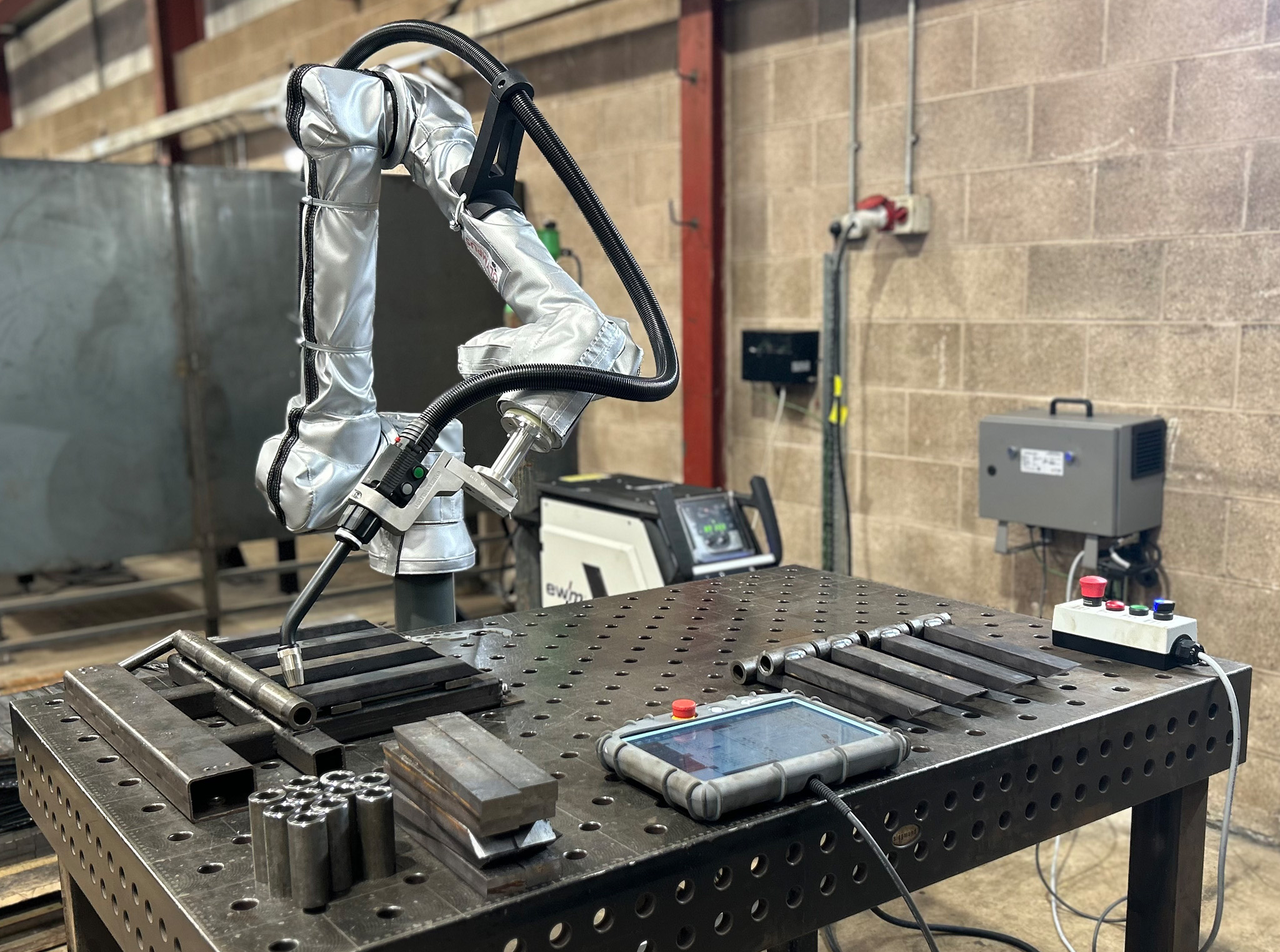














For a typical 350A cobot MIG cell welding an 8mm mild steel fillet, the direct operational cost is between £0.45 and £0.65 per metre. This figure deliberately strips out the initial capital expenditure to reveal the true variable cost of production. Understanding these components is the first step to accurately modelling your payback period.
The total cost isn't just the price of a spool of wire; it's a function of deposition rate, travel speed, and arc-on time. Changing one variable, like wire diameter, has a cascading effect on gas flow and power draw. At Olympus Technologies, we build these models to give clients a predictable cost-per-part before a single bracket is fabricated.
Core Cost Components of a Metre of Weld
Your cost per metre is dictated by four primary variables: filler wire, shielding gas, electricity, and the wear rate of consumables. Each one is a direct input into your operational cost. Overlooking any of them gives you an incomplete picture.
Filler wire is the most obvious cost, priced per kilogram. A standard ER70S-6 wire for mild steel runs £8–£15 per kg, whereas a stainless ER308LSi wire for food-grade applications can be £20–£35 per kg. Your choice is determined by the material being welded, but the wire diameter and deposition rate are the key factors for per-metre cost calculation.
Shielding gas, typically an Argon/CO2 mix for MIG welding steel, protects the weld pool from atmospheric contamination. A flow rate of 15-20 litres per minute is standard for a 350A process. Based on your system's travel speed, you can calculate the precise volume of gas consumed per metre of weld.
Finally, electricity and consumables add to the total. A modern welding power source like a Fronius TPS 400i consumes a specific amount of power to maintain the arc, which translates to a direct kWh cost per metre. Consumables like contact tips, nozzles, and liners are minor costs individually but must be factored in as a 'pence per metre' rate over their operational life.
Worked Example: 8mm Mild Steel Fillet Weld
To make this concrete, we've modelled the costs for a common application: a continuous 8mm fillet weld on mild steel. This scenario assumes a well-optimised cobot system running at a high duty cycle. The table below breaks down each component's contribution to the final cost per metre.
| Cost Component | Unit Cost (Typical) | Consumption per Metre | Cost per Metre |
| Filler Wire (ER70S-6, 1.2mm) | £12.00 / kg | 0.22 kg | £0.26 |
| Shielding Gas (Argon/CO2 mix) | £2.50 / m³ | 0.04 m³ | £0.10 |
| Electricity | £0.25 / kWh | 0.30 kWh | £0.08 |
| Consumables (Tips, Liners) | N/A | N/A | £0.04 |
| Total Operational Cost | N/A | N/A | £0.48 |
Source: Internal Olympus Technologies project data and 2024 UK supplier pricing. Assumes 500 mm/min travel speed.
This calculation demonstrates the pure variable cost of producing one metre of weld. It excludes the amortised cost of the cobot cell itself and any direct labour for supervision. The true power of this analysis comes from comparing it to manual welding, where lower arc-on times of 20-30% dramatically increase the cost contribution from labour and overheads for the same metre of weld.
When Does 'Cost Per Metre' Become a Misleading Metric?
The cost-per-metre model is highly effective for assessing high-volume, repeatable parts where the system reaches a steady production state. It assumes the dominant activity is welding. For job shops, prototype work, or repair tasks, this model can be deceptive because setup time and non-welding activities dominate the true cost of the operation.
In these scenarios, the amortised cost of an engineer's time for programming and fixture design can easily outweigh the consumable costs for an entire small batch. The focus must shift from 'cost per metre' to 'cost per completed job'. Pinpointing the source of non-value-added time is where the real savings are found.
The True Cost of the 'First Weld' in Prototyping
When you're running a single prototype or a batch of five, the cost isn't in the wire and gas; it's in the programming. A single hour of a skilled engineer’s time spent on the teach pendant to program a complex weld path can exceed the consumable cost for a hundred production units. This makes traditional costing ineffective.
The solution is to attack the setup cost directly. We use offline programming (OLP) software to simulate the entire weld path and check for collisions before the cobot cell is even switched on. This reduces on-the-floor programming from hours to minutes and makes one-off jobs economically viable.
Why Repair and Rework Defy Standard Costing
Repair welding introduces variability that makes predictable costing nearly impossible. You are not welding a clean, pre-defined joint from a CAD model; you are filling an unpredictable gouge or fixing a crack. The geometry is different every single time.
This type of work requires adaptive pathing, often guided by a 3D vision system that locates the defect and generates a toolpath on the fly. As a result, 'cost per metre' is a meaningless metric. The correct performance indicator becomes 'cost per successful repair', which accounts for the machine vision cycle time and the reduced need for manual intervention.
Frequently Asked Questions about Cobot Welding Costs
How much does wire selection affect the cost per metre?
Wire material directly impacts cost but is dictated by the job's engineering requirements, not as a cost-saving choice. A spool of ER308LSi stainless steel wire costs 2-3x more per kilogram than standard ER70S-6 mild steel wire. The more meaningful choice is wire diameter, which influences deposition rates, travel speed, and heat input, all of which affect the final cost per metre.
Is pure Argon cheaper for shielding?
Pure argon is used for TIG welding, not MIG welding on steel. For steel MIG applications, an argon/CO2 mix is essential for a stable arc, good penetration, and a quality weld finish. Attempting to use the wrong gas to save a few pounds per bottle results in porosity and spatter defects, costing far more in rework than any initial savings.
Does running a second shift double my ROI?
A second shift will accelerate your ROI far more than double. The capital cost of the cobot cell is fixed, so running a second shift amortises that investment over twice the output, significantly lowering the cost contribution per part. Since only consumables and electricity costs scale with the extra shift, the profitability of that shift is extremely high.
How does arc-on time impact the total cost?
Arc-on time is the single most critical factor in welding cost. A manual welder realistically achieves 20-30% arc-on time, spending the rest on repositioning, setup, and breaks. A well-integrated cobot cell from Olympus Technologies consistently runs at 60-80% arc-on time, producing weld for up to three times longer in a given hour and tripling output for the same fixed overheads. You can explore this further in our guide to cobot MIG duty cycle and arc-on time.
Model Your Exact Welding Costs
The figures here provide a solid baseline, but a true cost model must be based on your specific parts and processes. The next step is to analyse your production data to build a definitive business case.
Our team can help you calculate the precise cost-per-metre and ROI for your components. Book a no-obligation consultation with our welding automation specialists today.
Related Guides and Resources
For a deeper analysis of the factors driving these costs, explore our related engineering guides.
- Cobot Welding Cell Cost UK: A Practical Guide by Olympus Technologies
- Cobot TIG vs MIG: When 0.1mm Precision Beats 4x Speed: Understand the cost and quality trade-offs between different welding processes.
- Cobot Automation ROI Calculator Guide: Use our framework to build a comprehensive business case for automation.
- Cobot Welding Cost Per Weld UK: A Practical Model from Olympus Technologies