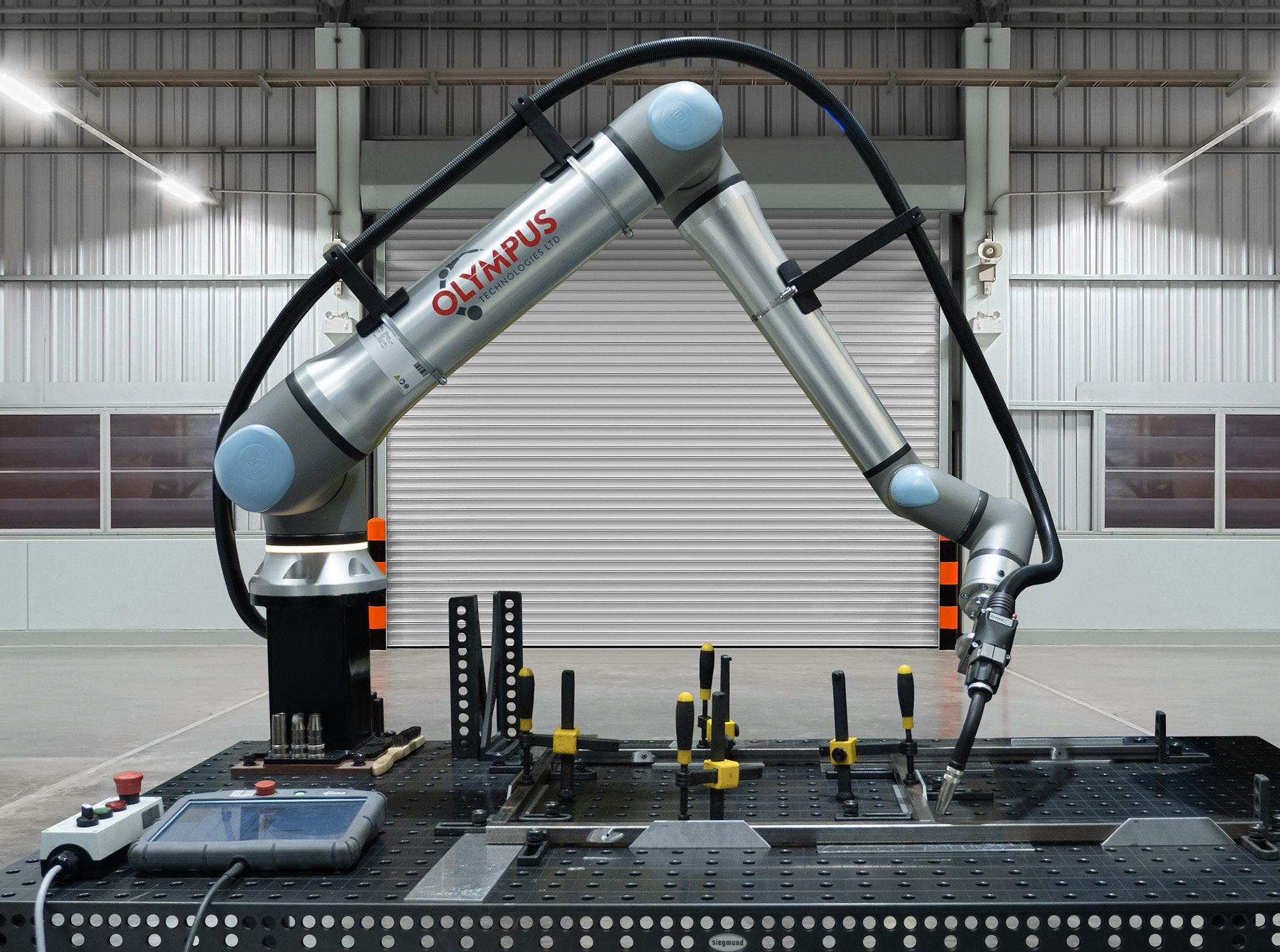














Cobot welding is becoming a cost-effective and reliable alternative to manual welding and traditional robotic welding systems across the UK.
As manufacturers face labour shortages, rising labour costs, and increasingly stringent quality standards, collaborative robots are being deployed to automate repetitive welding tasks while still allowing people to work safely alongside humans.
A cobot welding cell combines a cobot arm, welding equipment, safety systems, and software into a compact, flexible welding cell. Compared with traditional industrial robots, cobots require less floor space, lower safety infrastructure, and shorter setup time. Compared with manual welding, cobot welding delivers consistent welds, fewer defects, and improved quality assurance.
Understanding cobot welding cell cost UK is essential for manufacturers considering welding automation. This guide breaks down the total cost, explains where investment is made, and shows how Olympus Technologies helps businesses achieve long-term value.
Key Components of a Cobot Welding Cell and Their Cost Impact
A cobot welding cell is a complete robotic welding system. Each component affects the actual cost, performance, and return on investment.
Cobot Arm and Robotic Arm Selection
The cobot arm is the core of the welding cell. Cost depends on:
- Payload and reach
- Accuracy and repeatability
- Compatibility with welding processes
Higher accuracy is critical for high precision welding operations such as sheet metal fabrication or automotive manufacturing. Choosing the right robotic arm avoids unnecessary expense while ensuring high quality welds.
Welding Power Source and Welding Process
The welding power source has a major influence on both cost and weld quality. Common welding processes include:
- Metal inert gas welding
- Tungsten inert gas welding
- Stick welding
- Laser welding for specialist applications
Power supply capability, electric current control, duty cycle, and compatibility with wire feeders and shielding gas all affect cost. Advanced features improve arc stability and reduce spatter, which lowers waste and improves consistency.
Welding Torch, Wire Feeder, and Dress Pack
A robotic welding torch must be designed for continuous operation. Costs are influenced by:
- Torch cooling method
- Wire feeder integration
- Robotic dress pack quality
Reliable torch systems reduce downtime and extend consumable life, improving long term benefits.
Safety Equipment and Safety Enclosures
Although cobots are collaborative robots, welding introduces additional hazards. Safety equipment may include:
- Safety enclosures or welding screens
- Light curtains
- Extensive safety measures for arc and fume protection
These safety features allow human workers to work safely alongside humans while meeting UK safety requirements.
Fixturing, Positioning, and Floor Space
Fixturing ensures consistent weld positioning. Poor fixturing increases defects and reduces productivity. Costs depend on:
- Part size and base metal
- Production volume
- Tolerance requirements
Compact cobot welding cells typically require less floor space than traditional robotic cells, making them suitable for existing production lines.
Fume Extraction and Additional Equipment
Fume extraction is essential for health and safety compliance. Additional equipment may include:
- Torch cleaning stations
- Rotating tables
- Additional sensors for quality monitoring
These associated costs add to the total cost but significantly improve reliability and weld quality.
Olympus Technologies’ Cobot Welding Solutions: Customisation and Cost Control
Olympus Technologies designs cobot welding systems around the customer’s welding tasks, production volume, and quality requirements. Rather than offering fixed robotic cells, systems are tailored to balance cost, performance, and scalability.
Customisation allows:
- Control of estimated cost
- Modular upgrades as production increases
- Adaptation to new welding techniques or parts
This approach is particularly valuable for medium and high volume manufacturing where flexibility matters.
Software and Integration Costs for Cobot Welding Systems
Software and integration are critical to successful welding automation.
Programming and Welding Software
Programming costs depend on:
- Complexity of welding paths
- Seam tracking or vision requirements
- Offline programming tools
User-friendly programming reduces setup time and lowers labour costs over the system’s lifetime.
Integration with Existing Equipment
Integration may involve:
- CNC machines
- Conveyors
- Existing welding operations
Olympus Technologies focuses on seamless integration to minimise disruption and reduce additional expenses.
Installation, Training, and Ongoing Support Costs
A realistic cobot welding cell price UK must include implementation and lifecycle costs.
Installation and Commissioning
Installation includes:
- Mechanical and electrical setup
- Safety validation
- Welding parameter optimisation
More complex welding techniques increase installation effort but also increase automation benefits.
Training
Training ensures operators and technicians can:
- Adjust welding parameters
- Perform regular inspections
- Carry out basic maintenance
This reduces downtime and dependence on external support.
Maintenance and Associated Costs
Ongoing costs include:
- Regular maintenance
- Consumables
- Software updates
- Regular inspections
Planned maintenance improves reliability and protects weld quality.
Understanding Return on Investment for Cobot Welding
Cobot welding return on investment UK depends on more than replacing human welders.
Key ROI Drivers
ROI is typically driven by:
- Reduced labour costs
- Increased productivity across multiple shifts
- Fewer defects and reduced waste
- Consistent weld quality
- Reduced rework and scrap
In high volume manufacturing and the automotive sector, even small quality improvements can deliver significant savings.
Manual Welding vs Robotic Welding
Manual welding relies heavily on individual skill and consistency. Robotic welding systems deliver:
- High precision
- Consistent welds
- Improved quality assurance
Cobots allow skilled welders to focus on oversight, inspection, and complex tasks rather than repetitive welding.
Payback Period
Many manufacturers see an initial payback period of one to three years, depending on production volume and labour costs. While a cobot welding cell is a significant investment, it often proves cost effective over its operational life.
Factors Influencing Total Cobot Welding Cell Cost in the UK
Key variables include:
- Welding techniques required
- Production volume and cycle time
- Safety requirements and safety enclosures
- Additional equipment and sensors
- Future expansion plans
A detailed cost analysis early in the project helps avoid unexpected additional costs.
Choosing the Right Cobot Welding Partner
Successful robotic welding automation depends on expertise as much as technology.
Olympus Technologies provides:
- Application-led system design
- Experience across various industries
- Strong focus on safety and quality
- Transparent cost breakdowns
- Ongoing support and optimisation
This ensures customers achieve increased productivity, high quality welds, and long term value.
Conclusion: Making an Informed Investment in Cobot Welding
Cobot welding offers a practical route to automation for UK manufacturers facing labour shortages, quality demands, and cost pressures. Understanding the full cobot welding cell cost UK is essential for making informed decisions.
When specified correctly, cobot welding systems deliver consistent welds, fewer defects, reduced labour costs, and improved production efficiency.
Olympus Technologies supports manufacturers from initial consultation through implementation, training, and long-term support, ensuring welding automation delivers measurable results.
To discuss your application or receive a tailored cost estimate, contact Olympus Technologies for expert guidance.
Key Components of a Cobot Welding Cell and Their Cost Impact
- Cobot arm and robotic arm accuracy
- Welding power source and welding process
- Welding torch, wire feeder, and dress pack
- Safety equipment and safety enclosures
- Fixturing and positioning systems
- Fume extraction and additional equipment