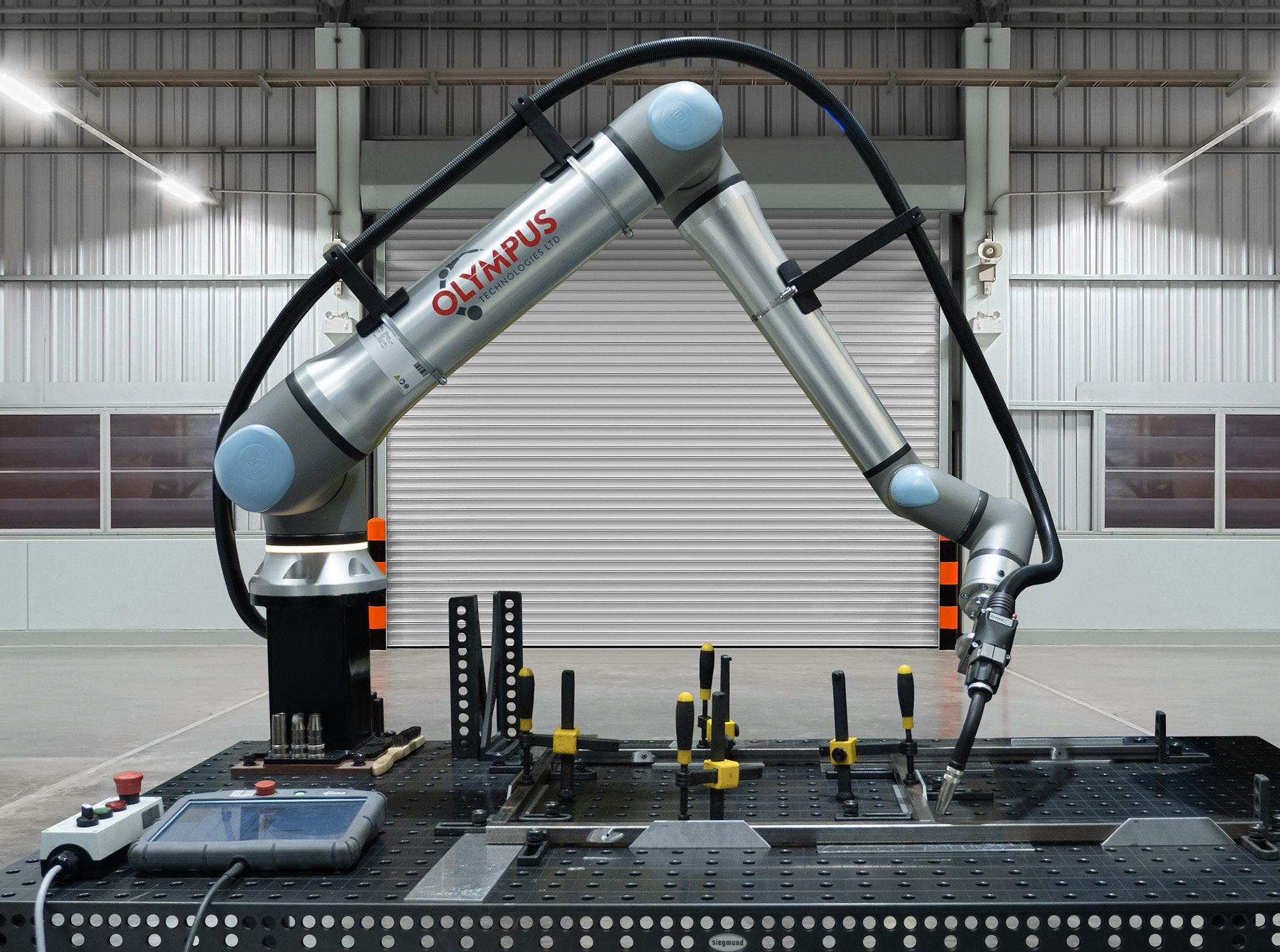














The fundamental difference between TIG welding stainless steel and aluminium with a cobot is the current type. Stainless steel uses DC electrode negative (DCEN) for a focused, penetrating arc. Aluminium requires an alternating current (AC) to break through its tough, high-melting-point oxide layer. Getting this wrong doesn’t just produce a bad weld; it makes welding impossible.
Our engineers use these distinct electrical properties to build highly repeatable weld procedures. DC welding for stainless steel concentrates heat directly into the joint, which is ideal for achieving full penetration without excessive heat input. AC welding for aluminium uses its positive half-cycle for "sputter cleaning" the oxide and its negative half-cycle for melting the base metal.
TIG Parameter Table for 304/316 Stainless Steel
These starting parameters are for automated TIG welding of 304L or 316L stainless steel in the flat (PA/1F) position using a Universal Robots cobot. They assume standard butt joints with good fit-up and a 2% Lanthanated (blue tip) tungsten electrode. All welds use 100% Argon shielding gas.
| Thickness (mm) | Amperage (A) (DCEN) | Filler Wire Dia. (mm) | Travel Speed (mm/min) | Gas Flow (L/min) |
| 1.5 | 65–80 | 1.0 | 350–500 | 10–12 |
| 3.0 | 110–130 | 1.2 | 250–400 | 12–15 |
| 5.0 | 160–190 | 1.6 | 200–300 | 15–18 |
Notes: These are starting points. Fine-tuning is based on joint geometry, fixture heat-sinking, and required cosmetic finish. Back-purging is mandatory for preventing root oxidation.
TIG Parameter Table for 5xxx/6xxx Aluminium
Welding 5000 or 6000 series aluminium requires precise control over the AC waveform. The parameters below apply to automated butt joints using a pure tungsten (green tip) electrode, which forms a stable balled tip under AC conditions. Changes in AC balance directly impact the trade-off between penetration and cleaning action.
| Thickness (mm) | Amperage (A) | AC Balance (% Cleaning) | AC Frequency (Hz) | Gas Flow (L/min) |
| 1.5 | 70–90 | 30–35% | 120–150 | 12–15 |
| 3.0 | 120–150 | 25–30% | 100–120 | 15–18 |
| 5.0 | 180–220 | 20–25% | 80–100 | 18–20 |
Notes: Insufficient cleaning (too low AC balance %) results in a "dirty" weld with inclusions. Too much cleaning wastes energy and can erode the tungsten electrode.
How to Diagnose and Fix Common Cobot TIG Defects
For stainless steel, the most common issue we see is "sugaring" on the weld root, a grainy, oxidised surface caused by poor gas coverage. This is solved by increasing back-purge flow or improving the purge dam design, not by adjusting amperage. A blue or rainbow colour in the heat-affected zone (HAZ) is acceptable; a grey or black colour indicates excessive heat input, which requires an increase in travel speed.
With aluminium, porosity is the primary defect, appearing as small pits or holes in the weld bead. This is almost always due to hydrogen contamination from an inadequate pre-weld clean or moisture in the shielding gas line. An inconsistent, wandering arc often points to incorrect AC frequency, while a sooty black deposit around the weld indicates too much cleaning action from the AC balance.
When Do These Starting Parameters Need Adjustment?
The tables above provide a baseline for flat butt welds on clean, new material with excellent fit-up. In a real production environment, those ideal conditions are rare. Positional changes, joint variations, and specific quality standards demand significant parameter adjustments that go beyond simple amperage or speed changes.
At Olympus Technologies, we find that moving from a flat butt joint to a vertical-up fillet weld on the same 3mm stainless steel requires a 15-20% reduction in amperage but the addition of a weave motion to prevent the weld pool from sagging. This path-based adjustment is where cobot automation provides consistency that manual welding cannot match.
What changes for thin-gauge material (<1.5mm)?
Welding thin sheet metal is a battle against heat input and distortion. The primary tool for this is not lower amperage, but high-frequency pulsing, which we typically set between 100 and 500 Hz. This constricts the arc into a focused plasma column, minimising the heat-affected zone and drastically reducing the risk of warping on materials like 1mm stainless panels.
A cobot's steady travel speed is critical here, often programmed above 600 mm/min to outrun heat soak. For thin aluminium, we also increase the AC frequency to over 120 Hz. This creates a stiffer, more focused arc that is less prone to wandering on sharp edges, providing the stability needed for a consistent bead width.
How do joint types alter the approach?
Joint geometry dictates the thermal load and the required weld profile. A T-joint (fillet weld) on 3mm material requires approximately 25% more amperage than a butt weld of the same thickness. The reason is that heat sinks into two separate paths at a 90-degree angle, requiring more energy to establish a molten pool at the root.
To ensure proper fusion, a simple stringer bead isn't enough for a load-bearing fillet. Our engineers program a slight triangular weave or oscillation pattern into the cobot's path. This motion precisely directs the arc to wash into the toe of each plate, ensuring a strong connection without undercut. This level of programmed path control is a core advantage of our cobot welding solutions.
Frequently Asked Questions
Why is pre-weld cleaning so critical for aluminium?
The surface of aluminium is covered by a layer of aluminium oxide, which melts at around 2,072°C, while the aluminium underneath melts at only 660°C. Without removing this oxide layer first, the base metal will liquefy and flow away before the oxide can be penetrated, resulting in no fusion. A dedicated stainless steel wire brush (used only for aluminium) and a solvent wipe are mandatory steps.
What is the primary benefit of pulsing in TIG welding?
Pulsing alternates between a high peak current (for penetration) and a low background current (to cool the puddle), reducing total heat input by up to 40%. This minimises distortion and warping, especially on stainless steel under 3mm thick. High-speed pulsing (over 100 Hz) also stiffens the arc, improving directional control for automated processes.
Can a cobot automatically adjust parameters during a weld?
Yes, modern welding power sources integrated with a cobot can provide real-time adjustments. Using a system like the Fronius TPS/i with its URCap for Universal Robots, the weld controller monitors the arc characteristics thousands of times per second. If it detects a change in arc length or joint gap, it can adjust voltage and wire feed speed automatically based on pre-set synergic lines, maintaining a consistent weld profile.
Do I need a different gas for stainless steel and aluminium?
For most applications up to 6mm thick, 100% Argon is the standard shielding gas for both materials. For thicker section aluminium (over 6mm), a mix of Argon and Helium (typically 75% Ar / 25% He) can be used. The helium provides a hotter arc for increased penetration and faster travel speeds, although it comes at a higher cost.
From Parameters to Production
Achieving the perfect weld parameter set is a critical first step. However, a successful automated welding cell depends equally on robust part fixturing, consistent component presentation, and a fully compliant safety system. These elements ensure the cobot can perform its task repeatably, cycle after cycle.
At Olympus Technologies, we design the entire system, from custom end-effectors to PLC-integrated safety enclosures. This integrated approach turns a list of parameters into a reliable and profitable production asset.
- Explore our complete Cobot Welding Systems.
- Learn about our Bespoke Gripping and Fixturing Solutions.
Ready to see if your parts are a fit for automated TIG welding? Book a no-obligation consultation with our engineering team today.