













A quick-change tool changer lets a single collaborative robot swap its end-of-arm tooling automatically within a production cycle. This is justified when a cell needs to perform two or more distinct tasks, such as gripping a part, inspecting it with a vision system, and then placing it. An automatic changer completes a swap in under 10 seconds, whereas a manual change takes minutes and halts production.
What is a cobot tool changer?
A tool changer is fundamentally a two-part coupling system: one side (the master) mounts to the robot's wrist, and the other (the tool) attaches to each end-effector. Automatic changers use pneumatic or electric actuators to lock and unlock, letting the cobot drop off one tool and pick up another without human intervention. This process is programmed directly into the robot's sequence.
Manual changers use the same master-and-tool-plate concept but rely on a hand-operated lever. They are not for in-cycle swaps, but for speeding up changeover between different jobs or batches. This still offers a significant time saving over unbolting the tool directly from the cobot's standard ISO 9409-1 mounting flange.
Key factors when choosing a tool changer
The decision between a manual, automatic, or no tool changer depends entirely on the cell's function and cycle-time targets. An automatic changer adds cost, weight, and a little arm extension, so it must provide a clear return. Its value is measured by the productivity gained from automating multiple processes.
The most critical specifications are payload, repeatability, and the pass-through of utilities. The changer's payload rating must exceed the combined weight and dynamic forces of your heaviest tool. For precision tasks like dispensing or inspection, a repeatability of 0.01 mm or better is essential so the tool tip returns to the exact programmed point after every change.
Manual vs automatic changer comparison
| Attribute | Manual tool changer | Automatic tool changer |
|---|---|---|
| Typical use case | Batch changeovers, R&D cells | In-cycle multi-process automation |
| Changeover time | 1 to 3 minutes | Under 10 seconds |
| Pneumatic passthrough | Usually none or limited | 2 to 8 ports standard |
| Electrical passthrough | 4 to 8 signal pins | 8 to 20+ pins (power and signal) |
| Typical cost | £500 to £1,500 | £2,000 to £5,000 |
| Primary benefit | Faster than unbolting EOAT | Unlocks multi-task automation |
Source: Olympus Technologies internal project data and industry component pricing.
Example use cases that justify a changer
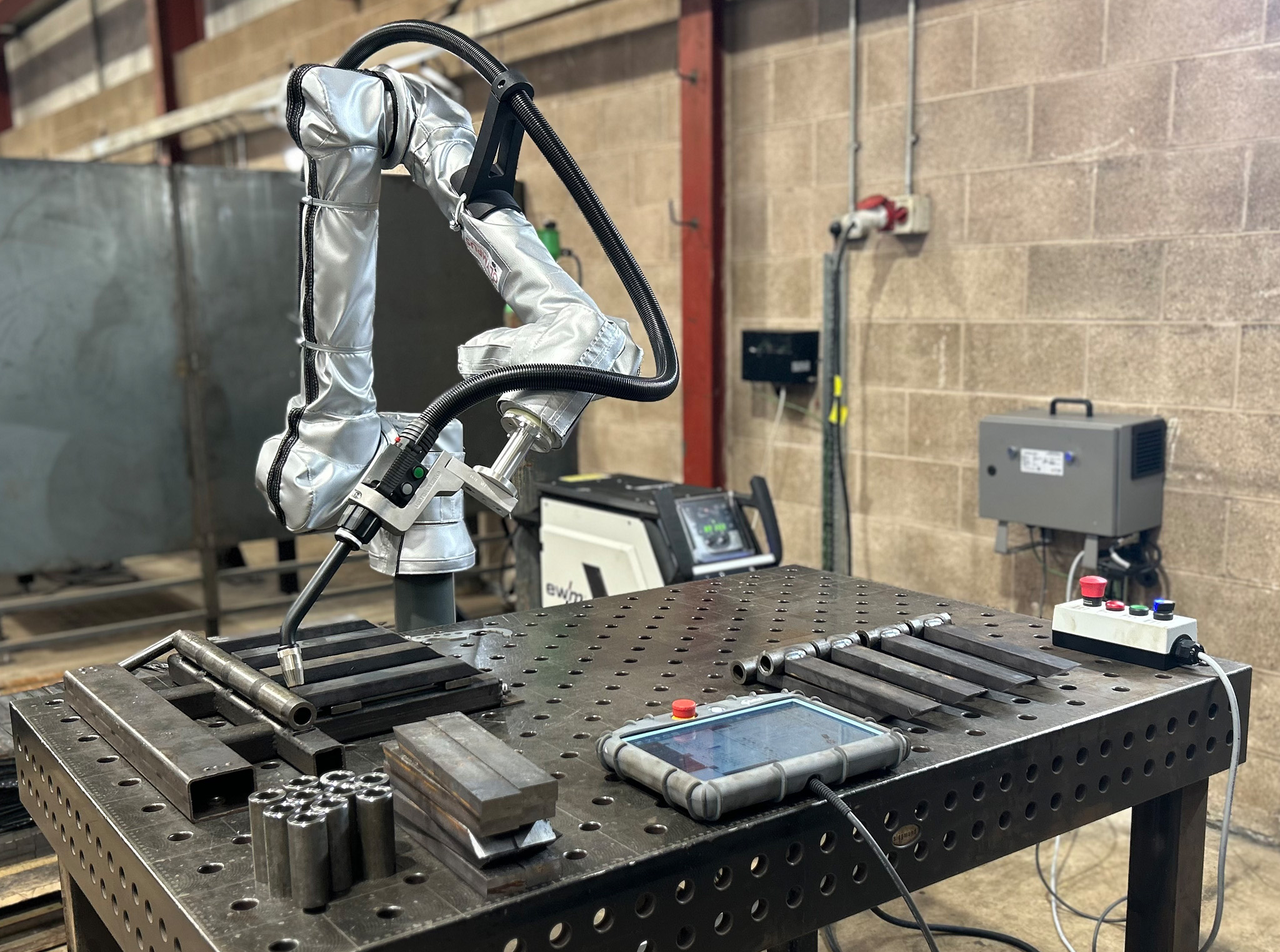
At Olympus Technologies, we implement tool changers when one robot must replace two operators or two separate machines. The business case becomes undeniable in cells that combine material handling with a value-added process, where a single cobot arm can manage a complete workflow from raw part to finished product.
A classic example is CNC machine tending. The cobot uses a mechanical gripper to load a raw billet into a lathe. After the machining cycle, it swaps the gripper for an air-blast nozzle to clear chips before using the same gripper to unload the finished part.
Another common application combines palletising with a secondary task. A UR20 cobot might use a large vacuum gripper to stack boxes onto a pallet. Once the pallet is complete, the cobot swaps the vacuum head for a labelling tool to apply a shipping label, all within the same automated sequence.
When a single, multi-purpose gripper makes more sense
A tool changer is not the default for every multi-step process. Adding a tool change introduces 5 to 10 seconds of non-productive time per cycle. If the total cycle time is only 20 seconds, this is a significant throughput penalty that can often be avoided. The alternative is a single, multi-functional end-effector that integrates two or more tools into one unit. We often design bespoke gripping solutions for precisely these scenarios; viability depends on the weight, size, and function of the required tools.
For cycle-time-critical, single-part processes
If two tasks can be performed without the tools physically interfering, a custom multi-tool is almost always faster. Consider a press brake tending application where the cobot places a sheet metal part against backstops and then holds it steady during the bend. A gripper designed with both magnets for handling and a compliant pusher for stabilisation performs both actions with zero tool-change delay. This consolidated approach reduces complexity, eliminates a potential point of failure, and cuts cycle time. It is the superior choice for high-volume production of a single part family where every second counts.
When payload or tool services are prohibitive
A tool changer becomes the necessary choice when the tools themselves are too large, heavy, or complex to mount simultaneously. A cobot MIG welding torch and a 10 kg magnetic gripper would likely exceed the payload of a UR10e if combined on one EOAT; a tool changer lets the cobot handle each individually, staying well within its 12.5 kg limit. This is also true for tool utilities: a weld torch needs a large-diameter power cable, gas hose, and wire-feed liner that are impractical to package with the pneumatic lines for a vacuum gripper. Separating the tools simplifies cabling and hosing, making the cell cleaner, safer, and easier to maintain.
Related pages
- Vacuum vs Mechanical Grippers for Cobots.
- Force-Torque Sensors on Cobots: When and Why.
- Press Brake Cobot ROI for Low-Mix, Low-Volume.
Frequently asked questions
How does a tool changer integrate with a Universal Robot?
Most modern tool changers integrate via a dedicated URCap that provides pre-built programming blocks in the PolyScope environment, letting you add Pick up Tool or Drop off Tool commands with a few clicks. The locking, unlocking, and sensor status are all handled by the URCap.
What are the limitations of electrical pass-through?
Standard passthrough modules are designed for low-voltage digital I/O and sometimes 24V DC power for sensors or small actuators. They are not designed to pass high-current power for welders or high-speed data protocols like EtherCAT without specialised, more costly connectors. We always verify the changer's electrical capacity matches the tool's requirements.
Is a manual tool changer worth the investment?
Yes, for workshops that frequently re-tool a cobot cell for different runs. A manual changer can cut changeover time from 15 minutes of unbolting and re-cabling to under two minutes, making automating smaller batches more profitable.
Next steps
If your process involves more than picking and placing, a tool changer could be the key to unlocking full automation. Our engineers can analyse your cycle time, payload, and process requirements to determine the most effective tooling strategy.
Book a free, no-obligation automation consultation with our technical team today. We can show the difference a multi-process cell could make to your throughput and bottom line.