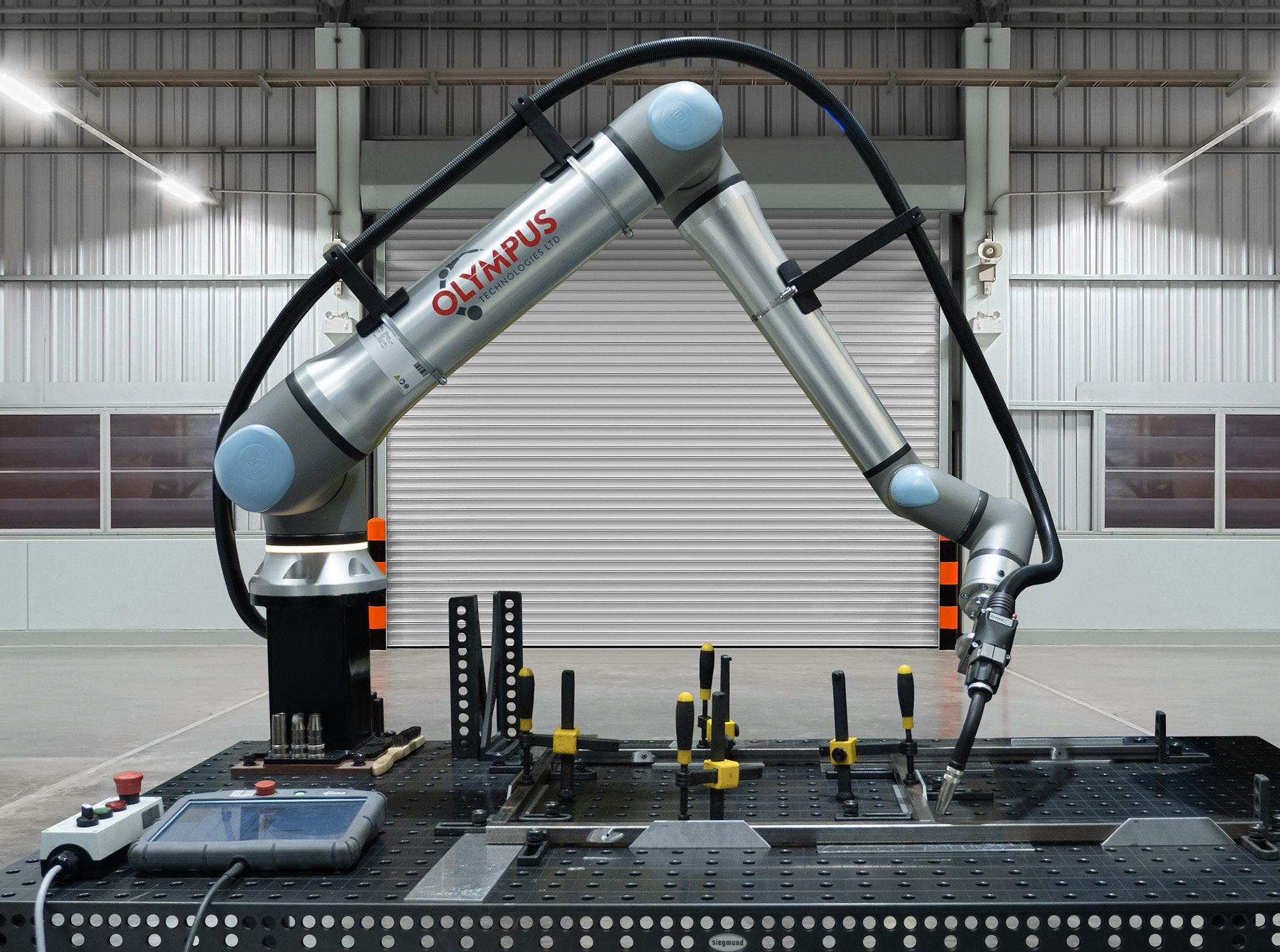














The primary trade-off between cobot TIG and MIG welding is simple: speed versus quality. A cobot MIG system welds at up to 800 mm/minute, roughly four times faster than a TIG torch. That said, robotic TIG welding delivers a flawless, spatter-free bead with positional accuracy down to 0.1mm, a requirement for high-finish parts and thin-gauge materials.
Your decision is not about which process is better, but which is right for your specific component and production goals. We build turnkey automated welding cells around both processes, and the correct choice always comes down to the engineering requirements of the part.
Core Process Comparison: Speed vs. Finesse
Cobot MIG (Metal Inert Gas) is a high-productivity process where a consumable wire electrode is fed continuously through the torch. This makes it ideal for filling gaps and welding thicker sections of mild steel, where deposition rate is key. Its primary benefit is a cycle time that is often 4x faster than TIG, directly increasing part throughput.
TIG (Tungsten Inert Gas) welding, by contrast, uses a non-consumable tungsten electrode to create the arc, with filler material added separately (if at all). This gives the robot precise control over heat and bead appearance, creating clean welds with no spatter. This process is slower, but it eliminates the need for secondary grinding or finishing operations, which is a critical cost-saving on cosmetic parts.
Decision Matrix: Key Attributes for Cobot Welding
This table breaks down the core differences we evaluate when designing a robotic welding cell for our clients. The "Why It Matters" column shows the direct impact on production outcomes.
| Attribute | Cobot TIG | Cobot MIG | Why It Matters for Automation |
| Weld Precision | ±0.1 mm | ±0.5 mm | Determines if you meet tight tolerances on aesthetic or critical joints. |
| Average Speed | ~200 mm/min | ~800 mm/min | Directly impacts cycle time and daily throughput. |
| Heat Input | Low | High | TIG reduces warping on thin materials (<3mm); MIG is better for thick section penetration. |
| Spatter | None | Moderate | TIG requires zero post-weld cleanup; MIG spatter can require a secondary grinding process. |
| Material Thickness | 0.5mm – 5mm | 1mm – 20mm+ | Defines the viable application range for each process. |
| Consumables | Tungsten electrode, filler rod, gas | Wire spool, gas, contact tip | TIG has fewer running consumable changes, improving cell uptime for complex jobs. |
Source: Olympus Technologies internal project data and manufacturer specifications.
The 6 Rules for Choosing Your Process
In our experience, the decision between automated TIG and MIG welding follows a clear logic based on six common manufacturing scenarios.
1. Choose TIG if the weld is a cosmetic feature. For consumer-facing products, architectural metalwork, or any component where the weld bead's appearance is part of the final finish, TIG's neat, "stacked-dimes" look is the standard.
2. Choose MIG for structural joints on mild steel. Where speed, deep penetration, and cost-per-part are the primary drivers on materials above 3mm thick, the productivity of a MIG cell delivers a much faster return on investment.
3. Choose TIG for stainless steel or aluminium under 3mm thick. The low, controlled heat input of the TIG process is essential to prevent warping and burn-through on these thermally sensitive materials.
4. Choose MIG for high-volume, long-run welds. If the task involves kilometres of weld bead on standard components, the 4x speed advantage of MIG directly translates to higher factory output and a lower cost per metre.
5. Choose TIG when post-weld grinding is unacceptable. TIG's spatter-free nature eliminates a costly and dirty secondary process, a critical factor in food-grade or pharmaceutical equipment manufacturing.
6. Choose MIG when part fit-up has gaps over 0.5mm. MIG's wire-fed nature is inherently better at bridging inconsistencies in component assembly, making it more forgiving than TIG in less-than-perfect jigs or fixtures.
Can You Run Both on One Cobot?
A single Universal Robots cobot arm can absolutely run both processes. We achieve this by integrating a quick-change system on the robot's wrist, allowing it to swap a MIG torch for a TIG torch in under a minute. This "hybrid cell" approach offers maximum flexibility for job shops or high-mix, low-volume manufacturers.
This configuration allows an operator to run a batch of thick, structural parts with MIG in the morning and switch to delicate, cosmetic TIG work in the afternoon. Modern power sources like the Fronius TPS/i, integrated via a URCap, store all weld parameters, making the changeover a simple program selection on the cobot's teach pendant.
When Does Cobot Laser Welding Outperform Both TIG and MIG?
While TIG and MIG cover most arc welding applications, cobot laser welding introduces a third performance tier. It offers welding speeds that match or exceed MIG (over 1000 mm/minute) but with heat input and precision that surpasses TIG. The primary trade-off is the capital investment, which is often double that of an arc welding cell, with turnkey systems starting around £120,000.
This process is not a replacement for arc welding but a solution for specific engineering challenges that TIG and MIG cannot solve. It opens up new manufacturing possibilities, particularly with ultra-thin materials and high-strength alloys. Deciding to invest in a laser system is driven by part requirements that make conventional methods unviable.
Zero-Distortion Welding on Ultra-Thin Gauge
Laser welding's focused energy beam deposits minimal heat into the component, making it the only process capable of welding materials under 0.5mm without distortion. We have found this is a critical requirement for manufacturing medical devices, electronics enclosures, and battery casings where warping is not tolerated.
The extremely narrow heat-affected zone (HAZ) also preserves the material's metallurgical properties right up to the weld seam. For aerospace components fabricated from high-strength alloys, this is not just a benefit; it's a non-negotiable requirement for passing certification.
Eliminating Filler Material Entirely
A significant portion of laser welding jobs are autogenous, meaning they fuse the parent material directly without adding any filler wire. This reduces consumable costs and simplifies the process by removing a key variable. This method, however, demands perfect part fit-up, typically with a gap of less than 0.1mm.
This constraint means that upstream processes like metal cutting and forming must be exceptionally precise. When we design an autogenous laser welding cell at Olympus Technologies, we often redesign the jigging and part presentation systems to guarantee this level of repeatability. It becomes a production line solution, not just a standalone machine.
Technical FAQs
How complex is it to switch a cell from MIG to TIG?
Mechanically, the switch involves swapping the torch assembly and wire feeder for a TIG torch and optional cold-wire feeder, a 30-minute task for a trained operator. The primary effort is in the software: creating and validating new weld parameters and robot paths. Using a power source like the Fronius TPS/i with its dedicated URCap significantly simplifies this process parameter management.
Can a single cobot use a dual-torch end-effector?
Yes, a custom dual-torch end-of-arm tool can be built to hold both MIG and TIG torches simultaneously. However, this adds significant weight and complexity to the end effector, which reduces the cobot's usable payload and can restrict its movement in tight spaces. For most scenarios, a quick-change plate system is the more practical and cost-effective approach.
What happens to the ROI calculation when choosing TIG over MIG?
Cobot MIG systems generally show a faster return on investment, typically within 6 to 12 months, because they are solving a high-throughput problem. The ROI is driven by raw speed and displacing labour costs on common fabrication tasks. Cobot TIG ROI is typically realised over 12 to 18 months as its value is rooted in quality improvement and process enablement, not just speed. It pays back by eliminating rework, reducing scrap rates, and making it possible to manufacture complex designs consistently.
Engineering & Next Steps
Choosing the right welding process is the foundational step. A successful project depends on what comes next: fixture design that ensures repeatability, a full risk assessment to guarantee UKCA compliance, and intuitive programming that your team can manage. Our engineers at Olympus Technologies have delivered certified Universal Robots welding cells to manufacturers across the UK, from aerospace to general fabrication.
If you are weighing the benefits of automated TIG, MIG, or even laser for a specific component, the most effective next step is a no-cost consultation. We can analyse your drawings and production targets to provide a clear, data-backed recommendation for your application.
- Book a free, no-obligation cobot welding consultation.
- Explore our work with cobot laser welding systems.