













When clients approach us about automating their welding processes with collaborative robots, the discussion quickly pivots from simply "welding" to the specific technology.
The real decision often comes down to laser welding versus MIG (Metal Inert Gas) welding, particularly when considering cost, throughput, and the materials involved.
We specialise in both, providing solutions that align with the precise demands of UK manufacturing, from high-volume automotive components to intricate aerospace assemblies.
Key Differences
The fundamental difference lies in how heat is applied and how consistently that heat can be maintained. MIG welding uses a consumable wire electrode and a shielding gas to create an arc, which melts the base metal and filler wire, fusing them together.
This is a mature, versatile process. Laser welding, by contrast, uses a highly concentrated beam of light to melt and fuse materials, often without filler material, achieving deep penetration and minimal heat-affected zones. This precision drastically alters the types of joints possible and the typical application environments.
Another critical distinction is the energy density; laser welding offers significantly higher energy concentration than MIG, leading to faster travel speeds and narrower, deeper welds. With MIG, the arc generates a wider heat spread, making it suitable for thicker sections and gap bridging. However, this also means more material distortion and a larger heat-affected zone (HAZ). We see manufacturers choosing laser welding for sensitive components where heat input must be tightly controlled, such as in medical device manufacturing or high-stress aerospace parts.
Attribute Comparison
At Olympus Technologies, we evaluate each project based on a clear set of attributes to determine the optimal welding method. These attributes dictate everything from material preparation to post-weld finishing, directly impacting overall project cost and cycle time.
| Attribute | Laser Welding | MIG Welding | Why It Matters |
| Heat Input | Very Low, highly localised | Moderate to High, diffuse | Influences material distortion and heat-affected zone (HAZ) size |
| Welding Speed | Very High (up to 20 m/min) | Moderate (300–800 mm/min) | Direct impact on throughput and cycle time |
| Penetration Depth | Very High (up to 25 mm in a single pass) | Moderate (typically 6-10 mm in multiple passes) | Determines joint strength and suitability for thick sections |
| Joint Design | Requires precise fit-up, narrow gaps | Tolerant of wider gaps and less precise fit-up | Impacts pre-weld preparation and fixturing requirements |
| Material Types | Wide range, including dissimilar metals, refractories | Most common ferrous and some non-ferrous alloys | Dictates application scope and material compatibility |
| Filler Material | Often no filler needed, or minimal | Always uses consumable filler wire | Affects material cost and bead profile control |
| Integration Complexity | Very High | High | Impacts project timeline, expertise required, and initial setup costs |
| Safety Requirements | Class 4 laser safety enclosure (ISO 11553-1) | Fume extraction per COSHH, arc flash protection | Critical for operator well-being and regulatory compliance |
| Turnkey Price Range | £130,000–£150,000 | £65,000-£80,000 | Significant factor in ROI calculation |
Source: internal project data, ISO standards, manufacturer specifications.
Choose Laser Welding If
You should opt for laser welding if your application demands extreme precision, minimal distortion, and high-speed processing on specific materials. We frequently recommend this technology for applications where you need to weld dissimilar metals, or when handling heat-sensitive components that prohibit significant HAZ. For example, high-volume production of thin-gauge stainless steel for consumer goods or complex titanium structures for aerospace benefits immensely from laser welding's speed and control. If your current MIG operation struggles with heat distortion on critical parts, adding a laser welding cell can resolve consistency issues.
Laser welding is also the go-to for situations requiring deep, narrow welds with superior aesthetic quality and minimal post-processing. Industries fabricating electronic enclosures or medical implants where surface finish and structural integrity are paramount find that laser welding delivers repeatable results that MIG struggles to match without extensive finishing work. Our integrations for these clients focus heavily on exact part presentation and beam alignment.
Choose MIG Welding If
MIG welding remains the workhorse for many automated applications, particularly where cost-effectiveness, gap bridging capability, and material versatility are key. We almost always specify cobot MIG welding for general fabrication of mild steel, structural components, and automotive frames. Its tolerance for wider joint gaps means less stringent part fit-up, which can reduce upstream manufacturing costs. The process is inherently forgiving and easier to program for varied joint geometries.
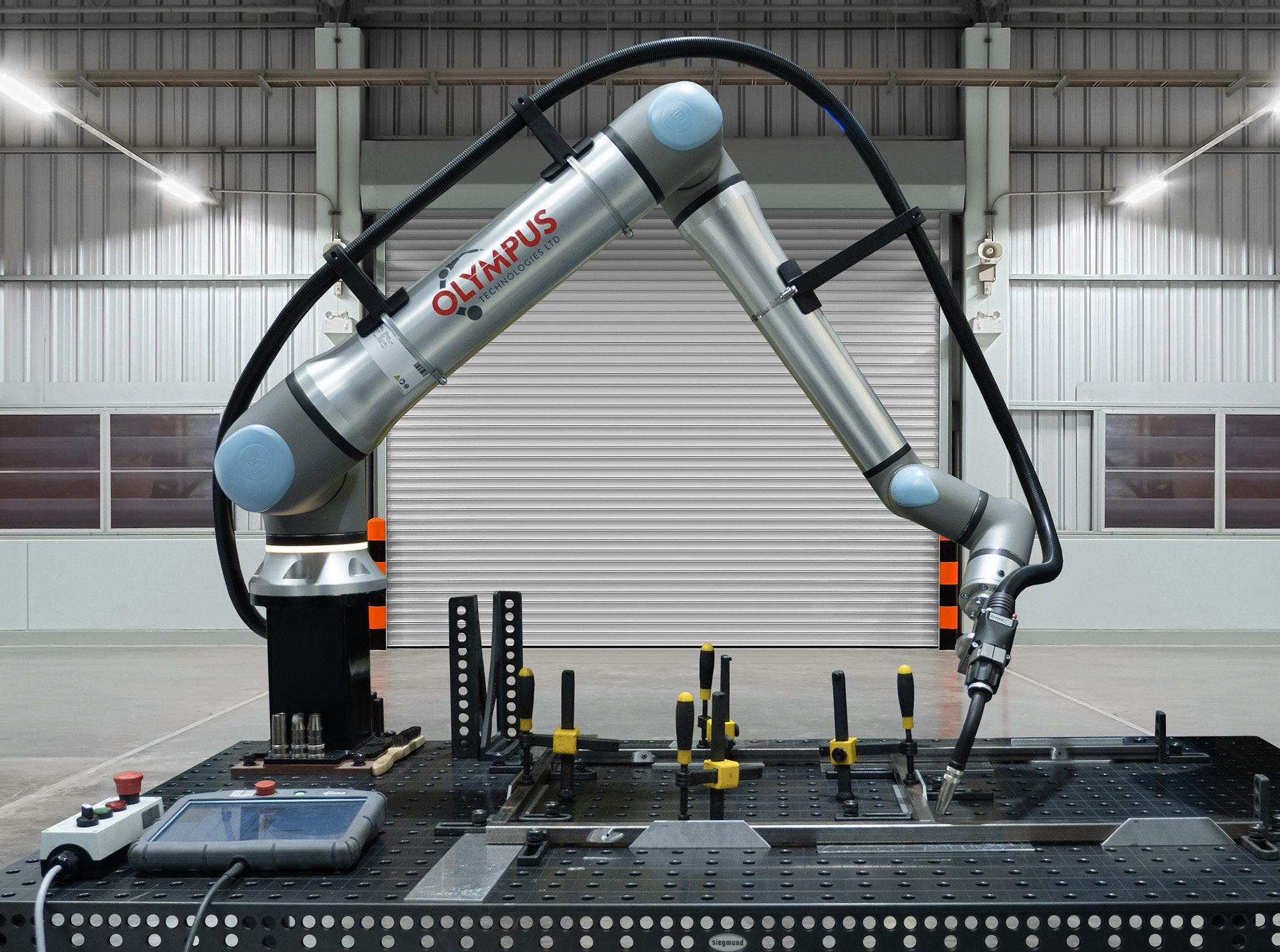
If your primary goal is to automate existing manual MIG processes to address labour shortages or improve consistency on thicker sections, a cobot MIG solution is typically quicker to integrate and establish an ROI. The consumable wire cost is a factor, but the lower entry point for capital expenditure, typically £65,000-£80,000 for a turnkey system (compared to £130,000-£150,000 for laser), often makes it the more viable option for small to medium-sized enterprises. At Olympus Technologies, we've deployed numerous UR20 cobot MIG cells that have consistently slashed cycle times on repetitive tasks, delivering ROI within 6 to 12 months.
The Critical Overlooked Variables in Welding Automation
While the direct comparison of laser and MIG welding attributes provides a solid starting point, manufacturers often overlook crucial variables that dictate long-term success and safety margins. The initial investment figures we provide for turnkey systems, £130,000-£150,000 for laser and £65,000-£80,000 for MIG, are comprehensive, but they assume standard operating conditions and readily available utilities. When considering high-volume production, say, a production schedule requiring a cobot to operate two 8-hour shifts daily, the thermal management of the laser source becomes a greater concern. The duty cycle demands on a laser often necessitate more robust cooling systems than initially accounted for, which adds to both capital and operational costs.
Integrating either system, especially laser welding, necessitates a deep understanding of your facility's infrastructure. For instance, the Class 4 laser safety enclosure, mandated by ISO 11553-1, isn't just a physical barrier; it requires interlocks, fume extraction systems, and designated safety zones that must be integrated seamlessly into your existing floor plan. This planning goes far beyond simply dropping a cobot and welding head into place. Similarly, for MIG welding, proper ventilation (per COSHH regulations) and effective arc flash protection for adjacent workstations are non-negotiable considerations that directly impact installation complexity and overall budget, often adding 10-15% to the initial infrastructure costs.
When Material Science Dictates the Process
The choice of welding technology also shifts dramatically when we consider advanced or performance-critical materials. While MIG welding is excellent for most common steels and some aluminium alloys, certain materials like high-strength steels, exotic alloys, or components requiring minimal internal stress demand the precision of laser welding. High-strength steels, for example, can experience significant embrittlement or cracking with the broader heat input of MIG welding, compromising part integrity. Laser welding's narrow HAZ and rapid cooling rates mitigate these risks. We regularly work with aerospace clients where nickel-based superalloys require laser welding to preserve material properties, a context where MIG simply isn't an option.
The True Cost of Integration Expertise
A turnkey system price encompasses the physical components, but the "Integration Complexity" attribute speaks to the specialized knowledge required to make these systems productive and safe. Laser source integration, beam delivery optics, and Class 4 enclosures require dedicated laser expertise, which fewer integrators possess compared to MIG systems. This higher complexity directly translates to longer ramp-up times and a greater reliance on a partner like Olympus Technologies who has certified laser safety officers and experienced laser engineers on staff, ensuring compliance and optimal performance from day one.
Alternatives
While laser and MIG welding dominate automated industrial applications, other processes such as TIG (Tungsten Inert Gas) welding offer alternatives for specific use cases. TIG excels in producing extremely high-quality, precise welds, often for thin materials where appearance is critical. However, it is significantly slower than both MIG and laser welding, making it less suitable for high-volume automated production unless the parts are very delicate or precision is paramount over speed. We typically reserve cobot TIG applications for intricate joints on medical devices or aerospace components where the added cycle time is justified by the superlative weld quality.
Deeper Guides
To further explore how collaborative robot welding can transform your operations, we invite you to consult our detailed guides. We offer insights into specific applications and the broader technical considerations.
- For details on setting up an automated MIG welding cell, explore our Cobot Welding Solutions Page.
- Learn about the key factors influencing robotic cell safety, including risk assessments and UKCA marking, by reviewing our resources on Cobot Safety Standards.
Contact us for a free consultation to discuss your specific welding automation requirements. We help you navigate the complexities of process selection, safety, and integration to achieve measurable ROI.