













A transparent welding curtain in a UK cobot cell must conform to EN ISO 25980, while textile covers and protective clothing require separate evidence based on their intended function, including EN ISO 11611 where applicable. The final specification comes from the cell risk assessment, welding process, arc current, spatter output, exposure duration and cover position.
Which standards apply to cobot welding covers?
EN ISO 25980 specifies safety requirements for transparent welding curtains, strips and screens used to protect people near arc welding operations. It addresses hazardous optical radiation, stability under ultraviolet exposure, flame resistance and mechanical performance.
EN ISO 11611 covers protective clothing used during welding and allied processes. It does not automatically certify a robot cover, but its flame spread, molten droplet and heat-transfer tests provide relevant evidence when a textile enclosure or cover faces welding hazards.
BS EN ISO 10218-2 governs the integration of industrial robot applications and cells. A cobot welding installation remains a robot application, so collaborative robot capability does not remove the requirement for safeguarding, validation and documented risk reduction.
PUWER requires work equipment to be suitable, maintained and protected against specified hazards. Regulation 12 addresses fire, overheating, unintended discharge and substances emitted by work equipment, while Regulation 11 covers access to dangerous parts.
EN ISO 25980 requirements for transparent curtains and screens
EN ISO 25980 applies to transparent materials intended for welding curtains, strips and screens. It does not apply to welding filters worn directly on the face or fitted to helmets.
A compliant product has traceable test documentation for spectral transmittance across ultraviolet, visible and infrared wavelengths. Colour alone does not demonstrate optical protection because two visually similar curtains can transmit different levels of hazardous radiation.
The curtain designation must match the intended welding process and operating conditions stated by the manufacturer. Procurement records must identify the product, standard, designation, thickness, batch or certificate reference and installation limitations.
Curtain overlap, floor clearance and gaps around fixtures affect real exposure. A compliant sheet with unprotected sightlines does not create a compliant enclosure.
EN ISO 11611 fabric classes
EN ISO 11611 divides protective clothing into Class 1 and Class 2 according to the severity of welding exposure. Class 1 addresses lower levels of spatter and radiant heat, while Class 2 addresses higher levels and more hazardous welding techniques.
The classification includes limited flame spread requirements and performance against molten metal droplets and radiant heat. Class 2 is not a universal requirement for every cobot cover because exposure depends on distance, orientation, process and fault conditions.
A declaration to EN ISO 11611 applies to the tested garment or assembly rather than automatically transferring to fabric sold by the metre. Seams, viewing panels, zips, thread, fasteners and cable openings require equivalent assessment as parts of the finished cover.
Textile covers around a torch, dress pack or robot arm also require compatibility with movement. Folding, abrasion and repeated contact can expose an inner layer that lacks the outer fabric's fire performance.
Flame retardancy and spatter resistance
“Flame retardant” is not a complete specification because it omits the test method, performance level and conditioning state. A purchase specification must state the standard, test result, number of wash or cleaning cycles and whether the rating applies to every layer.
Limited flame spread tests assess ignition behaviour, flame propagation, afterflame, afterglow and hole formation under defined conditions. They do not prove that a cover withstands continuous arc contact or a sustained pool of molten metal.
Spatter resistance depends on droplet mass, velocity, temperature, impact angle and dwell time. Silicone-coated glass fibre commonly resists welding spatter better than lightweight flame-retardant polymer fabric, but the exposed coating and seam construction determine actual service life.
Slag and concentrated hot particles collect in folds, hems and horizontal ledges. Cover geometry must shed debris away from motors, cables, connectors and combustible deposits.
Optical density and shade selection
A perimeter curtain controls radiation reaching people outside the cell, while a welding helmet filter protects the operator viewing the arc at close range. These products perform different functions and must not be substituted for one another.
Optical density expresses attenuation logarithmically, while welding shade numbers follow filter-specific transmittance requirements. A darker-looking curtain does not establish a helmet-equivalent shade rating.
The required curtain designation comes from the arc process, current range, duty cycle, viewing distance, exposure duration and workshop layout. MIG, MAG and TIG welding produce different spectra and operating envelopes, so one curtain colour does not cover every application.
Direct viewing through a curtain remains controlled by the manufacturer's declared use and the risk assessment. Cameras and remote viewing reduce routine exposure without requiring operators to watch the arc through the enclosure.
Material specification table
The figures below are procurement ranges rather than universal approval limits. The product datasheet and test certificate govern each installation.
| Material | Typical thickness | Indicative temperature limit | Relevant evidence | Typical use |
|---|---|---|---|---|
| Transparent welding-grade PVC strip or sheet | 0.35 to 2 mm | 50 to 70°C continuous | EN ISO 25980 declaration and spectral data | Perimeter curtains and viewing screens |
| Silicone-coated glass fibre | 0.4 to 1.5 mm | 260°C continuous, product-specific short peaks above this value | Flame-spread and molten-spatter test data | Robot-arm, dress-pack and enclosure covers |
| Vermiculite-coated glass fibre | 0.7 to 2 mm | 550 to 750°C continuous | Manufacturer's thermal and flame test reports | High-radiant-heat zones and heavy spatter |
| Silica fabric | 0.7 to 1.4 mm | 900 to 1,000°C continuous | Composition, thermal limit and flame test reports | Local shields near intense heat |
| EN ISO 11611-rated textile assembly | Product-specific | Product-specific | Class 1 or Class 2 certificate for the assembly | Removable textile barriers where the certified use matches the hazard |
Temperature ratings require careful interpretation. Continuous service temperature, short-duration peak temperature, coating limit and base-cloth limit describe different failure conditions.
Requirements checklist for a UK workshop
Use this checklist before approving a welding curtain, screen or robot cover:
1. Record the welding process, maximum current, voltage, duty cycle and planned cycle time.
2. Map direct arc sightlines, reflected radiation and access points for every operating position.
3. Specify EN ISO 25980 evidence for each transparent curtain, strip or screen.
4. Record spectral transmittance or the manufacturer's declared designation rather than colour alone.
5. Identify the textile test method, class and conditioning state for every non-transparent layer.
6. Confirm continuous and short-duration temperature limits for coatings, base cloth, seams and fasteners.
7. Assess spatter size, slag accumulation, torch faults and sustained contact with hot workpieces.
8. Check overlaps, floor gaps, cable penetrations, extraction ducts and maintenance openings.
9. Confirm that the cover cannot foul the robot, EOAT, torch neck, wire feed or teach pendant cable.
10. Include inspection intervals and rejection criteria for holes, glazing, embrittlement and damaged seams.
11. Validate safeguarding under BS EN ISO 10218-2 and record PUWER actions.
12. Retain declarations, certificates, drawings, installation instructions and replacement records.
A broader selection process is set out in how to choose a cobot welding cover.
How the cell risk assessment determines the cover specification
A fire-rated fabric or EN ISO 25980 curtain is one risk-control component, not a complete safeguarding system. The integration assessment starts with the robot, welding source, torch, EOAT, workpiece, positioner, extraction system and operator tasks.
BS EN ISO 12100 supplies the general risk-assessment method used alongside BS EN ISO 10218-2 for robot integration. The assessment records hazards during automatic production, teaching, recovery, cleaning, consumable replacement and maintenance.
Foreseeable faults include torch collision, wire feeding outside the joint, loss of shielding gas, dropped hot parts and a stopped robot with the arc energised. Each fault changes the required heat resistance, coverage and separation distance.
PUWER links the documented assessment to the equipment used in the workshop. Controls include fixed guarding, interlocked access, local extraction, protective screens, monitored stops, safe isolation and inspection routines.
A soft cover cannot prevent access to crushing, trapping or high-energy movement unless the validated system uses another protective measure. The comparison between welding covers and hard guarding explains where each barrier type fits.
The integrator then validates the complete cell rather than relying on individual component certificates. Validation records include stopping behaviour, interlock operation, residual optical exposure, fire controls and the condition in which production can restart.
Inspection, replacement and documentation
Inspect curtains and covers before each shift where spatter regularly reaches the barrier. Add a recorded weekly inspection for seams, fasteners, overlaps, viewing areas and points close to the torch path.
Reject transparent material with holes, cracked edges, severe discolouration or lost overlap. Replace textile sections when coating loss exposes the base cloth, seams open, material becomes brittle or embedded spatter creates a heat-retaining deposit.
Cleaning chemicals require approval from the material manufacturer because solvents can extract plasticisers or damage flame-resistant coatings. Replacement parts require the same declared standard, thickness and optical designation as the validated design.
The technical file must retain supplier declarations, test reports, drawings, risk assessments, validation results and inspection records. Guidance on physical formats appears in cobot welding covers.
Cover design around the robot and torch
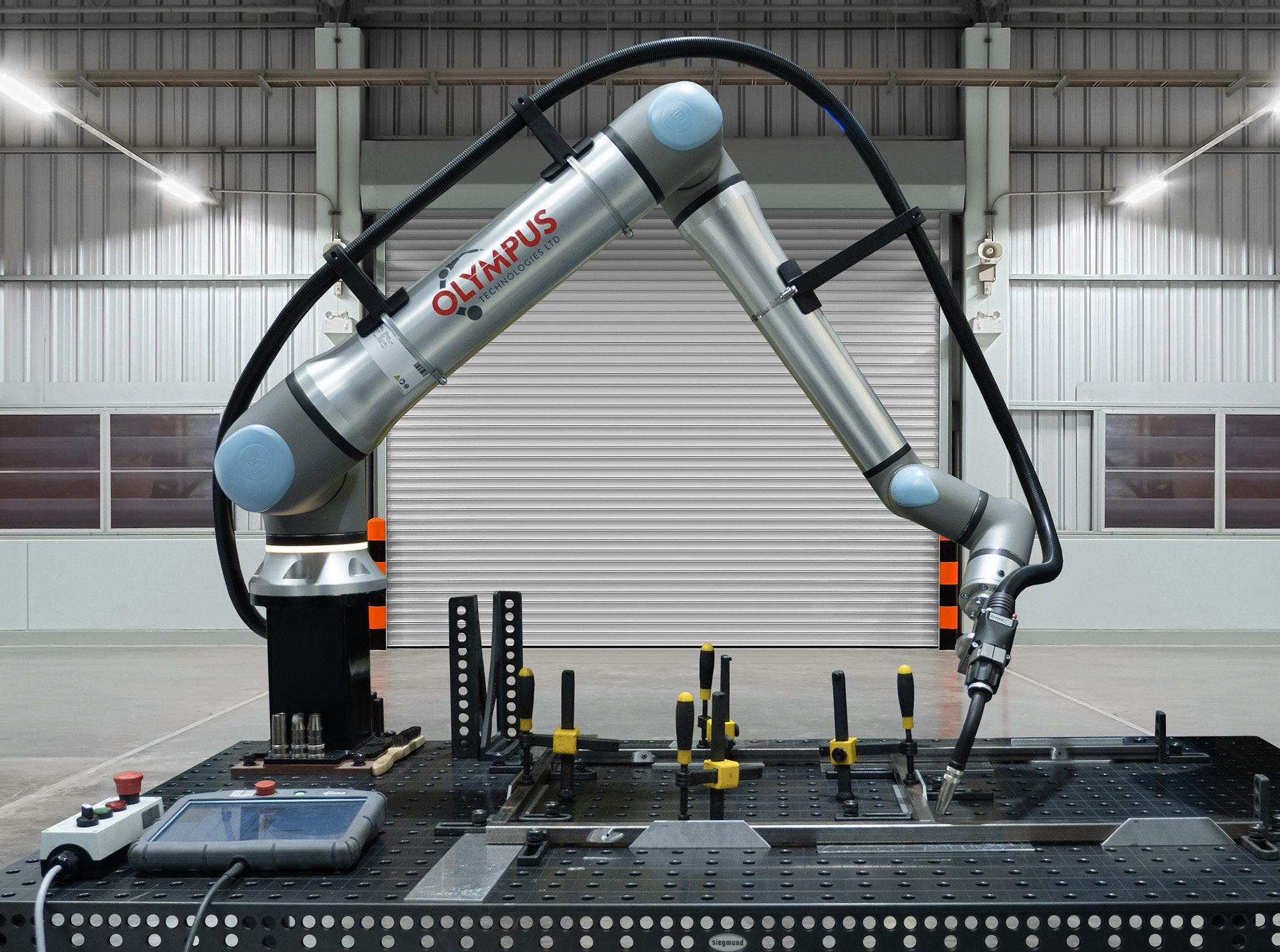
Robot-arm covers require enough allowance for the full motion envelope without creating loops that snag fixtures. The design must preserve cooling, joint movement, cable routing and access to inspection points.
Local protection around the torch faces higher radiant heat and more concentrated spatter than the cell perimeter. A special torch neck can improve access and increase separation between the wrist, cover and weld pool.
Metal connectors and exposed conductive parts require clearance from spatter accumulation and damaged fabric. The welding return path must not pass through robot bearings, guarding or cover fasteners.
Frequently asked questions
Does a cobot welding curtain require EN ISO 25980?
A transparent curtain, strip or screen sold for protection against welding radiation falls within the scope of EN ISO 25980. Obtain a declaration and product identification that match the installed material.
Is EN ISO 11611 mandatory for a robot cover?
EN ISO 11611 applies to protective clothing rather than every industrial robot cover. Its Class 1 or Class 2 evidence remains useful only when the certified assembly and intended use correspond to the assessed hazard.
What shade is required for MIG or MAG welding?
No single curtain shade covers every MIG or MAG application. Selection uses the EN ISO 25980 product designation, spectral transmittance, welding current, exposure geometry and manufacturer instructions.
Can a welding curtain replace fixed guarding?
A curtain controls optical radiation and limited spatter when specified for those hazards. It does not provide equivalent resistance to impact, crushing access or deliberate entry unless the complete protective system is designed and validated for those functions.
Does CE marking or UKCA marking prove the curtain is suitable?
A mark on a component does not prove suitability for a specific cell. The integrator must verify scope, standards, declared performance and installation conditions within the complete risk assessment.
How often must welding covers be replaced?
There is no universal calendar interval. Replace a cover when inspection finds perforation, seam failure, coating loss, embrittlement, impaired visibility or damage outside the validated acceptance criteria.