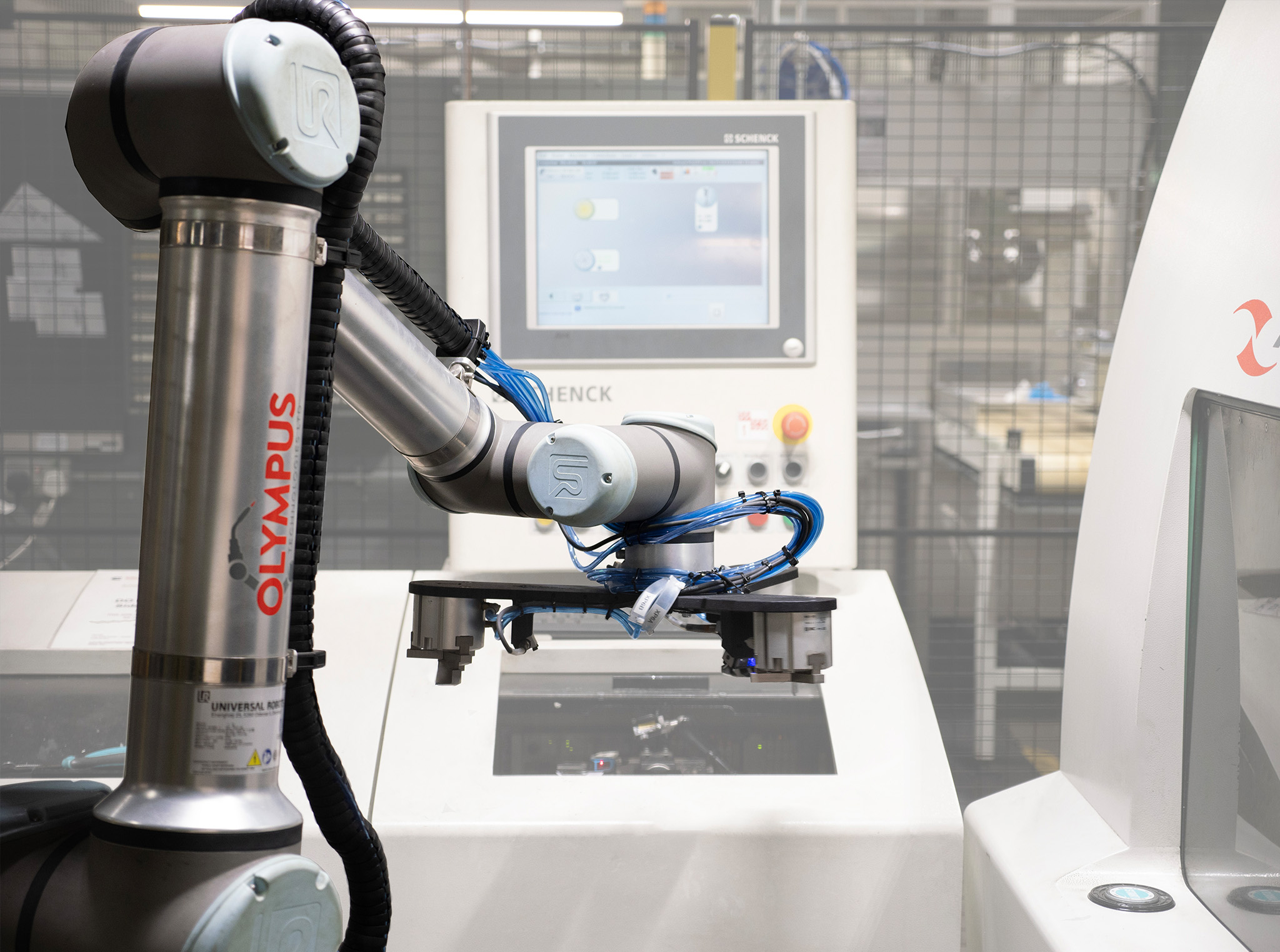













Automate high-precision metal joining with Cobot TIG welding. Use collaborative robots for consistent Gas Tungsten Arc Welding on thin-gauge stainless steel.
Cobot TIG welding is the integration of collaborative robotic arms with Gas Tungsten Arc Welding (GTAW) power sources to automate high-precision joining of thin-gauge metals like stainless steel and aluminium. Unlike manual welding, a cobot maintains a constant arc length and travel speed, which are critical for managing the non-consumable tungsten electrode gap and high-frequency (HF) start interference. As a robotics and automation integrator, Olympus Technologies provides these systems to ensure repeatable weld beads that meet coded welding standards while allowing human operators to work in close proximity without traditional physical guarding.
This page covers the technical integration of collaborative robots with TIG welding power sources and the specific motion control requirements for precision GTAW. It does not cover heavy-duty submerged arc welding or robotic plasma cutting.
What is a Robotics and Automation Integrator?
In the context of Cobot TIG welding, a robotics and automation integrator acts as the technical architect that bridges the gap between the robotic arm and the welding power source. This role involves synchronising the robot’s software with the welding inverter’s digital interface to ensure that the torch path and arc parameters are perfectly aligned. As an integrator, Olympus Technologies selects the appropriate communication protocols and shielding to prevent high-frequency interference from disrupting the robot's control system.
Key Types and Categories
Automated TIG applications generally fall into two categories: fusion-only (autogenous) and cold wire feed. Fusion welding relies on the melting of the base metals alone, requiring perfect fit-up and edge preparation. Cold wire feed systems involve a secondary motor that pushes filler wire into the weld pool at a set rate, allowing the cobot to bridge small gaps in the joint geometry. As a robotics and automation integrator, we specify systems such as the Fronius iWave or Lorch V-Series where digital communication between the wire feeder and the robot arm movement is guaranteed.
How Cobot TIG Welding Works
In a collaborative TIG setup, the robot controller manages the 3D path and the welding parameters simultaneously. The system must account for the high-frequency ignition used in TIG welding, which can interfere with unshielded electronics. A robotics and automation integrator establishes a communication loop between the robot's Teach Pendant and the welding inverter to modulate current and pulse frequency based on the torch's position.
| Attribute | Manual TIG Welding | Cobot TIG Welding |
|---|---|---|
| Arc Length Maintenance | Subjective/Variable | Constant via Encoder Feedback |
| Travel Speed | Operator Dependent | Programmed (mm/s) |
| HF Interference | No impact on tools | Requires shielded cabling |
| Heat Input Control | Variable | Precise via Pulse Synchronisation |
How to Choose the Right Robotics and Automation Integrator
Determining the shift from manual to collaborative automation depends on the repeatability of the workpiece and the complexity of the weld path. Which TIG application parameters dictate the switch from manual to cobot-assisted production? The decision is driven by the required duty cycle, the batch size, and the material thickness. If a component requires circular or multi-axis welds on thin-gauge material (under 3mm), the cobot provides a level of consistency that reduces scrap rates compared to manual torch manipulation.
| Decision Factor | Manual Preference | Cobot Preference |
|---|---|---|
| Batch Volume | One-off / Bespoke | Repeatable Batches |
| Geometry | Highly Irregular | Linear, Circular, or Programmed Paths |
| Material Thickness | Heavy Plate | Thin-gauge (0.5mm to 6mm) |
| Fit-up Quality | Gap compensation required | High-precision fit-up |
| Specialist Skill | Requires Coded Welder | Requires Operator for Program Loading |
Technical Integration and Compliance for UK Manufacturing
Integrating collaborative robots for TIG welding in a UK workshop requires adherence to the Provision and Use of Work Equipment Regulations (PUWER). While the robot is 'collaborative', the TIG process involves UV radiation, welding fumes, and hot surfaces, necessitated by the GTAW process itself. Therefore, a risk assessment must determine if additional shielding or extraction is required despite the lack of a full robot cell perimeter.
System Components and UK Standards
A complete installation involves specific hardware such as the Cobot Welding System Components which include the robot arm, the welding interface, and the torch mount. For manufacturers looking to calculate the financial viability of this investment, the Cobot Welding ROI Calculator provides a framework based on shift patterns and labour costs.
| Component Types | Common UK Integrations |
|---|---|
| Robot Brand | Universal Robots (UR10e, UR20) |
| Power Source | Fronius iWave, Lorch V-Series |
| Torch Interface | Dinse or Binzel TIG Robot Torches |
| Safety Standard | Depends on application risk assessment |
Direct definition
Cobot TIG welding refers to the automated application of Gas Tungsten Arc Welding using a collaborative robot arm. In this setup, the non-consumable tungsten electrode is held by the robot, which maintains a precise distance from the workpiece to establish a stable arc. Unlike traditional industrial robots, these systems are designed to be programmed via hand-guiding or intuitive software interfaces, making them accessible to workshops without dedicated robotic programmers.
The process is characterised by its ability to produce high-quality, aesthetically pleasing welds on materials such as stainless steel, titanium, and aluminium. The integration ensures that the travel speed and filler wire deposition, if used, are perfectly synchronised, eliminating the inconsistencies typically associated with manual torch manipulation.
Key attributes
The primary attributes of a Cobot TIG system include high-frequency (HF) shielding, precise motion control, and integrated pulse management. Because TIG welding often uses a high-voltage, high-frequency start to initiate the arc, the robot and its cabling must be specifically shielded to prevent electromagnetic interference from crashing the controller or damaging internal encoders.
Another critical attribute is the ability to maintain a sub-millimetre arc length. The robot's motion sensors provide continuous feedback, allowing the system to follow complex contours while keeping the tungsten electrode at a constant standoff. This level of control is vital for thin-gauge materials where even slight variations in arc length can lead to burn-through or lack of penetration.
Context and usage
In UK manufacturing, Cobot TIG welding is deployed primarily in sectors requiring high-precision joins, such as food processing equipment, laboratory furniture, and aerospace components. It is used as a solution to the acute shortage of skilled TIG welders, allowing existing staff to oversee multiple robot cells rather than performing repetitive manual welds.
Usage typically involves batch production where parts have consistent fit-up. While a manual welder can compensate for poor joint preparation, a cobot requires accurate jigging to perform effectively. Therefore, the context of usage often includes the implementation of precision welding fixtures alongside the robot integration.
Related concepts
Relevant developments in this field include the comparison between TIG and other automated processes. For manufacturers prioritising speed over fine precision, the transition to Cobot MIG Welding provides a faster deposition rate for thicker materials. Both processes fall under the broader category of collaborative automation, which focuses on augmenting human labour rather than replacing it.
Other related concepts include "Cold Wire Feed" technology, which automates the manual task of dabbing filler rod into the weld pool. This is a crucial upgrade for TIG systems that need to fill gaps or add structural reinforcement to a joint.
Common Questions
Can a cobot perform autogenous TIG welding?
Yes, cobots are highly effective for autogenous (fusion) welding where no filler material is added. This requires very tight tolerances on part fit-up, as the robot will follow a programmed path and melt the base materials together.
How do you protect the robot from HF interference?
Protection is achieved through the use of specialised "TIG-kit" integrations that include double-shielded communication cables and ferrite cores. These components suppress the electromagnetic noise generated during arc ignition.
Related Topics
Further details on the operational requirements can be found in the guide to Collaborative Robot Welding Requirements. This document outlines the necessary infrastructure for power, gas, and safety monitoring within a UK workshop environment.