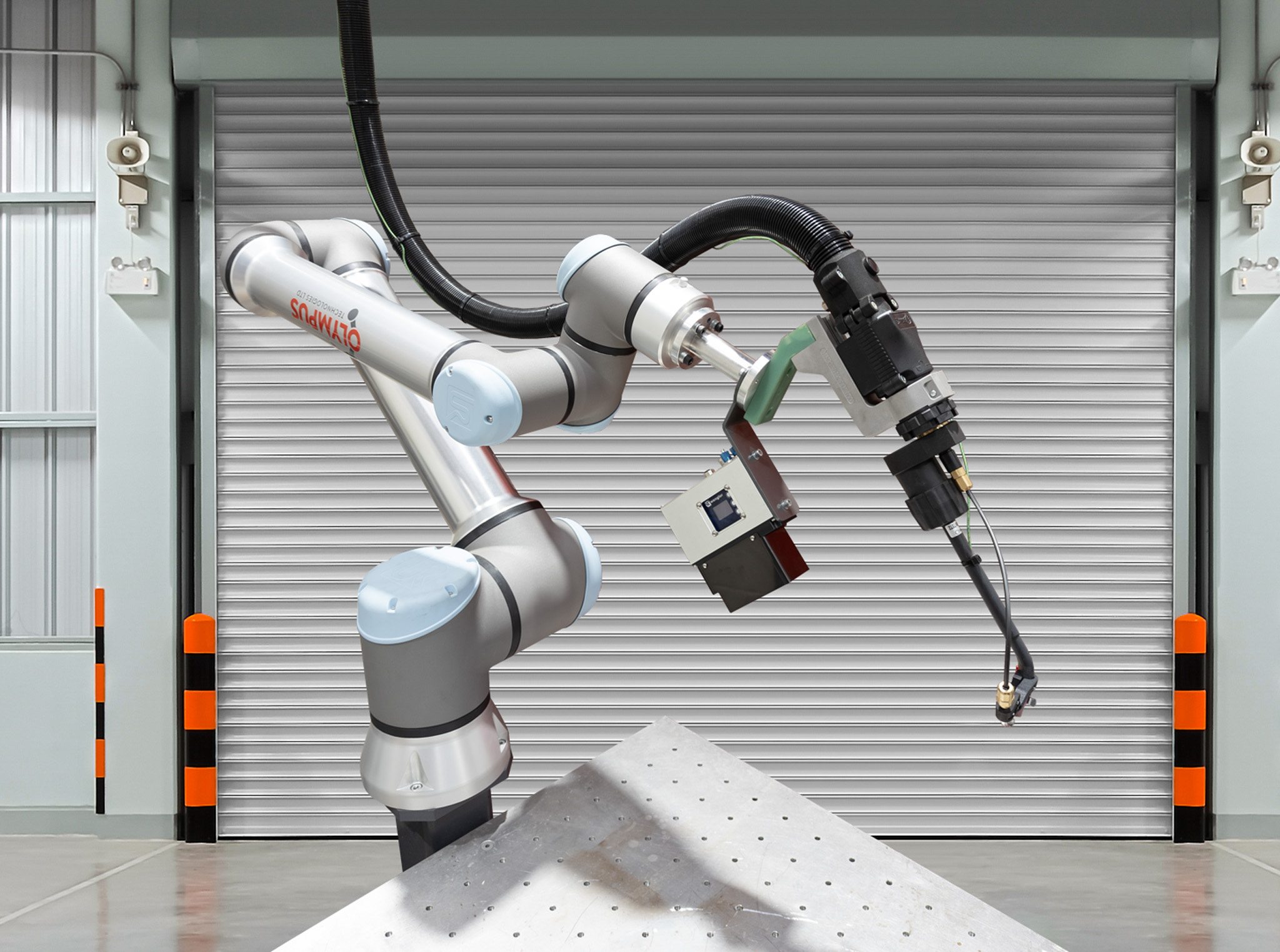













Custom CNC machine tending automation solutions. Increase productivity and address labour shortages with cobot and industrial robot loading systems.
CNC machine tending automation is the integration of industrial robots or collaborative robots (cobots) to perform the loading of raw workpieces and the unloading of finished components from CNC machinery. This process replaces manual intervention, allowing machine tools to operate continuously through multiple shifts or 'lights-out' periods. As a Robotics and Automation Integrator, Olympus Technologies implements these systems to solve UK manufacturing challenges, specifically reducing the impact of skilled labour shortages and increasing spindle utilisation rates.
This page covers automated CNC loading and unloading with cobots and industrial robots. It does not cover manual work-holding adjustments, manual tool presetters, or non-robotic bar feeders.
What is a Robotics and Automation Integrator?
In the context of CNC tending, a Robotics and Automation Integrator serves as the technical architect that bridges the gap between a standalone machine tool and a robotic arm. We specialise in designing the interface logic, selecting appropriate end-effectors, and ensuring the robot controller synchronises perfectly with CNC protocols like Fanuc or Siemens. Our role involves assessing floor space, cycle times, and safety requirements to deliver a turnkey production cell.
Key Types and Categories
As a Robotics and Automation Integrator, we categorise systems by their physical footprint and interaction level. Cobot-based systems facilitate high-mix, low-volume production where operators work in close proximity to the machine. Industrial robot cells provide higher payload capacities and speeds for high-volume, dedicated production lines. Multi-machine setups involve a single robot on a dedicated rail or linear transfer system servicing two or more CNC centres to maximise capital equipment value.
How CNC Machine Tending Automation Works
Successful integration relies on a structured communication bridge between the robot controller and the CNC machine control (such as Fanuc, Siemens, or Heidenhain). The workflow uses digital I/O (Input/Output) signals or M-codes to synchronise the machine door opening, vice/chuck actuation, and cycle start commands. This ensures the robot only enters the machine envelope when the spindle is stationary and the workspace is safe.
| Feature | Cobot Tending | Industrial Robot Tending |
|---|---|---|
| Safety Barrier | Sensor-based/fenceless for low-speed apps | Physical guarding required for high-speed |
| Programming | Hand-guiding and flowcharts | Script-based or Teach Pendant |
| Floor Space | Compact, mobile bases common | Fixed, larger footprint |
| Typical Payload | 3kg to 25kg | 10kg to 1000kg+ |
Cobot solutions provide the entry point for SMEs looking to automate existing manual machines without extensive floor plan alterations. See Cobot Machine Tending Solutions for more details.
How to Choose the Right Robotics and Automation Integrator Solution
Which automation architecture matches your specific batch size and part complexity?
Transitioning from manual loading to automation requires defining the boundary between collaborative and industrial systems. Decision drivers include the weight of the raw material, the cycle time of the CNC programme, and the frequency of part changeovers. If your process requires high-speed cycles under 30 seconds, industrial robots are the standard specification. If your facility requires flexible redeployment across different machines, cobots offer a modular alternative.
| Decision Factor | Collaborative (Cobot) | Industrial (Robot) |
|---|---|---|
| Batch Size | 10 - 500 units | 500+ units |
| Operator Presence | Frequent interaction | Restricted access |
| Changeover Time | < 30 minutes | 1 - 4 hours |
| Integration Logic | Software-led interfaces | Hard-wired I/O and PLC |
Implementation and Operational Technicalities
Integrating CNC automation involves specific hardware and software configurations to ensure reliable 24/7 operation. For detailed technical specifications on power and air supply, refer to Cobot Machine Tending Installation Requirements.
Safety Standards and Compliance
The necessity for specific safety measures depends on the findings of a formal UKCA/CE risk assessment. Collaborative applications must specifically adhere to ISO/TS 15066, which dictates force and speed monitoring limits. Our integration process includes a full risk assessment to determine if additional pressure-sensitive mats or laser scanners are required. Detailed safety protocols are outlined in our Cobot Machine Tending Safety documentation.
Economic Impact and Scaling
The viability of automation is measured by the reduction in cost-per-part and the increase in weekly spindle hours. For metal manufacturers calculating the period required to recoup investment, the Machine Tending ROI guide provides a framework based on UK energy and labour costs.
Common Questions
How much floor space is required for a CNC robot? Compact cobot systems vary in size based on the machine footprint, whereas industrial cells vary based on the robot reach and required safety fencing.
How do operators transition from manual loading to robot supervision? Operators move from repetitive manual tasks to high-value roles such as tool management, quality inspection, and robot programming. Systems using our Cobot Machine Tending Software Integration simplify this transition through graphical user interfaces.
| Requirement Area | Specification Detail |
|---|---|
| End Effectors | Dual grippers for 'part-for-part' exchange |
| Safety Standard | Compliance depends on individual risk assessment |
| Interfacing | MTConnect, OPC UA, or Digital I/O |
Related Topics
This section explores the broader ecosystem of robotic manufacturing. As a Robotics and Automation Integrator, we often combine machine tending with secondary processes to maximise efficiency. This includes automated deburring, laser marking, and coordinate measuring machines (CMM) for in-process quality control. Understanding how these systems interact within a smart factory environment is essential for long-term scalability.
Further considerations include the software layer required for fleet management and the selection of raw material feeding systems, such as vibratory bowls or flexible feeders. These components determine how long a system can run unattended, which is a critical metric for achieving 'lights-out' manufacturing goals.
Direct definition
CNC Machine Tending Automation refers to the use of a robotic arm to automate the cycle of loading a raw part into a CNC machine and unloading it once the machining operation is complete. The system consists of a robot, a gripper (end effector), a part staging area (such as a drawer system or conveyor), and a communication interface that connects the robot to the machine's CNC controller.
The primary objective is to maximise spindle 'up-time' by ensuring the machine is never idle while waiting for a human operator. This is achieved through precise synchronisation where the robot interacts with the machine's chuck, door, and coolant systems via M-codes or digital I/O.
Key attributes
The effectiveness of a tending system is defined by its reach, payload, and repeatability. Reach must be sufficient to access both the part storage area and the deepest point of the CNC machine's work envelope. Payload capacity must account for the weight of the raw workpiece, the finished part, and the weight of the gripper itself.
Another critical attribute is the method of part presentation. This includes static tables, vertical drawer systems for high density, or conveyors for continuous flow. The integration of dual-gripper heads allows the robot to swap a finished part for a raw part in a single entry into the machine, reducing exchange time compared to single-gripper configurations.
Context and usage
In UK manufacturing, CNC tending is frequently utilised in metal machining, plastic turning, and aerospace component production. It is particularly effective in environments facing labour shortages where skilled machinists are better utilised for complex setup tasks rather than repetitive loading. The context of usage dictates the choice between a cobot, which is suitable for frequent changeovers, and an industrial robot, which is high-speed, heavy-duty applications.
Usage also extends to 'lights-out' manufacturing, where the system is configured to run through the night without any human presence. This requires error-handling logic and sensor feedback to detect broken tools or misaligned parts, ensuring the system safely halts if a terminal error occurs.
Related concepts
Machine tending is closely linked to the concept of 'Single Minute Exchange of Die' (SMED) and Lean Manufacturing. By automating the loading process, manufacturers can achieve more predictable cycle times and reduce the 'internal' time lost during manual part changes. It also overlaps with Industrial Internet of Things (IIoT) concepts, where data from the robot and the CNC machine is collected to monitor Overall Equipment Effectiveness (OEE).
Another related concept is 'Part-to-Robot' processing. While machine tending usually involves the robot moving parts to a machine, related secondary operations might involve the robot holding the part against a deburring wheel or inspection station. This creates a fully automated production cell where the part leaves the CNC machine ready for assembly or shipping.