













When Storth Machinery came to us, their problem wasn't demand. It was welders. Like most agricultural equipment manufacturers, they couldn't find enough qualified people, and the skilled welders they did have were spending their days on basic, repetitive weld work rather than the specialist fabrication that earns the margin.
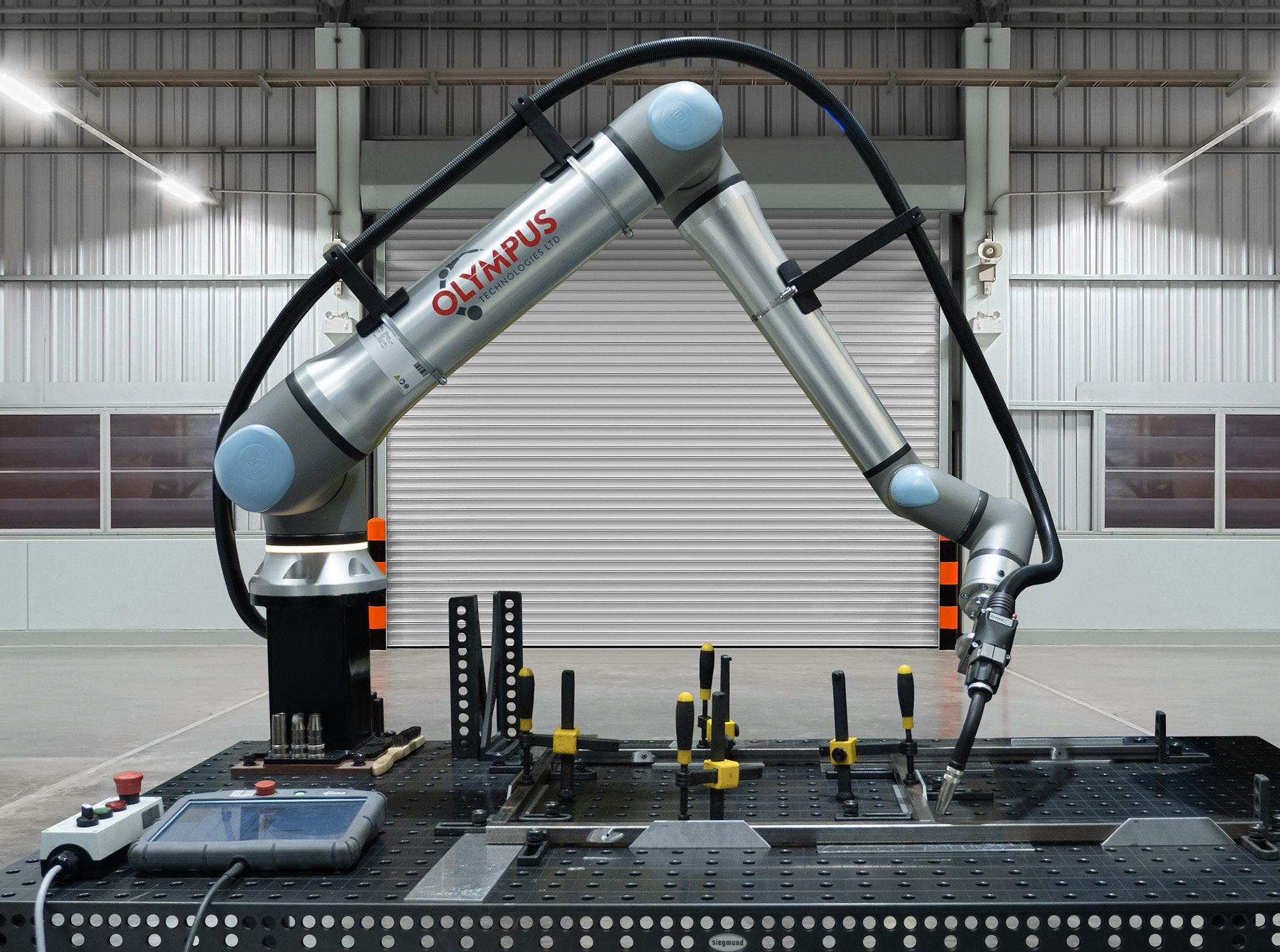
We installed a Universal Robots welding system to take on that repetitive work. The results were immediate: Storth doubled its output of scraper parts and gained the equivalent of two welders in production capacity, which let the business move its experienced people onto higher-margin contracts it previously had to turn away. The impact was strong enough that Storth later ordered a second system, this time a UR10 welding cell integrated with an EWM Phoenix 355 power source and a DINSE robotic torch, mounted on a Bosch Rexroth linear seventh axis so it can weld much larger parts.
| Measure | Published outcome at Storth |
|---|---|
| Scraper part output | Doubled against the previous manual process |
| Production capacity | Equivalent of two welders gained |
| Skilled welders | Redeployed to higher-margin specialist fabrication |
| Second system | UR10 with EWM Phoenix 355 and DINSE torch on a Bosch Rexroth seventh axis, for larger parts |
That project is a fair picture of how automation actually lands in agricultural machinery. The sector is defined by high-mix, low-volume production of heavy steel fabrications, exactly the profile that traditional industrial automation struggles to justify. Cobot cells change the maths because the programming lives with your operators, not with an external specialist, and changeover between part families takes minutes.
Where the payback comes from
Two applications consistently justify themselves fastest in agricultural equipment fabrication: robotic MIG welding and CNC machine tending. Both target the same underlying problem, which is skilled people tied up on repetitive tasks.
Heavy fabrications demand long, continuous welds that are physically punishing and prone to inconsistency over a shift. A cobot welding cell lays the same bead on the hundredth part as on the first, which cuts weld defects and removes most post-weld grinding. Chassis, brackets and structural components, the staples of farm machinery, are well suited to this. Your experienced welders move from production bottleneck to fixture setup, inspection and the complex one-off jobs that genuinely need them.
Machine tending is the second opportunity. A cobot can load and unload a CNC mill, lathe or laser cutter through an entire shift, including breaks and changeovers, which often doubles a machine's productive hours. For the batches of brackets, pins and hydraulic fittings that run through most agricultural workshops, this decouples production from labour availability and makes a second or third shift realistic without extra supervision.
Small batches are not the barrier you'd expect
The most common objection we hear from high-mix manufacturers is batch size. The answer lies in fixture design rather than in the robot. We build modular fixture plates with quick-change locating features, so an operator can switch the cell from one part family to another in a matter of minutes: bolt on the pre-set clamps for the next job, load the corresponding program on the teach pendant, and run. For businesses working in batches of ten to a hundred, this is what makes the numbers work.
Where part variation exceeds what a mechanical fixture can absorb, we integrate vision. A 2D camera can locate a flat part on a table and guide the pick; for harder problems like locating weld seams on parts with dimensional variance, a 3D vision system does the job. Vision adds cost, so we only specify it where fixturing genuinely can't hold the tolerance.
How a project runs
Every project starts with a free on-site feasibility study. We analyse your parts, processes and cycle times, and we'll tell you honestly if the application isn't there yet. From order, we handle system design, risk assessment, build, installation and commissioning, and we train your operators to run the cell without any programming background. Each system is delivered as a complete, UKCA-marked cell with fume extraction and safety guarding included.
Common questions
Can one cobot do both welding and machine tending? Technically yes, practically rarely. The tooling, guarding and programming differ enough that a dedicated cell almost always pays back faster.
What happens to our welders? They get better jobs. In every installation we've done, including Storth, the point was to free skilled people for specialist fabrication, not to remove them.
How disruptive is installation? The cell is built and tested at our facility first, so on-site installation and commissioning is measured in days.
If you'd like to see whether your parts are candidates, contact our engineering team for a no-obligation consultation and production audit.