













We define robotic gluing and adhesive dispensing as the automated, precise application of various liquid or semi-liquid materials onto components, sub-assemblies, or finished products.
This process spans everything from sealing and gasketing to bonding, potting, and conformal coating in manufacturing environments.
At Olympus Technologies, we implement collaborative robots (cobots) to execute these tasks, moving beyond manual methods to achieve consistent quality and reduce material waste.
Our solutions ensure repeatable bead paths and volumes, which directly impacts product integrity and operational efficiency.
How Cobot-Based Dispensing Works in Manufacturing
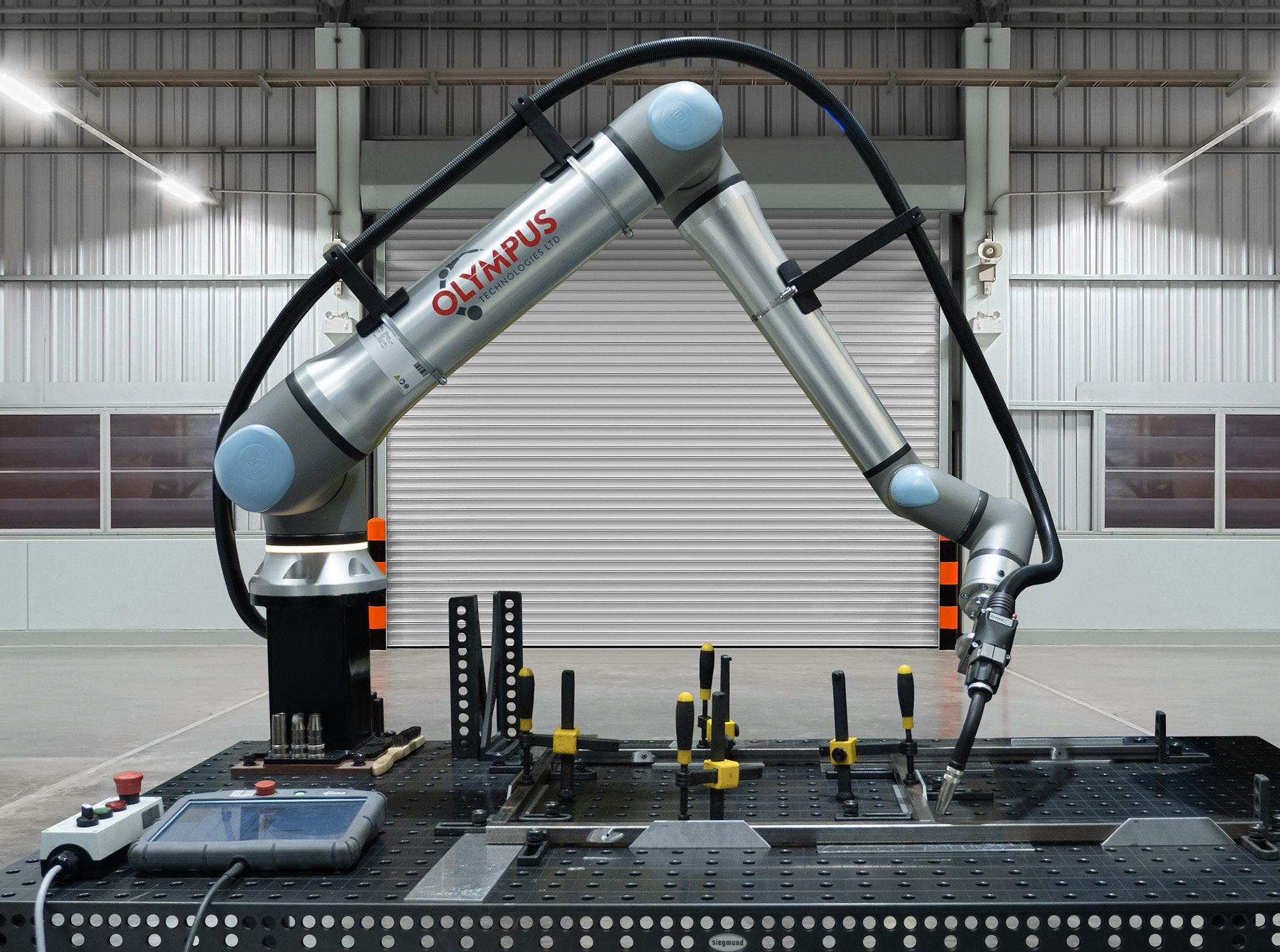
In practice, a cobot-based dispensing system combines a Universal Robots cobot arm with a specialised end effector, typically a volumetric pump or pneumatic dispenser.
We programme the cobot to follow a precise 3D path over the workpiece, applying the adhesive or sealant with exact force and speed. This setup eliminates the inconsistencies inherent in manual application, such as uneven bead thickness, inconsistent flow rates, or operator fatigue.
For example, in automotive component assembly, a cobot applies a sealant bead with ±0.5 mm accuracy for a perfect seal, a level of precision manual application struggles to match consistently.
Our approach often integrates vision systems for part detection and path correction, particularly useful for irregular components or those with slight positional variances.
This allows the cobot to adapt its dispensing path in real-time, maintaining accuracy even if parts are not perfectly presented.
The result is a significant improvement in product quality, reduced rework, and a substantial cut in adhesive consumption due to precise application. We typically see ROI periods for dispensing automation fall within 12–24 months, largely depending on the cost of the adhesive and the volume of production involved.
Key Attributes of Our Dispensing Automation Solutions
When we design and implement robotic dispensing systems, several core attributes drive our solution architecture.
These characteristics define the performance and applicability of the system within various manufacturing contexts. Understanding them helps our clients visualise the direct benefits to their specific production lines.
Precision and Repeatability
Our systems deliver exceptional precision, often achieving bead accuracy of ±0.5 mm, which is critical for applications like electronic conformal coatings or gasketing in sensitive components.
This level of repeatability ensures every product meets stringent quality standards, avoiding failures that can arise from inconsistent application. The consistent path control of Universal Robots cobots, combined with advanced dispensing heads, makes this possible across thousands of cycles without deviation.
Reduced Material Waste
Manual dispensing frequently leads to overspray, inconsistent bead sizes, or drips, all contributing to material waste. Our automated systems control the exact volume of adhesive dispensed per unit, drastically minimising this waste.
For instance, in a high-volume scenario, a 5% reduction in adhesive usage can translate into tens of thousands of pounds in annual savings, directly impacting the ROI of the system. This directly reduces operational costs for our clients in industries such as automotive, electronics, and construction.
Enhanced Safety
Dispensing certain industrial adhesives and sealants can expose human operators to fumes, skin irritants, or repetitive strain injuries. By automating these tasks, we remove operators from hazardous environments, significantly improving workplace safety.
This also allows us to implement optimal ventilation and containment solutions around the automated cell, protecting personnel who remain in the vicinity.
Target Industries and Applications
We've successfully deployed dispensing automation across a diverse range of industries. Each sector leverages the precision and efficiency of cobots for specific applications:
- Automotive: Sealing headlights, applying structural adhesives, gasketing engine components.
- Electronics: Potting circuit boards, conformal coating, applying thermal paste.
- Construction: Applying sealants to modular building components, adhesive bonding of panels.
- Packaging: Gluing cartons, sealing protective packaging.
- Medical Devices: Precision bonding of small components, applying biocompatible adhesives.
Our solutions are versatile, adapting to the unique requirements of each application.
Dispensing Automation System Components
A complete robotic dispensing system typically comprises several key components that we select and integrate to meet specific manufacturing needs. Our focus is on creating cohesive, efficient, and reliable systems.
Universal Robots Cobots
We primarily utilise Universal Robots cobots for their inherent safety features, ease of programming via the Polyscope teach pendant, and versatility.
The UR range offers various payload capacities and reaches, allowing us to select the optimal model for the application. For example, a UR10e with its 12.5 kg payload and 1300 mm reach handles many common dispensing tasks, while a UR20 provides a 20 kg payload and 1750 mm reach for larger workpieces or heavier dispensing equipment.
Dispensing End Effectors
The choice of end effector depends entirely on the material type and application. We integrate various solutions:
- Volumetric Pumps: Ideal for high-precision, consistent flow rates of single or two-part epoxies and silicones.
- Pneumatic Dispensers: Suitable for lower viscosity materials or where precise pressure control is sufficient.
- Spray Nozzles: For conformal coating or broad-area adhesive application.
We partner with leading manufacturers to ensure our clients receive the most appropriate and reliable dispensing technology for their specific adhesive or sealant.
Vision Systems
Optional but increasingly common, vision systems enhance accuracy and flexibility. They allow the cobot to locate parts precisely, inspect bead quality post-application, and compensate for component variations. A Pickit 3D vision system, for example, can detect parts in under 1 second, enabling dynamic path adjustments for irregular surfaces or components presented loosely.
Material Supply Systems
These systems manage the adhesive or sealant from its bulk container to the dispensing head. This includes reservoirs, pumps, agitators for two-part materials, and heating elements for temperature-sensitive substances. Proper material supply ensures consistent viscosity and prevents clogs, which are critical for an uninterrupted dispensing process.
Typical Turnkey Dispensing Automation Costs and ROI
We understand that initial investment is a key consideration for our clients. A turnkey robotic dispensing solution from Olympus Technologies typically ranges from £50,000 to £100,000. This encompasses the cobot, dispensing equipment, tooling, safety integration, programming, installation, and training.
Dispensing Automation ROI periods vary, but we consistently see returns on investment within 12 to 24 months. This rapid payback is driven by factors:
| Cost Component | Typical Range | Notes |
| Universal Robot (Arm only) | £35,000 – £50,000 | Varies by payload capacity (e.g., UR10e vs UR20) |
| Dispensing End Effector | £5,000 – £20,000 | Varies by precision, material type (volumetric vs pneumatic) |
| Vision System (Optional) | £5,000 – £25,000 | For part detection, inspection, or path correction |
| Safety Enclosure/Interlocks | £3,000 – £10,000 | Per UKCA/CE machinery directive, risk assessment |
| Integration & Programming | £10,000 – £25,000 | Our engineering time for setup, calibration, and path generation |
| Material Supply System | £2,000 – £10,000 | Pumps, tanks, heaters for bulk material handling |
| Total Turnkey Solution | £50,000 – £100,000 | Excludes VAT. Specifics depend on application complexity. |
Source: Olympus Technologies typical project ranges, 2024.
The primary drivers for this quick ROI are labour cost reduction, minimised material waste, and improved product quality reducing rework. For example, a system handling high-value adhesives could see its payback accelerated through substantial material savings alone.
Beyond the Standard Dispensing Setup
While the core principles of robotic dispensing remain consistent, specific application nuances often dictate significant adjustments to the standard configuration. We typically look beyond the basic cobot-and-dispenser pairing when clients face unique material challenges or require integrating into existing, complex production lines. A general-purpose dispensing system works well for many tasks, but high-viscosity materials or strict environmental requirements introduce variables that demand specialist considerations.
When Material Properties Dictate System Design
The rheology and curing characteristics of the adhesive or sealant fundamentally impact dispenser selection and process control. A simple pneumatic dispenser might suffice for low-viscosity, ambient-curing glues, but applying a thixotropic epoxy that cures rapidly often requires a volumetric pump with precise temperature control and static mixers. Furthermore, highly abrasive materials can necessitate specialised dispenser components to prevent premature wear. This directly influences both the initial equipment investment and the long-term maintenance schedule, ensuring the system remains operational with minimal downtime.
Integrating with Existing Infrastructure
Many of our clients operate within established production infrastructures, meaning a new dispensing cell cannot exist in isolation. We often integrate cobot dispensing systems with existing conveyor lines, curing ovens, and enterprise resource planning (ERP) systems. This level of integration involves complex I/O (Input/Output) signalling between the cobot, the dispenser, the material supply, and external machinery. It ensures parts flow seamlessly through the process and critical real-time data is captured for quality control and inventory management. This capability is paramount for minimising disruption and maximising the overall efficiency of the factory floor.
Dispensing Automation FAQs
What types of adhesives can cobots dispense?
Our systems handle a wide range of materials, including epoxies, silicones, urethanes, acrylics, hot melts, and sealants. The specific material dictates the choice of dispensing equipment (e.g., volumetric pump, pneumatic dispenser, or spray nozzle) to ensure accurate and consistent application.
How precise are robotic dispensing systems?
Using Universal Robots cobots, we achieve bead placement accuracy down to ±0.5 mm, particularly with vision-guided path correction. This precision is crucial for intricate patterns or sensitive applications like electronic component encapsulation.
What maintenance is required for a dispensing cobot?
Routine maintenance generally involves checking the dispensing needle or nozzle for clogs, cleaning the material supply lines, and verifying the cobot's calibration. The frequency depends on the adhesive type and production volume. We provide full training and offer ongoing support packages.
Can a cobot dispensing system adapt to different part sizes?
Yes, we design our systems with flexibility in mind. With programming adjustments, the cobot can dispense on various part sizes and geometries. Integrating a vision system further enhances this adaptability by allowing the cobot to dynamically adjust its path for different parts or positional variations.
Related Automation Solutions
- Precision Dispensing Automation Strategy
- Cobot Welding
- Machine Tending
- Palletising Automation
- Vision Systems for Quality Control
For a free consultation on how robotic gluing and adhesive dispensing can benefit your manufacturing process, contact us today. Our team at Olympus Technologies will assess your specific needs and propose a tailored solution.