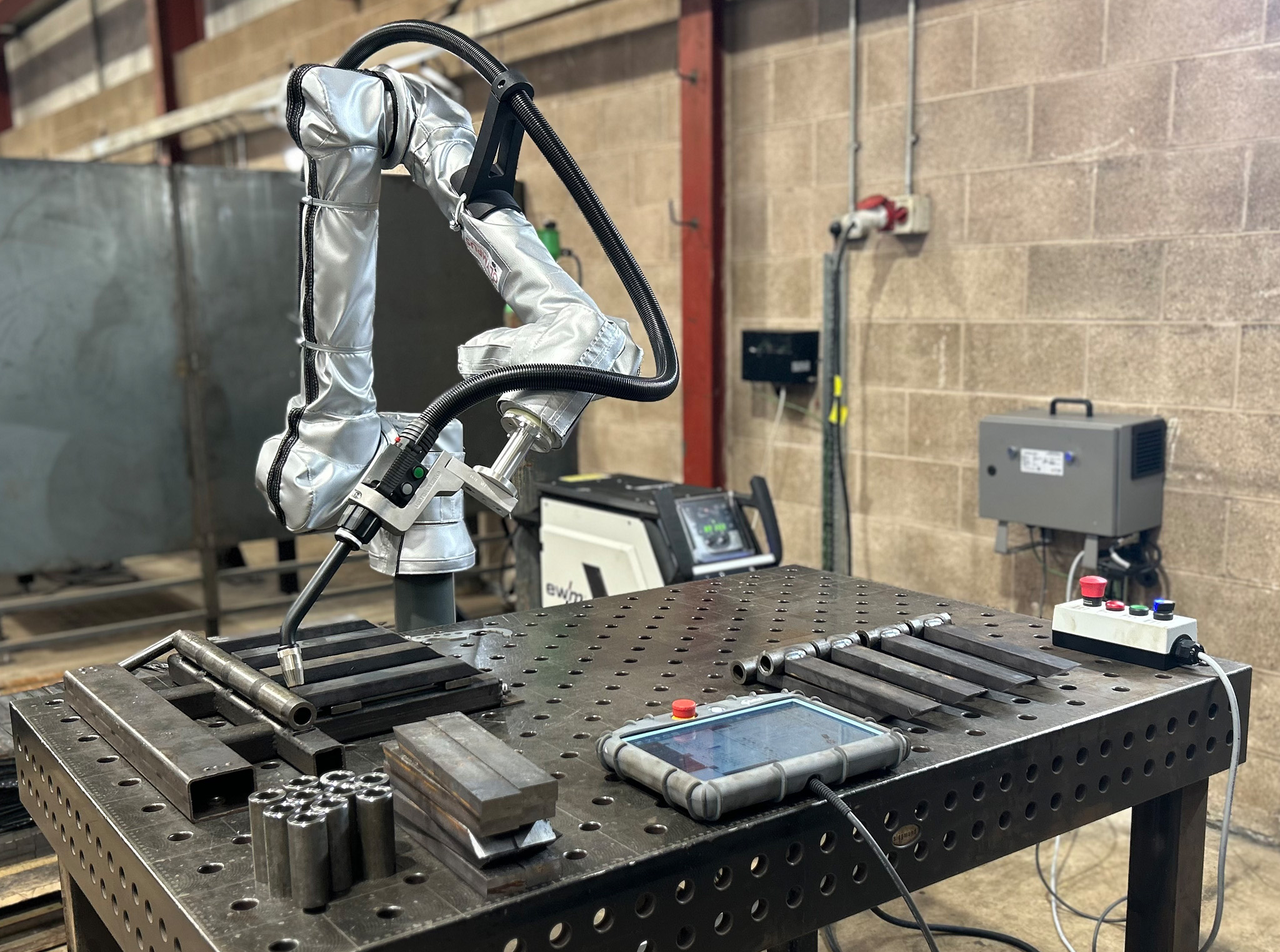














When evaluating production efficiency, the choice between automated dispensing robots and manual processes significantly impacts output quality, material consistency, and operational cost. We at Olympus Technologies consistently see manufacturers wrestling with this decision as they look to scale production or improve product integrity. Our experience shows that while manual methods offer initial flexibility, automated solutions like our dispensing cobots provide repeatable precision simply unattainable by hand.
Key Differences
The fundamental distinction lies in consistency and scalability. Manual dispensing relies entirely on an operator's skill and endurance, introducing variability in bead size, path, and application speed. This leads to inconsistent adhesion, uneven sealing, or cosmetic defects, especially in high-volume or intricate applications. A dispensing robot, by contrast, executes pre-programmed paths with sub-millimetre precision, applying material uniformly at a controlled rate on every cycle.
Manufacturing environments often highlight these differences acutely. In automotive electronics, for example, a manual application of thermal paste to PCBs results in uneven heat dissipation or material waste. Automated dispensing with a Universal Robots cobot, supported by a Dispensing URCap, ensures that every component receives the exact same volume and pattern, directly improving product reliability.
Attribute Comparison
Every dispensing task carries specific demands, and the method chosen directly influences performance across 10 key metrics. We quantify these differences to give our clients a clear picture of what to expect from each approach. Manual dispensing appears cheaper upfront, but the recurring costs of material waste, rework, and inconsistent quality quickly erode any perceived savings.
| Attribute | Manual Dispensing | Dispensing Robot (Olympus Technologies) | Why It Matters |
| Consistency | High variability based on operator skill/fatigue | Bead accuracy ±0.5 mm with vision-guided path correction | Directly impacts product quality, adhesion, and aesthetic finish. |
| Cycle Time | Highly variable, operator-dependent | Consistent and optimised, often 2-3x faster than manual | Determines throughput, production capacity, and labour cost per unit. |
| Material Waste | Significant, due to over-application or spills | Minimised through precise volume control and path accuracy | Reduces raw material expenditure and environmental impact. |
| Labour Cost | Continuous, human operator required | Initial setup, then monitoring; labour redirected to value-add | Reduces ongoing operational expenses and addresses labour shortages. |
| Safety | Exposure to fumes, repetitive strain injury (RSI) | Operator safely removed from hazardous materials/tasks | Improves worker wellbeing and reduces workplace injury claims. |
| ROI Period | N/A (continuous cost) | 12–24 months (typical for Olympus Technologies projects) | Short-term investment for long-term financial gain. |
| Cost Range | Indirect (labour, waste, quality control) | £50,000–£100,000 turnkey | Initial capital outlay versus ongoing operational burden. |
| Target Industry | Low-volume, prototyping, highly adjustable tasks | Automotive, electronics, construction, packaging | Suitability for high-volume, precision, or hazardous environments. |
Source: Olympus Technologies project data and industry benchmarks.
Choose Dispensing Robots If
You choose a dispensing robot when your applications demand repeatable accuracy, higher throughput, or involve hazardous materials. We frequently recommend automated dispensing for tasks where precision is paramount, such as applying conductive adhesives in electronics or sealing critical components in automotive manufacturing. If your product requires a bead accuracy of ±0.5 mm or better, manual application becomes impractical for anything beyond prototyping. Furthermore, if you are struggling with labour availability for repetitive, low-value tasks, automation provides a sustainable solution. Our solutions address common pain points in industries like construction, where consistent sealant application over large areas is a challenge, and in packaging, where precise adhesive placement maximises structural integrity.
You can find more information about our dispensing automation solutions on our website.
Choose Manual Dispensing If
In specific scenarios, manual dispensing remains the more appropriate choice. This typically applies to very low-volume production runs, one-off customisation, or tasks with extremely adjustable geometries that change frequently. For prototype development, where processes are still being defined and require constant adjustment, the immediate adaptability of a human operator is advantageous. Complex, non-repetitive tasks that lack a defined path or require subjective judgment, such as artistic applications or highly variable repair work, also fall into this category. The initial capital investment for an automated system is not justified for sporadic use or applications without a clear, repeatable process.
The Variables Integrators Overlook
While direct attribute comparisons provide a clear starting point, the true value of automated dispensing often lies in how it influences adjacent processes. The specifications alone, such as bead accuracy or cycle time, do not tell the full story regarding integration challenges or long-term operational dynamics. For instance, the stated accuracy of ±0.5 mm assumes an optimised material flow and ambient conditions; fluctuations in material viscosity due to temperature or humidity introduce variances that require process compensation.
We've found that the real complexities emerge when considering how dispensing automation affects upstream and downstream operations. A faster dispensing cycle is only beneficial if components can be fed and removed from the cell at a matching rate. Our team at Olympus Technologies always builds solutions with this broader context in mind.
When Product Design Impacts Dispensing Efficiency
The geometry and material of the product itself can introduce significant edge cases for both manual and automated dispensing. A manual operator can intuitively adjust to minor surface imperfections or inconsistent part placement. A robot, however, depends on consistent presentation or, more complexly, real-time vision guidance. This means that if your parts have tolerances exceeding what the vision system can compensate for, the robot's precision is effectively diluted.
Consider parts with complex 3D contours or undercut areas. Programming a precise path for these manually is time-consuming and prone to error, but automating it requires advanced path planning or 3D vision, which adds to the initial complexity. For example, applying a gasket to a component with internal cavities seems simple by hand, but achieving uniform coverage with a robot requires a tailored end effector and sophisticated trajectory control. Our process at Olympus Technologies addresses these design considerations early, often collaborating with clients to optimise part design for automation.
Dispensing Automation: Cost, ROI, and Implementation
Beyond the direct comparison, understanding the financial and logistical aspects of implementing dispensing automation is crucial. The investment in a dispensing robot, typically ranging from £50,000 to £100,000 for a turnkey solution from Olympus Technologies, includes not just the cobot arm and dispensing unit but also integration, programming, and safety assessments. Our experience shows a typical ROI period of 12–24 months for these systems, driven by reductions in material waste, increased throughput, and lower labour costs. This includes the initial costs of the Universal Robot cobot itself, the specific dispensing end effector, and any necessary vision systems for path correction.
We structure our projects to ensure transparency around these costs and deliver predictable outcomes. This involves a detailed quotation, clear project milestones, and a commitment to ongoing support.
Common Dispensing Applications
- Adhesive Bonding: Consistent application of structural adhesives in automotive assembly.
- Sealing & Gasketing: Precise sealant beads for waterproof enclosures in electronics.
- Potting & Encapsulation: Controlled filling of components with protective resins.
- Thermal Management: Accurate application of thermal greases or pastes to electronic devices.
- Lubrication: Automated oiling or greasing of moving parts in machinery.
Deeper Guides
To explore specific aspects of dispensing automation further, we have additional resources:
- Dispensing Automation Pillar: Learn more about our full range of solutions and services
- Dispensing Cobot Cost and ROI: Understand the financial justifications for your automation project.
- Collaborative Robots Overview: Discover the safety and flexibility benefits of Universal Robots in dispensing.
If you're ready to discuss your specific dispensing challenges, you can request a complimentary automation consultation. Our experts will assess your production needs and outline a tailored solution.