













We see increasing demand for automation that handles product variety without sacrificing efficiency. The distinction between cobot welding for small batches and for mass production often comes down to adaptability and setup time, not just weld volume.
While both approaches benefit from robotic precision, our focus at Olympus Technologies for small batch applications prioritises rapid reprogramming, flexible fixturing, and efficient material handling for diverse part geometries and fluctuating production schedules.
Key Differences
The primary differentiator in cobot welding deployments lies in the balance between initial setup and ongoing operational flexibility.
For mass production where thousands of identical parts are welded, optimising every millisecond of cycle time is paramount; this typically means complex, dedicated tooling and high-speed industrial robots.
In contrast, small batch cobot welding, often serving industries like custom fabrication or prototyping, demands quick changeovers and simplified programming. We design systems to minimise non-welding time, ensuring that the robotic cell remains productive even with frequent part variations. This strategy often results in an ROI period of 6-12 months, particularly where skilled labour shortages drive up manual welding costs.
Attribute Comparison
The table below outlines how key attributes of cobot welding solutions shift in priority and configuration when adapting from a mass production environment to one focused on small-batch, high-mix manufacturing.
| Attribute | Small Batch Cobot Welding (High-Mix) | Mass Production Industrial Welding (High-Volume) | Why It Matters |
| Programming Time | 15-30 minutes per new part variant | Weeks for full line integration | Directly impacts changeover efficiency for diverse jobs |
| Fixture Complexity | Simple, reconfigurable, magnetic, or clamp-based | Custom, dedicated, often hydraulic/pneumatic | Ease of part loading/unloading and adaptability |
| Robot Type | Collaborative Robot (e.g., UR10e, UR20) | High-speed Industrial Robot (e.g., KUKA, Fanuc) | Safety, ease of use, and integration with human operators |
| Throughput (Weld Speed) | 300-800 mm/min (optimised for quality) | 500-1200+ mm/min (optimised for speed) | Quality and precision over raw speed for lower volumes |
| Part Run Size | 1-100 units | 1000s+ units | Dictates the frequency of setup changes |
| Integration Cost | £70,000–£90,000 (MIG/MAG) | £120,000–£250,000+ | Reflects complexity and customisation level |
| Occupancy | Shared workspace with operator with the correct safety & guarding | Guarded cell, isolated from humans | Operator interaction is a key cobot advantage |
Source: Olympus Technologies project data and industry benchmarks.
Choose Small Batch Cobot Welding If
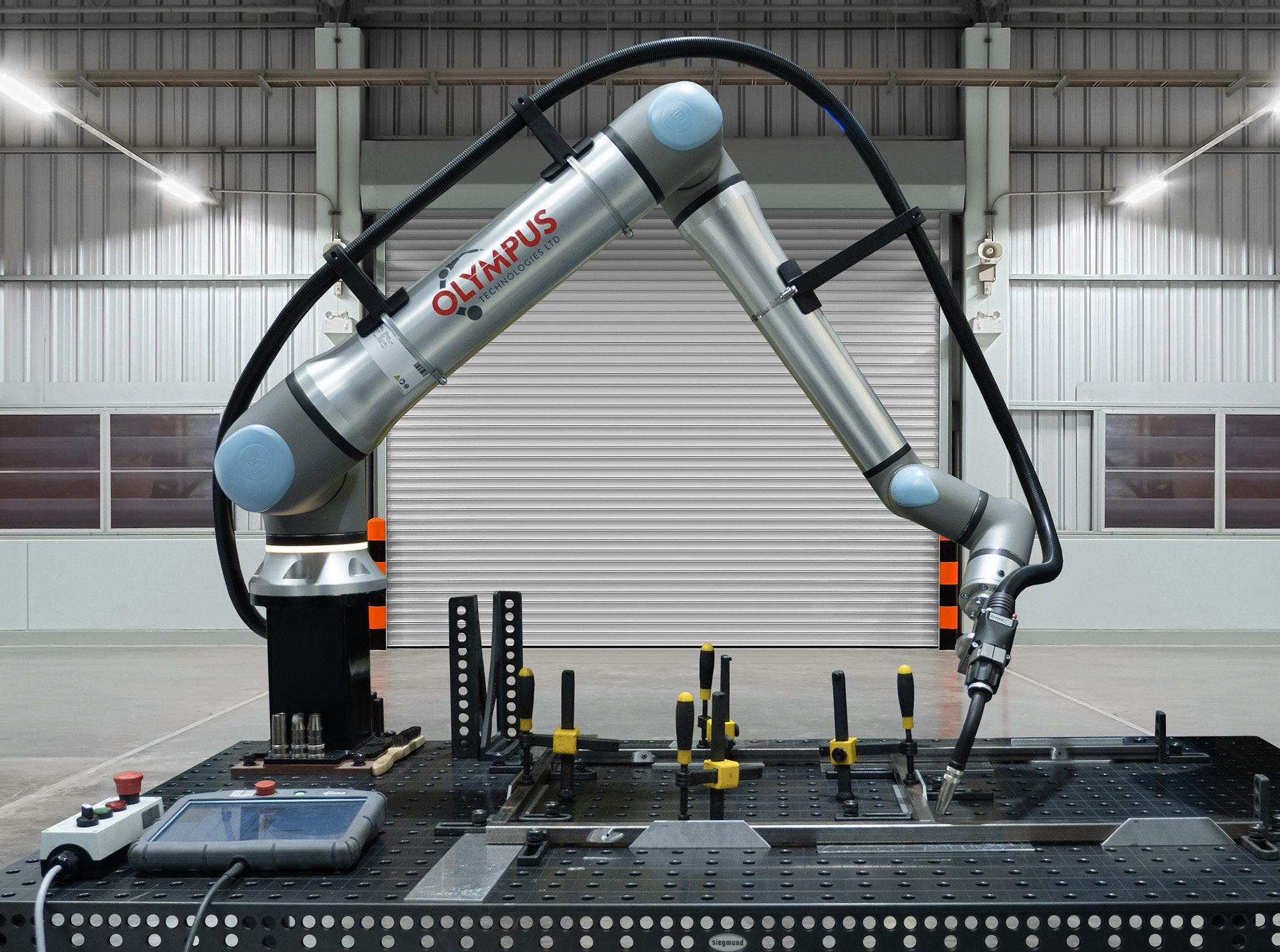
You operate in environments where job orders fluctuate frequently, and product customisation is the norm. This approach suits you if your manufacturing involves welding different parts daily or even hourly, making dedicated, complex setups impractical. We find this solution ideal for companies seeking to free up skilled welders from repetitive, simple tasks to focus on complex, high-value work. If you are experiencing difficulty recruiting or retaining skilled welders, or need to address safety concerns with manual welding, a cobot system offers a reliable solution. Our systems typically integrate a Universal Robots cobot, DINSE welding package, and bespoke fixturing tailored to your specific part families, ensuring both quality and flexibility.
Choose Mass Production Industrial Welding If
Your operation involves continuous, high-volume production of identical components where maximum throughput and minimal human intervention are the main objectives. These systems are designed for relentless, high-speed execution over extended periods with minimal changeovers. If your production runs into the tens or hundreds of thousands of parts, justifying the significant investment in large, high-speed industrial robots and their complex, purpose-built cells is straightforward. We typically implement these solutions for tier-one automotive suppliers or large structural fabricators where every second saved translates directly into substantial cost reductions at scale.
The Dynamics of High-Mix, Low-Volume Automation
While the initial appeal of cobot welding often focuses on the ease of programming and collaborative safety, the real value for small batch production emerges from its influence on overall operational fluidity. Standard cycle times or payload ratings found on spec sheets, such as a UR20's 20 kg payload or a typical weld speed of 300–800 mm/min, are only part of the story. For high-mix environments, it's the effective cycle time - including rapid setup, part loading, and quality checks that defines efficiency. A system might weld quickly, but if a tooling change for a new part takes an hour, its utility for small batches diminishes rapidly. We optimise for minimising these non-welding bottlenecks, a critical factor for manufacturers running 30 different jobs in a single shift.
That said, the promise of quick changeovers comes with a set of nuanced considerations that are often overlooked. We consistently see manufacturers underestimate the impact of fixture design on their changeover times, or fail to account for the consistent availability of consumables for a diverse product range. These operational variables directly influence the true ROI of a small batch welding cell, often pushing payback periods beyond the typical 6-12 months if not addressed during the initial design phase.
When Part Variation Becomes a Programming Challenge
Many businesses assume a cobot's ease of programming eradicates all setup time. Here's the thing: while drag-and-drop interfaces and URCaps simplify path generation, handling true random part variation still demands smart strategies. When parts vary significantly in geometry, material, or joint type, each new variant can feel like starting from scratch. That's why we focus on developing part families within your production, allowing for template-based programming that streamlines the process from 30 minutes for a new part to under 5 minutes for a variation within an established family. This proactive approach to data management is essential for sustainable high-mix automation.
The Consumables Conundrum
For manufacturers producing a single product, standardising welding consumables is straightforward. However, introduce 50 different parts needing MIG welds on mild steel, stainless, and aluminium, and suddenly you require three different wires plus corresponding gas mixtures. Managing this inventory, ensuring the correct consumable is loaded, and tracking usage impacts more than just cost; it introduces potential for error and downtime. We often implement colour-coded systems and clear visual triggers to guide operators, mitigating these risks.
Alternatives to Small Batch Cobot Welding
While cobot welding is a strong solution for high-mix, low-volume production, other automation methods might suit specific needs:
- Manual Welding: For extremely low volumes or highly complex, artistic welds, skilled manual welders remain indispensable. However, they command higher wages and are subject to fatigue, impacting consistency.
- Off-line Programming Software: For large or complex parts that still require batch production, off-line programming can streamline the initial robot path generation, reducing robot downtime during teaching. We integrate solutions that allow engineers to simulate welding processes before they ever reach the machine.
- Dedicated Welding Jigs: For specific, recurring high-volume jobs that don't quite justify a full industrial robot cell, investing in precision-engineered welding jigs can improve consistency and speed for manual operations.
Deeper Guides
To understand more about specific aspects of robotic welding and automation, explore our detailed resources:
- Cobot Welding: Explore the broader applications and technical capabilities of our collaborative welding solutions on our main hub page for more information.
- Integrating Vision Systems for Welding: Discover how our vision systems enhance welding accuracy and quality control.
- The Benefits of Bespoke Gripping Solutions: Learn how custom end of arm tooling optimises part handling in diverse applications.
Frequently Asked Questions
What kind of ROI can I expect from cobot welding for small batches?
Our data shows that manufacturers typically see an ROI for cobot welding within 6-12 months. This is largely driven by consistent weld quality, reduced labour dependency, and increased throughput per shift, even with frequent job changes.
How complex is it to reprogram a cobot for a new part?
With user-friendly interfaces like the Universal Robots Polyscope teach pendant and specific URCaps, basic reprogramming for a new part can often be completed in 15-30 minutes. Olympus Technologies provides comprehensive training to your team to ensure they are proficient in managing these changeovers.
Is specialist tooling required for small batch cobot welding?
Typically, we design small batch welding cells with flexible, reconfigurable fixturing. This often involves magnetic clamps, modular jigs, or quick-release mechanisms that allow for rapid changeovers between different part types without extensive retooling, keeping costs down and flexibility high.