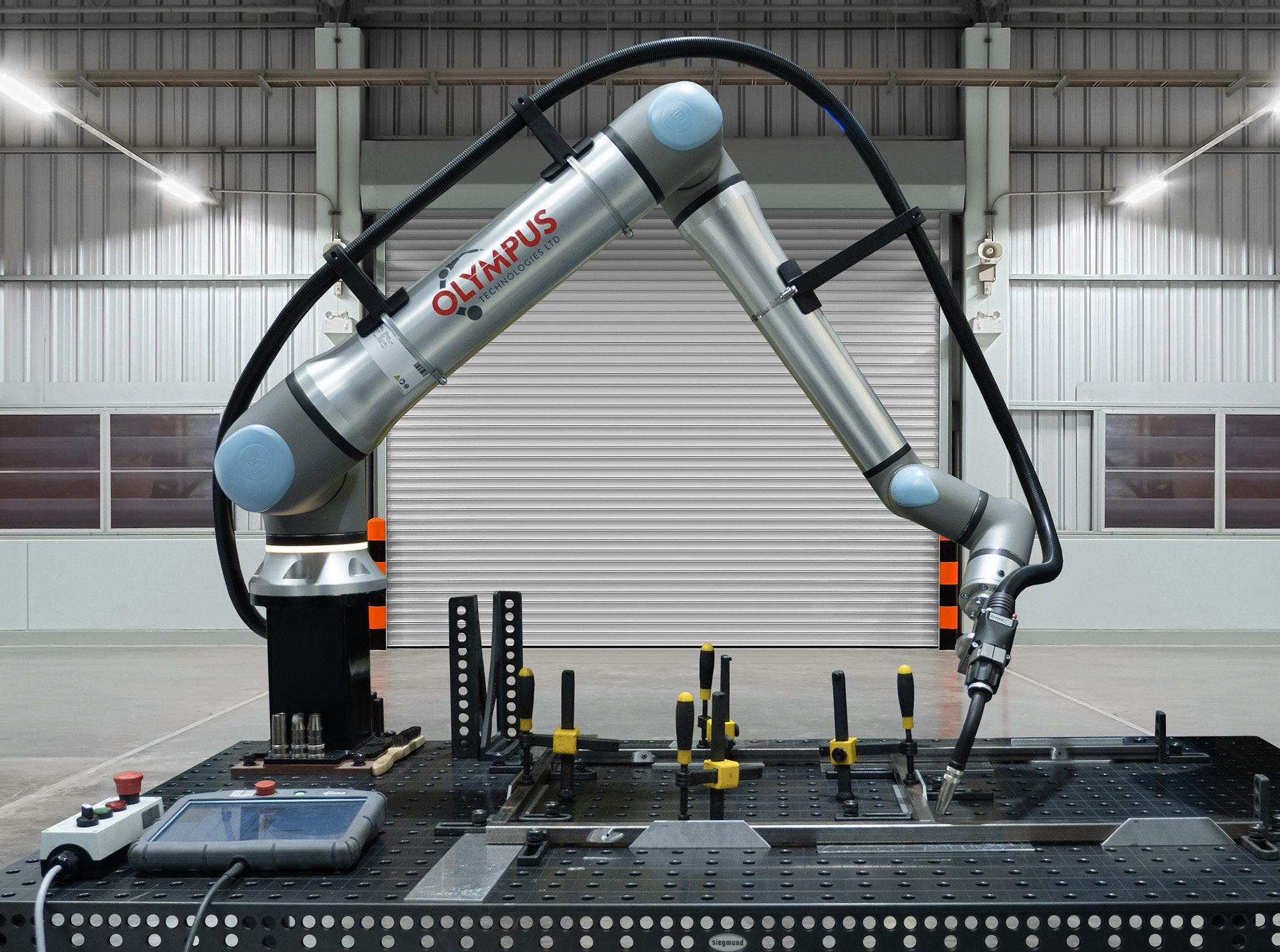














Collaborative robot (cobot) machine tending is the automated loading and unloading of CNC machines, lathes, or presses using flexible, sensor-guarded robotics. As a Robotics and Automation Integrator, Olympus Technologies deploys these systems to solve the UK manufacturing labour shortage by enabling 24/7 'lights-out' production without the intensive floorspace requirements of traditional industrial robots. This page covers operational gains, financial drivers, and ergonomic safety benefits of cobot integration. It does not cover manual machine operation techniques or traditional high-speed fixed-fence industrial robotics.
What is a Robotics and Automation Integrator?
A Robotics and Automation Integrator serves as the technical architect between robot manufacturers and end-user factory floors. In the context of machine tending, the integrator's role is to specify the correct cobot payload, design bespoke end-of-arm tooling, and programme the interface between the robot and the CNC controller. This ensures that the automated system adheres to UK safety standards while optimising spindle uptime through precise synchronisation.
Key Types and Categories
When a Robotics and Automation Integrator evaluates a machine shop, the deployment strategy follows one of three categories based on mobility requirements. Fixed-base systems are bolted to the floor for high-repetition tasks. Mobile pedestal systems allow the cobot to be moved between different CNC centres as production demands change. Finally, rail-mounted cobots can tend multiple machines in a linear cell, increasing the utility of a single robotic arm across a range of 2-4 spindles.
How Robotics and Automation Integrator Works
The integration process involves mapping the physical reach of the cobot against the machine's vice or chuck location. The Robotics and Automation Integrator configures the "handshake" between the robot and the machine tool via M-codes or dedicated I/O to signal when a door is open or a cycle is complete. Sensor-guarded zones are then established to allow the cobot to slow down or stop safely when a human operator enters the shared workspace, maintaining a collaborative environment.
Operational and Financial Advantages
Implementing cobots for machine tending directly improves spindle uptime by removing the delays associated with manual part changeovers. Cycle consistency becomes a fixed variable, allowing for precise production scheduling and predictable lead times. Transitioning from manual labour to an integrated system alters the cost structure of a machine shop, moving from variable hourly labour costs to a fixed capital investment with a defined payback period.
| Attribute | Manual Machine Tending | Cobot Machine Tending |
|---|---|---|
| Production Hours | Limited by shift patterns | 24/7 Capability (Lights-out) |
| Cycle Consistency | Variable by operator fatigue | Precise and repeatable |
| Safety Guarding | Procedural/PPE based | Sensor-based/Force-limited |
| Footprint | Requires operator clearance | Compact / Collaborative zones |
Manufacturers can find further strategic context in our Machine Tending Solutions Overview to understand how these systems fit within a wider factory automation strategy. For firms focused on justifying the capital expenditure, evaluating Machine Tending ROI involves calculating the difference between current manual throughput and the expanded capacity provided by unmanned night shifts.
Human-Centric and Safety Improvements
Automating the loading of CNC machines removes staff from repetitive, ergonomically straining tasks. Cobots are designed to work alongside humans, using power and force limiting (PFL) technology to reduce the risk of injury. Compliance with specific regulations is mandatory for any deployment. Our guide on Cobot Machine Tending Safety details the risk assessment process required for CE and UKCA marking. See Cobot Machine Tending Installation Requirements for more details. See Cobot Machine Tending Software Integration for more details.
When does a standard machine tending cobot become insufficient for high-mix/low-volume environments?
A standard cobot solution is most effective for consistent part geometries and long production runs. Transitioning to high-mix/low-volume (HMLV) environments requires a shift in technical selection, specifically regarding end-of-arm tooling (EoAT) and software flexibility. When the time spent reprogramming for a new part exceeds the gains from automation, the system requires bespoke grippers or advanced vision systems to maintain efficiency.
How to Choose the Right Robotics and Automation Integrator
Selecting a partner depends on their experience with your specific CNC control systems and the complexity of your part portfolio. A qualified integrator must provide a safety risk assessment that covers the entire application, including the workpiece. Look for providers who offer modular software blocks that allow your internal staff to perform basic re-tasking without needing deep robotic coding knowledge for every new batch.
| Decision Factor | Standard Solution | Bespoke/HMLV Solution |
|---|---|---|
| Part Variety | Single or similar geometries | Diverse shapes and weights |
| Changeover Frequency | Rare (Weekly/Monthly) | Frequent (Daily/Hourly) |
| Tooling Type | Standard vacuum or parallel gripper | Quick-change or multi-head grippers |
| Interface | Basic I/O signals | Sophisticated ERP/MES integration |
Misconceptions and Technical Compliance
A frequent misconception in manufacturing is that a 'collaborative' robot is inherently safe regardless of the task. While the arm is power-limited, the application - including the workpiece and the CNC environment—must be assessed. For example, if a cobot is handling a sharp or hot metal part, the application requires the installation of hard physical guarding or light curtains to satisfy the risk assessment. UK manufacturers must adhere to the Robot Safety Standards for Machine Tending, specifically ISO/TS 15066, to remain legally compliant.
Integration and Continuity
Sustaining the benefits of automation requires a structured plan for mechanical health. Implementing Preventative Maintenance for Cobot Machine Tending reduces the risk of unplanned downtime, which is critical when relying on a robot for 'lights-out' production. For facilities comparing different automation tiers, reviewing CNC Machine Tending Automation provides a macro view of available technologies, while an analysis of Robot Machine Tending vs. Human Operators helps in quantifying the production gap bridged by robotics.
| Maintenance Element | Frequency | Purpose |
|---|---|---|
| Gripper Cleaning | Weekly | Ensure secure part pick-up |
| Cable Inspection | Monthly | Prevent wear and signal loss |
| Software Updates | Quarterly | Optimise pathing and security |
| Force Calibration | Annually | Maintain safety compliance |
Summary of benefits
The primary benefit of cobot machine tending is the transition to autonomous production, which enables UK manufacturers to maintain output regardless of labour availability. By utilising "lights-out" shifts, a facility can effectively double or triple its usable spindle hours without adding to the headcount. This increased productivity is achieved through predictable cycle times and the removal of human error in loading sequences.
Furthermore, the introduction of robotics improves the working environment by reallocating human staff to higher-value roles, such as quality control or process optimisation. The reduction in repetitive strain injuries and the precision of robotic movements lead to higher overall equipment effectiveness (OEE) and a more sustainable manufacturing model.
Detailed benefits
Operational gains centre on the removal of "spindle starvation," where machines sit idle waiting for an operator to clear a finished part. Cobots provide a continuous loading loop that maintains a 100% duty cycle as long as raw materials are available. This consistency allows production managers to quote lead times based on literal machine speeds rather than estimated human availability.
Environmentally and physically, the compact footprint of collaborative systems means they can be integrated into existing workshop layouts without the need for massive safety cages. Sensors and force-limiting technologies allow the robot to operate in the same vicinity as human workers, preserving the flexibility of the workshop while adding the tireless performance of an automated system.
Conditions and caveats
The effectiveness of a cobot system is contingent on the stability of the upstream process. If raw material dimensions vary, the robot fails to achieve a secure pick. Automation requires standardised part presentation, such as the use of indexed trays or vibratory feeders, to ensure the arm can reliably find the next workpiece.
Additionally, the collaborative speed of the robot is locked at a lower rate than that of a dedicated industrial robot. While this allows for safe operation around humans, it means the cycle time of the robot must be checked against the cycle time of the CNC machine. If the robot takes longer to load a part than the machine takes to cut it, the robot becomes the bottleneck in the production line.
Compared to alternatives
When compared to manual tending, cobots offer superior consistency and the ability to work through unsociable hours, directly addressing the UK sector's recruitment challenges. Unlike manual operators, robots do not suffer from fatigue-related slowdowns towards the end of a shift, ensuring the first part produced in the morning is identical in cycle time to the last part produced at night.
In comparison to traditional industrial robots, cobots are more flexible and easier to redeploy. Traditional robots require fixed safety fencing and logic-controlled interlocks, which can consume valuable floor space and make it difficult for humans to access the machine for maintenance. Cobots allow for a hybrid approach where machines can be tendered by robots for high-volume runs but remain accessible for manual setups or one-off prototypes as required.
Common Questions
How quickly can a cobot be reprogrammed for a new part? With intuitive software like Cobot Machine Tending Software Integration, integrated systems allow operators to teach new points by physically moving the arm, reducing setup time to minutes.
What are the floor space requirements? Most cobot machine tending cells require little more than the footprint of a standard pallet, though the specific reach requirements of the CNC machine will dictate the final pedestal location as outlined in Cobot Machine Tending Installation Requirements.
Related context
This content explores the technical layer of software handshakes and GUI-based programming which supports the physical benefits discussed on this page. See Cobot Machine Tending Software Integration for more details.
Essential technical preparation steps including floor levelness and power supply specifications for a successful deployment. See Cobot Machine Tending Installation Requirements for more details.