













Choosing between pulsed laser welding and continuous laser welding in a robotic cell is not simply a laser selection decision. It is a process choice that directly affects heat input, weld quality, mechanical properties, throughput, and long term production cost.
In modern industrial applications, the wrong choice can lead to excessive thermal distortion, poor penetration, unstable weld seams, or unnecessary rework. The right choice, by contrast, delivers consistent performance, precise control, and predictable quality at scale.
This article explains pulse vs continuous laser welding in robotics from a practical manufacturing perspective, focusing on outcomes rather than theory.
The Quick Answer: Which Should You Choose?
Most manufacturers can narrow the decision quickly once the application context is clear.
Choose Pulsed Laser Welding When
Pulsed laser welding is typically the better choice when working with thin sheets, heat sensitive materials, or delicate assemblies that demand minimal heat input.
Pulsed lasers deliver high peak power in short bursts, allowing precise heat control with low average power. This makes pulsed welding well suited to cosmetic weld seams, spot or stitch welds, surgical tools, and assemblies where thermal stress or distortion must be tightly controlled.
Pulsed laser technology is also more forgiving when joint fit-up varies slightly, as the rapid cooling rate limits heat affected zone growth and reduces burn through risk.
Choose Continuous Laser Welding When
Continuous wave laser welding, often referred to as CW laser welding or continuous wave CW operation, is better suited to applications requiring deeper penetration, longer weld seams, and higher welding speed.
CW lasers deliver an uninterrupted beam with sustained heat and higher average power, enabling stable keyhole formation in thicker materials and long, continuous joints. When joint preparation is consistent and fixturing is robust, continuous laser welding offers superior productivity and throughput.
Pulsed vs CW at a Glance
| Best for | Strengths | Limitations | Typical outcomes | Common pitfalls |
|---|---|---|---|---|
| Pulsed laser welding | Thin materials, sensitive parts | Low heat input, high precision | Limited penetration depth | Clean seams, low distortion |
| Continuous laser welding | Thick sections, long seams | High energy densities, speed | Higher heat input | Deep penetration, strong joints |
What Changes in a Robotic Cell (Not Just the Laser)
A key differentiator between successful and problematic robotic laser welding cells is understanding that the laser source is only one part of the system.
Motion, Seam Tracking, and Repeatability
In robotics, good welding starts with good motion.
Pulsed systems are more tolerant of small speed variations because energy delivery is discretised into pulses. Continuous mode, by contrast, relies on consistent robot motion to maintain uniform power density along the weld seam.
Acceleration limits, corner behaviour, and path smoothness directly affect heat input distribution. In CW laser welding, poor motion control often leads to excessive heat affected zone growth or inconsistent penetration.
Fixturing and Joint Preparation Requirements
Joint preparation has a much stronger influence on CW lasers than pulsed systems.
Pulsed welding tolerates minor gaps due to high peak power and short pulse duration. Continuous wave laser welding demands tighter gap tolerance, clean edges, and stable clamping to prevent loss of penetration or excessive heat input.
In both cases, surface cleanliness affects laser absorption, particularly when welding reflective metals.
Sensor Stack and Monitoring
Machine vision, seam tracking, and coaxial monitoring are not always mandatory, but their value depends on the welding method.
For pulsed systems on short seams or thin materials, basic monitoring may be sufficient. For continuous laser welding in production environments, seam tracking and height sensing often become essential to maintain consistent energy delivery and avoid defects.
How Pulsed and Continuous Welding Behave in Practice
Heat Input and Distortion Risk
Heat input is the dominant factor separating pulsed welding from continuous mode.
Pulsed lasers achieve low heat input by concentrating laser energy into short bursts, producing minimal heat affected zone HAZ and reducing thermal distortion. This is particularly important for thin materials and assemblies with tight dimensional tolerances.
Continuous wave lasers deliver sustained heat, which increases the temperature gradient across the base material. Without careful control, this can result in more heat, larger HAZ, and increased thermal stress.
Penetration and Weld Profile
Pulsed welding generally operates closer to conduction mode, producing shallow, well controlled weld zones with low penetration depth. This supports cosmetic quality and precise control but limits structural capability.
Continuous laser welding more readily forms a stable keyhole, enabling deeper penetration and stronger mechanical properties. This makes CW lasers well suited to carbon steel and stainless steel joints where strength and leak tightness matter.
Speed and Productivity
CW laser welding typically enables higher welding speed and throughput, especially on long seams with consistent joint geometry.
However, in applications where pulsed mode significantly reduces rework or distortion correction, overall OEE can favour pulsed systems despite lower instantaneous speed.
Material and Thickness Guidance
Material Behaviour Overview
Different materials respond differently to laser technology due to thermal conductivity and laser absorption.
Stainless steel absorbs laser light efficiently and supports both pulsed and continuous wave processes. Carbon steel behaves similarly but is more sensitive to oxidation and corrosion resistance considerations.
Reflective metals such as aluminium and copper alloys demand higher energy density and careful beam quality control, particularly in continuous mode.
Thin Sheets and Delicate Assemblies
For thin sheets and heat sensitive materials, pulsed laser welding is often preferred. Low average power combined with high peak power enables precise control, minimal heat input, and reduced risk of burn through.
Applications such as surgical tools and precision components benefit from this approach.
Thicker Sections and Long Seams
Thicker materials and long weld seams generally favour continuous laser welding. Sustained heat and higher average power allow stable penetration and consistent weld quality when joint conditions are controlled.
Material x Thickness x Mode Guidance
| Material | Thickness range | Joint type | Recommended mode | Notes and risks |
|---|---|---|---|---|
| Stainless steel | Thin sheets | Lap, edge | Pulsed | Low distortion, high precision |
| Stainless steel | Thick sections | Butt | Continuous | Control heat affected zone |
| Carbon steel | Medium to thick | Butt, fillet | Continuous | Watch thermal distortion |
| Reflective metals | Thin | Lap | Pulsed | Laser absorption sensitive |
Parameter Levers That Matter Most
Pulsed Welding Parameters
Key pulsed welding parameters include peak power, pulse duration, and pulse frequency.
Peak power drives penetration. Pulse duration controls heat build up. Pulse frequency influences energy delivered per unit length and cooling rate.
Continuous Welding Parameters
In continuous wave CW laser welding, laser power, welding speed, and spot size define energy density and penetration.
Balancing power output and travel speed is critical to avoid undercut or excessive heat affected zone growth.
Shared Parameters
Focus position, shielding gas, and filler wire (where used) influence both modes. In some cases, filler wire stabilises the weld pool and improves mechanical properties.
Defect Troubleshooting by Mode
| Symptom | Likely cause | Pulsed fix | CW fix | Prevention |
|---|---|---|---|---|
| Burn through | Excess energy | Reduce peak power | Increase speed | Improve fixturing |
| Lack of fusion | Low energy | Increase pulse width | Increase power | Joint prep |
| Distortion | Heat build up | Lower frequency | Reduce heat input | Motion tuning |
Quality, Validation, and Compliance
Qualifying a Robotic Laser Weld
Qualification typically includes sample coupons, macro etch analysis, and mechanical testing such as tensile or bend tests. Leak testing may be required depending on the application.
Inline Inspection Options
Vision systems can monitor weld seam appearance, while trend analysis of laser power and temperature supports early defect detection.
Documentation for Regulated Industries
For regulated sectors, parameter locking, recipe control, and traceability logs are essential to demonstrate compliance and consistent performance.
Safety Requirements for Robotic Laser Welding
Laser Safety Basics
Robotic laser welding cells require enclosures, interlocks, protective equipment, fume extraction, and careful management of reflections.
Operational Safety
Clear SOPs, operator training, maintenance lockout procedures, and particulate controls are critical to safe operation.
Safety Controls Checklist
| Control | Why it matters | When required | Owner |
|---|---|---|---|
| Enclosure | Contain laser light | All CW systems | Engineering |
| Interlocks | Prevent exposure | Automated cells | Controls |
| Extraction | Remove fumes | All welding | EHS |
Cost and ROI Considerations
What Drives Total Cost of Ownership
Total cost includes the laser source, optics, cooling, safety enclosure, sensors, robotic integration, and validation effort.
CW lasers often carry higher cooling and safety costs, while pulsed systems may limit throughput.
Where ROI Comes From
ROI is typically driven by reduced rework, higher productivity, improved quality, and fewer downstream correction steps.
ROI Inputs
| Input | How to measure | Baseline source | Expected impact |
|---|---|---|---|
| Rework | Scrap rate | Quality data | Medium to high |
| Throughput | Parts per hour | OEE | High for CW |
| Distortion | Rework hours | Production | High for pulsed |
How We Help You Choose and Prove the Process
Process Selection Workshop
Olympus Technologies works with customers to review parts, joint design, target KPIs, and risks before committing to a laser welding solution.
Trials and Sample Welds
Process trials using pulsed lasers or continuous wave lasers generate measurable evidence of penetration, distortion, and quality.
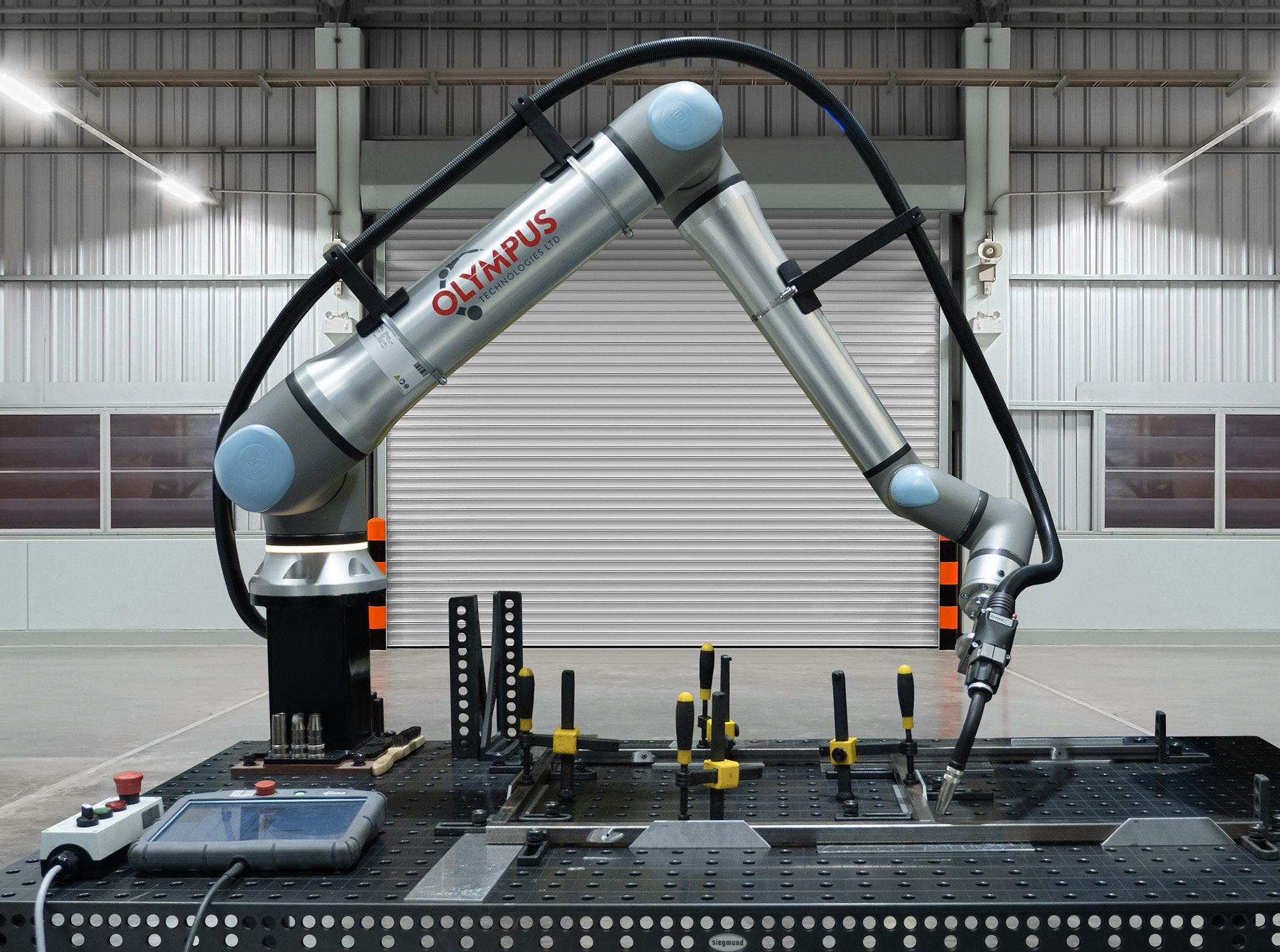
Turnkey Robotic Cell Integration
From design and build through FAT, installation, SAT, and ramp up support, Olympus Technologies delivers complete robotic laser welding systems validated for real production.
CTA: Book a Process Review or Request a Budgetary Cell Proposal
Frequently Asked Questions
Can pulsed replace CW for production speed?
Sometimes, but only when reduced rework offsets lower welding speed.
When does CW cause distortion issues?
When joint prep, motion, or heat input is not well controlled.
Do we need seam tracking?
Often yes for continuous laser welding in production.
Can reflective metals be welded reliably?
Yes, with correct energy density and process control.
What is the difference in maintenance burden?
CW systems typically require more cooling and optics management.