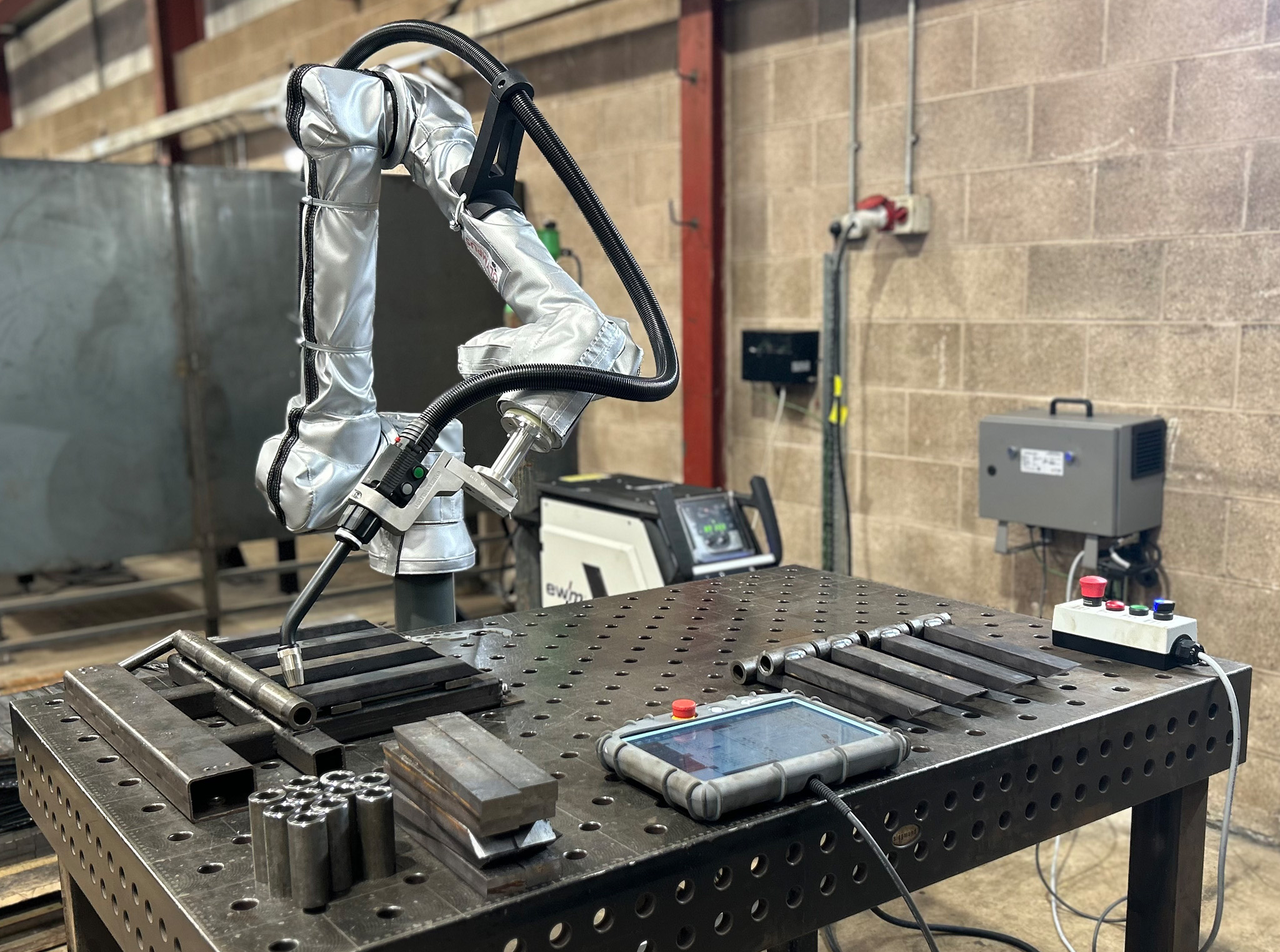














Add capacity, improve consistency, and reduce strain injuries without a full automation overhaul.
For small manufacturers and small to medium enterprises, robotic automation has often felt out of reach. Traditional industrial robots were expensive, complex, and required major changes to production lines and shop floor layouts.
Collaborative robots, commonly known as cobots, have changed that equation. Designed to work side by side with human workers, cobots offer a practical entry point into advanced automation for low volume production, high mix environments, and labour intensive tasks.
This article explains why collaborative robots in small scale manufacturing are a game changer, how to assess whether a cobot is right for your operation, and how to reduce risk before investing.
Why Cobots Are Different and Why SMEs Choose Them
Collaborative robots are a new generation of robotic automation designed around flexibility, safety, and ease of integration.
Unlike traditional robots, cobots are built to operate safely alongside human operators, making them especially attractive to small manufacturers with limited space, limited programming experience, or evolving production needs.
Cobots vs Traditional Industrial Robots
Cobots and industrial robots both use a robotic arm to perform tasks, but they are designed for very different manufacturing environments.
| Factor | Cobot | Industrial robot | Best choice when |
|---|---|---|---|
| Footprint | Small, compact | Larger, fixed | Space is limited |
| Programming | Guided, simplified | Complex programming steps | Limited programming experience |
| Safety | Force and speed limited | Guarded, high power | Humans work side by side with minimal guarding |
| Flexibility | Easy redeployment | Fixed cell | High mix production |
| Speed and payload | Moderate | High | Heavy or high speed tasks |
Cobots do not remove the need for safety measures, but they use a different safety approach based on force limits, speed monitoring, and risk assessment rather than full perimeter guarding.
The Best First Cobot Scenarios
Cobots deliver the strongest benefit where manual labour is repetitive, time consuming, or physically demanding.
Typical first cobot use cases include:
- Labour shortages or reliance on overtime
- Repetitive tasks that cause fatigue or strain injuries
- Quality drift caused by human error
- Low volume or high mix production where flexibility matters
For many small manufacturers, a single cobot creates new opportunities by stabilising output and freeing skilled employees for higher value work.
Is a Cobot Right for Your Shop?
Not every task is a good fit for a collaborative robot. A quick readiness check helps avoid wasted time and cost.
Fast Readiness Checklist
- Is part presentation stable and repeatable?
- Is the cycle time realistic for a collaborative robot?
- Is there space for safe operation on the shop floor?
- Does someone own basic maintenance and recovery?
- Is there a clear KPI such as throughput, scrap, or worker safety?
If most answers are yes, integrating cobots is usually feasible.
A short video of the task is often enough to confirm fit and highlight any early blockers.
Top Cobot Applications for Small Manufacturers
This is where most buyers look to answer a simple question. Is there a use case that looks like mine?
Machine Tending
Cobots are widely used for machine tending on CNCs, lathes, mills, and brake press operations.
Typical goals include:
- Automated load and unload
- Door and machine handshake
- Simple buffers to maintain consistent throughput
This reduces manual handling and improves utilisation without replacing existing machines.
Assembly and Screwdriving
Collaborative robots perform repetitive fastening and assembly tasks with high consistency.
Common applications include:
- Screwdriving with torque control
- Presence checks to prevent missed steps
- Basic traceability for quality assurance
Cobots excel at intricate tasks where precision matters but speed demands are moderate.
Inspection and Quality Checks
Vision based inspection with cobots helps reduce human error in quality sensitive processes.
Typical inspection tasks include:
- Presence and absence checks
- Simple measurement
- Code reading and verification
This is especially valuable where improved product quality directly impacts customer satisfaction.
Packaging, Palletising, and End of Line
Cobots are increasingly used for:
- Case packing and labelling
- Small footprint palletising
- End of line handling in constrained environments
| Application | Typical goal | Key requirement | Common blocker | Fix |
|---|---|---|---|---|
| Machine tending | Uptime | Stable cycle | Door interface | Simple IO |
| Assembly | Consistency | Torque control | Part variation | Better fixturing |
| Inspection | Quality | Lighting | Reflections | Controlled lighting |
| Packaging | Throughput | Space | Reach limits | Layout adjustment |
High Mix and Low Volume: Where Cobots Shine
Small manufacturers often deal with frequent changeovers and variable demand.
Quick Changeovers Without Heavy Reprogramming
Cobots support simple recipes, guided setups, and fixture swaps. This allows fast changeovers without complex programming or specialist robotics expertise.
This is not no programming, but it is far more accessible for teams without dedicated robotics engineers.
Flexible Cells That Move With Demand
Many cobot cells are mounted on carts or modular stands with quick connect utilities. This allows the same robot to support different machines or processes as demand changes.
Enhanced flexibility is one of the biggest advantages for small manufacturers.
What Makes a Cobot Cell Actually Work
The robot itself is only part of the system.
End of Arm Tooling Matters More Than the Arm
Grippers, compliance devices, and quick change tooling define what the cobot can actually do.
Good tooling helps handle part variability, reduces cycle time, and minimises failures.
Part Presentation and Fixturing
Simple trays, nests, and locating features often remove the need for complex vision or artificial intelligence.
Better part presentation improves reliability and reduces integration complexity.
Buffering and Takt Time Stability
Simple buffers prevent short stops from shutting down the entire process. This stabilises takt time and improves overall productivity.
Vision and AI: Useful, But Not Magic
Innovative technologies like vision systems and artificial intelligence can add value, but only when applied correctly.
When Vision Adds Value
Vision is effective for:
- Random part orientation
- Inspection and defect detection
- Traceability and code reading
When Vision Causes Problems
Vision systems struggle with:
- Poor lighting
- Reflective surfaces
- Uncontrolled variation
| Feature | Useful for | Cost and complexity | Watch out for |
|---|---|---|---|
| Vision | Inspection | Medium | Lighting control |
| AI tools | Variation | High | Data quality |
| Sensors | Presence | Low | Mounting accuracy |
Safety, Risk Assessment, and Compliance
Collaborative Does Not Mean Risk Free
Cobots still require formal risk assessment. Speed, force, and workspace interaction must be evaluated to ensure worker safety.
Practical Safeguarding Options for SMEs
Common safety measures include:
- Area scanners and light curtains
- Safe speed and monitored stop
- Localised fencing where required
| Safeguard | Best for | Throughput impact | Typical pitfall |
|---|---|---|---|
| Area scanner | Shared space | Low | Poor positioning |
| Light curtain | Access points | Medium | Frequent stops |
| Fencing | High risk zones | High | Over guarding |
Implementation: From First Call to Running Cell
Our Cobot Deployment Process
Cobots succeed when implementation is structured.
The typical process includes:
- Discovery and task scoring
- Concept design and budget ROI estimate
- Cell design covering tooling, safety, and layout
- Build and factory acceptance testing
- Install, site acceptance testing, and training
- Ramp up and ongoing support
This reduces disruption and builds confidence among operators and decision makers.
Costs, ROI, and Payback
What Drives Cobot Project Cost
Key cost drivers include:
- Tooling complexity
- Safety measures
- Vision and sensors
- Interfaces with existing equipment
- Cycle time expectations
ROI Inputs to Calculate Before You Buy
Cobots are often justified through:
- Labour redeployed
- Reduced scrap and rework
- Increased throughput
- Reduced injury risk and absenteeism
- Avoided overtime
| ROI input | How to measure | Where to find the data | Notes |
|---|---|---|---|
| Labour savings | Hours redeployed | Shift records | Avoid double counting |
| Scrap reduction | Yield | Quality data | Use averages |
| Throughput | Units per shift | ERP | Demand must exist |
| Safety | Incidents | HSE records | Long term benefit |
Payback period varies by application, but realistic estimates create better long term decisions.
Proof: Results From Real Small Manufacturers
Small manufacturers using collaborative robots commonly achieve:
- Consistent throughput without adding shifts
- Reduced reliance on manual labour
- Improved worker safety
- Measurable productivity gains
Photos, videos, and before and after metrics help validate real world performance.
Frequently Asked Questions
Cobot or industrial robot, which do I need?
Cobots suit shared spaces and flexible tasks. Industrial robots suit speed and payload.
Do cobots need guarding?
Sometimes. Risk assessment determines the required safety measures.
How long does installation take?
Most cobot cells install within days, not weeks.
What training do operators need?
Basic operation and recovery training is usually sufficient.
Can a cobot run multiple machines?
Yes, with proper buffering and scheduling.
What maintenance is required?
Routine checks and basic preventative maintenance.
Next Step: Get a Cobot Suitability Assessment
A feasibility check helps confirm whether a cobot is the right solution for your process.
Simple inputs include:
- Process description
- Shift pattern
- Part information
- Cycle time
- Primary pain point
Get in contact with Olympus Technologies to book a cobot feasibility call.