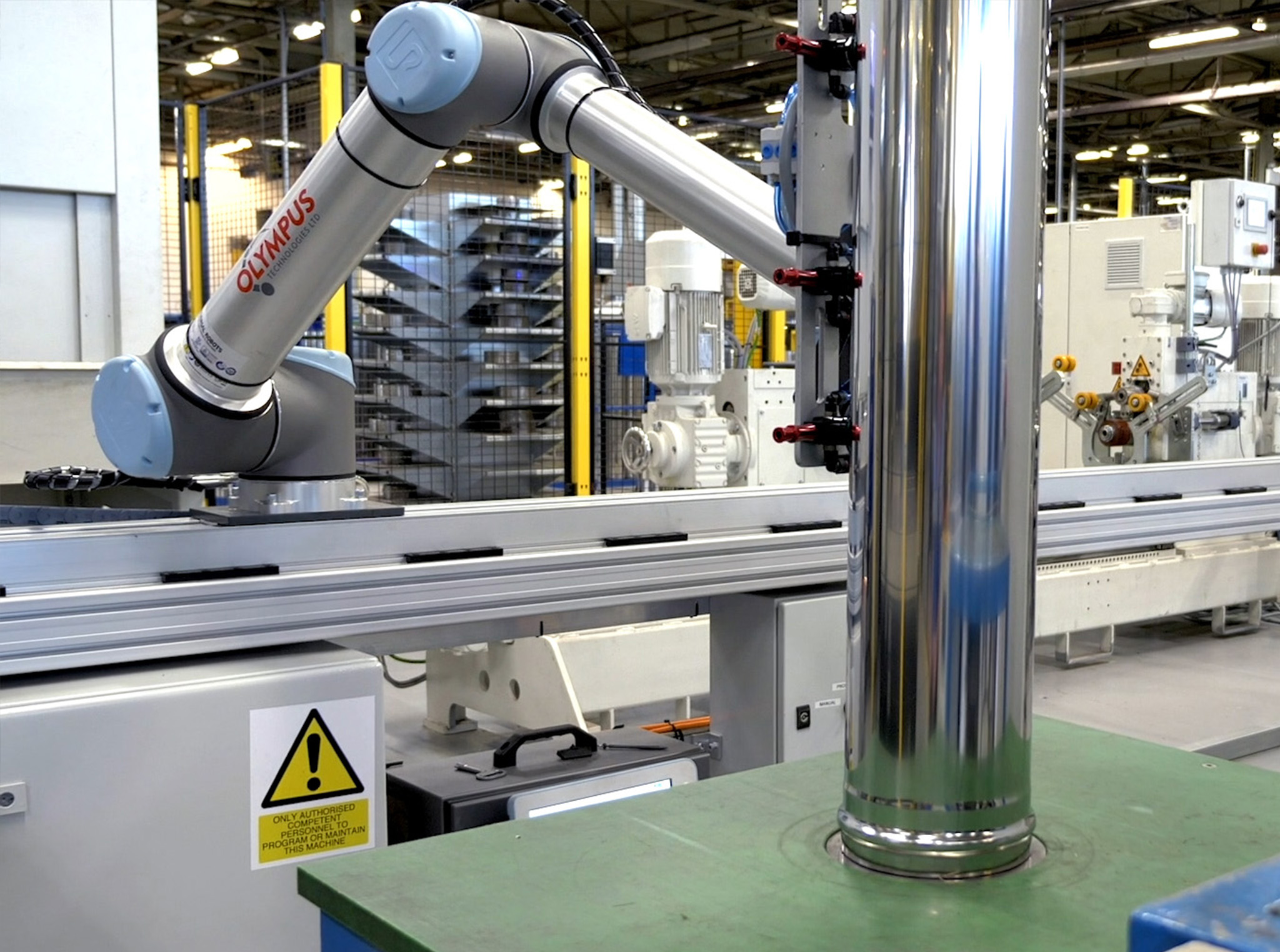














If you work with collaborative robots long enough, you will hear the same sentence more than once:
“We thought the robot supplier covered compliance.”
Unfortunately, under UK law, that assumption is one of the fastest ways to end up exposed during an inspection by the Health and Safety Executive.
At Olympus Technologies, we design and integrate cobot systems for real production environments. We see first-hand how often UKCA and CE marking responsibilities are misunderstood, even by experienced engineering teams. Collaborative robots may be sold as flexible and accessible, but once they are integrated into a cell, they are regulated as industrial robots under machinery safety legislation.
This article explains, in plain terms, who is legally responsible, when UKCA or CE marking is required, and what technical documentation must exist for a compliant cobot cell in the UK.
If something goes wrong, the safety executive will not ask who wrote the program.
They will ask who placed the machinery on the market and into service.
Why Cobot Compliance Causes So Much Confusion
Cobots sit in an awkward space between marketing and regulation.
They are sold as:
- Safe to work alongside human contact
- Easy to deploy
- Faster than traditional industrial robots
But in law, a cobot cell is still a robot system governed by:
- The Machinery Directive (and its UK equivalent)
- UKCA marking or CE marking
- Work Equipment Regulations (PUWER)
- Relevant EU legislation and UK regulations
Once a cobot is combined with electrical equipment, tooling, conveyors, scanners, vision systems, or guarding, it becomes machinery, not a component.
That shift is where most compliance failures begin.
Who Is the Legal “Manufacturer” of a Cobot Cell?
The most important concept to understand is that the manufacturer is defined by responsibility, not by who supplied the robot.
When the End User Becomes the Manufacturer
The end user becomes the legal manufacturer when they:
- Assemble or modify the cobot cell themselves
- Integrate additional equipment or automation
- Change the function, speed, or mode of operation
- Introduce new hazards through integration
At that point, the end user holds legal responsibility for:
- A detailed risk assessment
- Meeting all essential safety requirements
- Creating and retaining the technical file
- Issuing the Declaration of Conformity
- Applying UKCA marking or CE marking
This applies even if every individual component was already CE marked.
When the System Integrator Is the Manufacturer
If a cobot system integrator supplies a complete, installed cell and places it into service, the integrator is normally the manufacturer.
This must be explicit in contracts.
The integrator is then responsible for:
- Overall machinery safety
- Safety functions and risk reduction measures
- Compliance with industrial robot safety standards
- Validation against relevant safety standards
- Providing compliant technical documentation
OEMs and Robot Suppliers
Robot manufacturers certify the robot, not the cell.
Their responsibility stops at the robot flange unless they also act as the system integrator. This is true for collaborative robots and traditional industrial robots alike.
Substantial Modification: The Point Where Responsibility Changes
A “substantial modification” is where many cobot cells quietly fall out of compliance.
What Counts as a Substantial Modification
- Introducing new hazards
- Changing performance or operating mode
- Integrating conveyors, tooling, or additional robot systems
- Adding safety scanners, vision systems, or guarding
- Altering human-robot interaction zones
- Installing the cell into a live production line
Any of these can trigger the need for new UKCA or CE marking.
What Usually Does Not
- Like-for-like component replacement
- Minor layout adjustments
- Software changes within original design intent
The problem is not change itself. The problem is undocumented change.
UKCA vs CE Marking in the UK
Post-Brexit, machinery placed on the UK market falls under UK Conformity Assessed requirements.
Key points:
- UKCA marking applies in Great Britain
- CE marking may still be accepted in limited cases
- Northern Ireland follows EU requirements
- Integrated cobot cells are treated as machinery, not components
In practice, most UK cobot cells still require full machinery compliance under UK legislation.
What a Compliant Cobot Cell Documentation Pack Looks Like
Auditors, enforcement authorities, and market surveillance authorities expect evidence, not assumptions.
Risk Assessment
A compliant cell must have a risk assessment process aligned with ISO 12100, covering:
- Identifying hazards
- Evaluating risk
- Applying protective measures
- Verifying risk reduction
This is not the same as a task-based RA.
Technical File
The technical file must include:
- Mechanical and electrical drawings
- Safety function descriptions
- Performance calculations
- Validation records
- Reference to harmonised standards
- Evidence of conformity with essential requirements
Instructions and Manuals
Clear documentation for:
- Operators
- Maintenance staff
- Foreseeable misuse
- Safe start-up and shutdown
- Ongoing compliance
Declarations and Marking
A valid Declaration of Conformity must include:
- Manufacturer’s full business address
- Product’s serial number
- Applicable UK or EU regulation
- Referenced safety standards
- Signature of the responsible legal entity
Guarding, Scanners and Collaborative Operation
“Collaborative” does not mean unguarded.
Auditors expect:
- Justification for physical or virtual guarding
- Defined safety zones
- Validated safety functions
- Correct permissible force values
- Evidence of calibration, including calibrated force sensors
Systems such as Fanuc Dual Check Safety or equivalent must be documented, validated, and appropriate to the risk.
PUWER and UKCA: How They Work Together
PUWER covers employer duties under the Work Equipment Regulations.
UKCA and CE marking cover placing machinery on the market.
You need both.
The Health and Safety Executive enforces them together, not separately.
Common UKCA and CE Mistakes We See
- Assuming UR or robot certification covers the whole cell
- No clarity on who the manufacturer is
- No documented change control
- Treating compliance as paperwork, not design
- Mixing safety logic with standard control logic
- Ignoring energy related products regulations or RoHS regulations
- Overlooking potentially explosive atmospheres regulations
When Compliance Problems Point to a Design Issue
Over-complex safety architectures, unclear operating modes, or poorly defined human interaction zones often indicate a deeper system problem.
Good compliance is usually the result of good design, not the other way around.
Final Word from Olympus Technologies
UKCA and CE marking for cobot cells is not about box-ticking. It is about clear safety responsibilities, robust risk reduction, and traceable decisions that stand up under scrutiny.
Collaborative robots are powerful tools for UK manufacturers, but only when compliance is treated as part of the engineering process, not an afterthought.
If you are unsure who carries legal responsibility for your cobot cell, whether your technical documentation is complete, or whether your system would stand up to inspection by enforcement authorities, Olympus Technologies can help you review it properly before it becomes a problem.
Because fixing compliance after an incident is always more expensive than designing it in from the start.