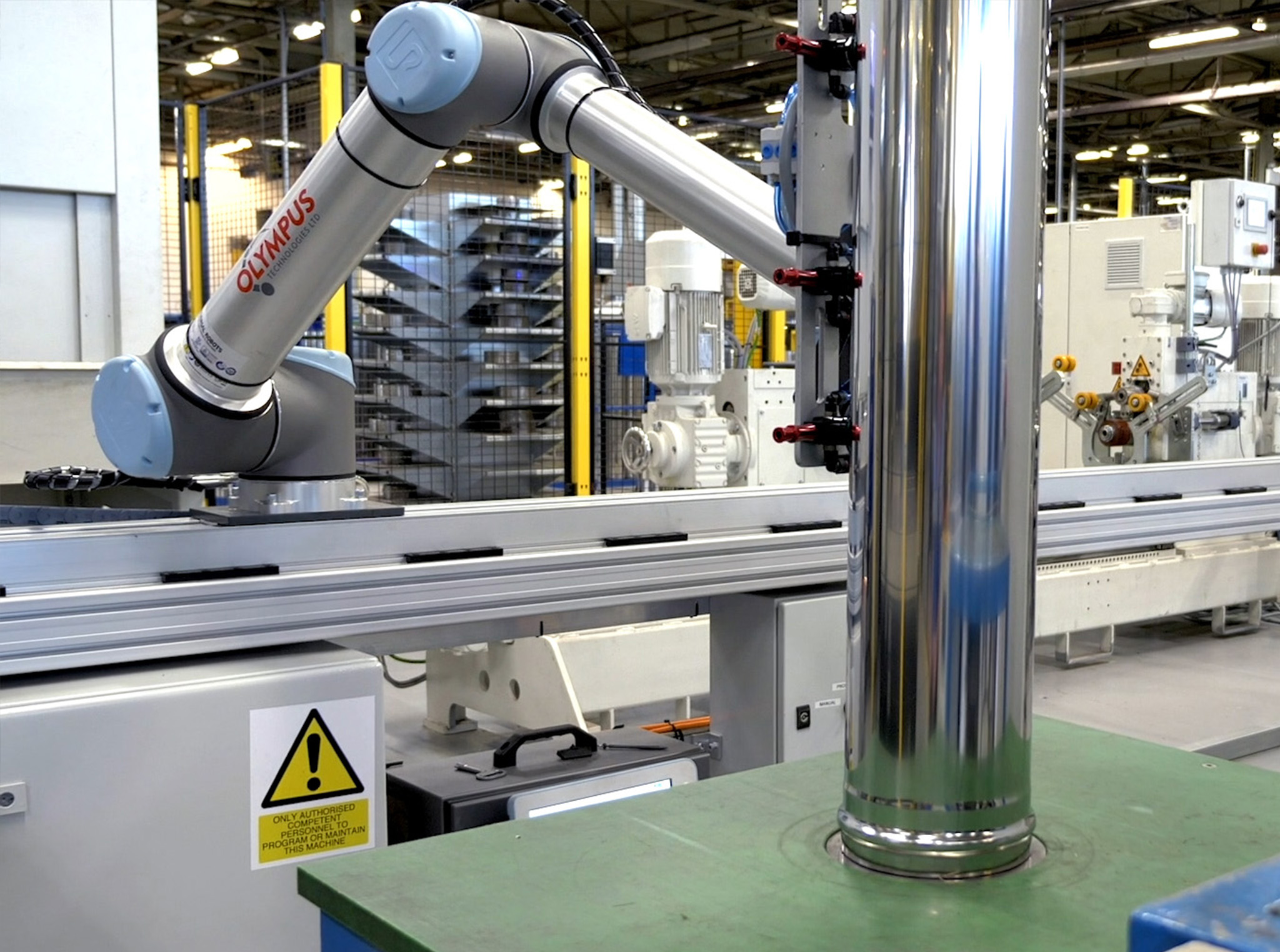













Add high speed, high precision laser welding into existing production lines without rebuilding your manufacturing processes, using proven robotic integration, safety enclosures, and validated commissioning.
Across automotive manufacturing, medical device manufacturing, aerospace applications, and heavy equipment production, manufacturers are increasingly retrofitting laser welding systems into existing operations. Unlike traditional welding methods, modern laser welding technology enables high quality welds with minimal distortion, minimal human intervention, and significantly improved production efficiency.
At Olympus Technologies, we retrofit robotic laser welding systems into live production environments. Our focus is seamless integration, minimal disruption, and consistent results that support production goals while protecting product quality and overall productivity.
When Retrofitting Laser Welding Makes Sense
Retrofitting laser welding into existing production lines is most effective when there is a clear operational constraint rather than a general desire to adopt new technology.
It typically makes sense when manufacturing companies need to:
- Increase productivity or reduce cycle times without adding shifts
- Improve weld quality where traditional welding methods introduce thermal distortion or spatter
- Produce tight tolerance parts such as surgical tools, medical devices, or aerospace components
- Address labour shortages or skill bottlenecks across welding tasks
- Improve traceability, real time monitoring, and process control
Laser welding delivers minimal distortion, high speed, and high precision, making it particularly well suited when traditional methods are limiting production efficiency.
Share your part geometry, material composition, and joint details and we will confirm feasibility.
What You Gain Beyond Faster Welding
Laser welding technology delivers benefits that extend far beyond speed alone.
Lower heat input minimises thermal distortion, reduces material waste, and improves dimensional stability. Consistent laser power and controlled laser parameters produce high quality welds with improved mechanical performance. The focused laser beam enables welding in hard to reach areas and supports intricate welds that are not feasible with traditional methods.
Modern laser welding systems also enable automated controls, real time monitoring, and data capture that support predictive maintenance, remote diagnostics, and continuous improvement.
| Benefit | What changes on the line | How you measure it |
|---|---|---|
| Minimal distortion | Smaller heat affected zone | Rework and straightening time |
| High quality welds | Stable laser parameters | Defect and scrap rate |
| Increased productivity | Faster cycle times | Parts per hour |
| Better QA | Real time monitoring | Audit findings |
| Reduced downtime | Predictive maintenance | Unplanned stops |
Retrofit Reality Check: Constraints You Must Plan For
Retrofitting laser welding requires a realistic assessment of constraints within existing production environments.
Part and Joint Suitability
Material composition, thickness, joint design, and surface condition directly affect laser welding performance. High strength steel, stainless steel, and many aluminium alloys are commonly suitable. Highly reflective materials or coated surfaces require careful control of laser power and beam delivery.
Laser welding excels where minimal distortion and high precision are critical, but not every weld joint is a candidate.
Line Constraints
Existing production lines impose fixed realities including footprint, infeed and outfeed logic, buffering capacity, changeovers, and takt driven cycle times. A successful retrofit respects these constraints and integrates the laser welding machine into existing production flow.
Utilities and Environment
Laser welding systems require stable power, adequate cooling systems, effective exhaust systems, and careful management of reflections. Environmental cleanliness and temperature stability influence weld quality and optimal performance, especially in extreme conditions.
Retrofit Options: Where the Laser Fits in Your Line
Laser welding can be integrated in several ways depending on volume, flexibility, and risk tolerance.
Standalone Laser Welding Cell
A standalone laser welding system is often used where parts can be buffered. This simplifies safety enclosures, reduces integration complexity, and supports test runs without impacting upstream processes.
Inline Robotic Laser Welding Station
Inline robotic laser welding integrates directly into conveyor driven production lines. This approach suits high volume production with stable parts and consistent takt times.
Cobot Assisted Laser Welding
Cobot assisted laser welding is well suited to high mix environments and SMEs, offering flexibility, minimal disruption, and faster redeployment.
| Retrofit approach | Best for | Integration effort | Throughput potential | Safety complexity |
|---|---|---|---|---|
| Standalone cell | Buffered processes | Medium | Medium | Medium |
| Inline robotic station | High volume production | High | High | High |
| Cobot assisted | Flexible lines | Low | Medium | Medium |
The Integration Blueprint: What Actually Needs Connecting
Successful laser welding retrofits depend on system level integration rather than standalone equipment.
Core System Components
A typical laser welding system includes the laser source, beam delivery optics, cooling systems, exhaust systems, and safety enclosures. These components must be sized correctly for duty cycle, laser power, and production speed.
Automation and Control Systems
Robotic arms provide precise motion control. Automated controls manage laser power, welding parameters, safety interlocks, and system states. PLC and HMI integration ensures the laser welding machine operates as part of existing production, not as an isolated asset.
Sensors and Monitoring
Real time monitoring may include seam tracking, height sensing, and process monitoring depending on application. These systems support consistent weld quality and remote diagnostics.
Data and Traceability
Laser welding systems can log weld parameters, reject events, and process data per part or batch. This supports quality audits, root cause analysis, and compliance requirements.
Commissioning and Validation: How We Prove It Works
Validation is essential when introducing laser welding technology into existing operations.
Trials and Parameter Development
Test runs are used to define laser parameters, confirm weld quality, and align results with acceptance criteria before production impact.
FAT and SAT
Factory and site acceptance testing verify cycle times, repeatability, safety interlocks, and automated controls under real operating conditions.
Quality Control Strategy
Inline verification is combined with offline inspection as required. Recipes are locked, change control is enforced, and documentation supports consistent results.
| Validation step | What it proves | Output |
|---|---|---|
| Trials | Weld quality | Sample reports |
| FAT | Performance | Test records |
| SAT | Integration | Acceptance sign off |
| Ongoing QC | Stability | Audit logs |
Safety for Laser Retrofits
Laser Safety Fundamentals
Laser welding requires comprehensive safety enclosures, safety interlocks, controlled viewing windows, and exhaust systems to manage fumes and reflections.
Operational Safety
Clear SOPs, operator training, maintenance lockout procedures, and emergency response planning are essential to safe operation.
| Safety control | Why it matters | Owner | Verification |
|---|---|---|---|
| Safety enclosure | Contain laser energy | Engineering | Inspection |
| Safety interlocks | Prevent exposure | Controls | Functional test |
| Extraction | Remove fumes | EHS | Air monitoring |
Keeping Uptime High
Preventive and Predictive Maintenance
Routine cleaning, optics inspection, calibration, and cooling checks support optimal performance. Predictive maintenance reduces unexpected failures and helps reduce downtime.
Spares and Support
Critical spare parts, defined escalation paths, and a responsive support team protect production continuity. Remote diagnostics enable faster resolution of issues.
Training
Operators and technicians are trained on start up, stop, recovery, and safe intervention, supporting consistent results and increased productivity.
Cost and ROI of Retrofitting Laser Welding
What Drives Total Cost
Key cost drivers include laser source capability, required speed and penetration, safety enclosures, sensors, integration depth, fixturing changes, and validation effort.
Where ROI Usually Comes From
ROI is driven by reduced rework and scrap, increased throughput, reduced downstream finishing, and fewer disruptions caused by manual variability.
| ROI input | How to measure | Baseline source | Notes |
|---|---|---|---|
| Scrap | Defect rate | Quality data | Before and after |
| Throughput | Cycle times | Production data | Stable demand |
| Downtime | Stops | OEE reports | Root causes |
Industries and Typical Applications
Laser welding retrofits are commonly deployed across various industries including:
- Automotive manufacturing for brackets, housings, and sub assemblies
- Medical device manufacturing for high precision surgical tools
- Aerospace applications where minimal distortion is critical
- Heavy equipment and metal fabrication for heavy duty components
Frequently Asked Questions
Can laser welding be added with minimal downtime?
Yes, phased integration and pre validation reduce disruption.
Do we need full safety enclosures?
In most cases, yes, depending on laser class and layout.
What materials are suitable?
Carbon steel, stainless steel, aluminium alloys, and high strength steel are common.
How are joint gaps handled?
Through fixturing, laser parameter optimisation, and monitoring.
What maintenance is required?
Routine optics, cooling, and system checks.
Next Step: Book a Retrofit Assessment
A retrofit assessment begins with understanding your exact needs, including material composition, production goals, target cycle times, and available footprint.
Typical inputs include part drawings, materials, thickness, and constraints from existing production.
Get in contact with Olympus Technologies today to book a retrofit assessment or request a budgetary proposal.