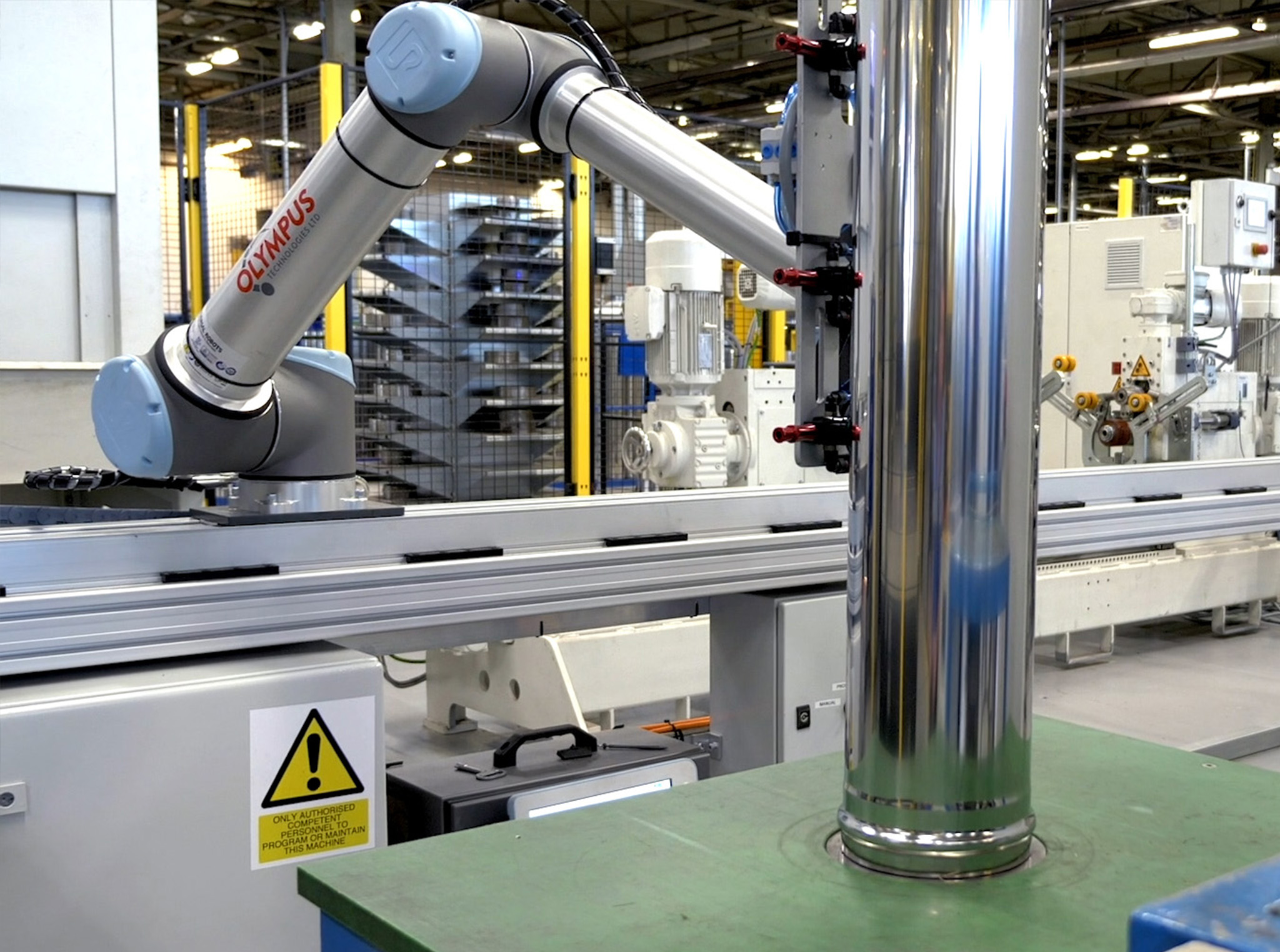













UR machine tending on rails means a Universal Robots cobot mounted on a linear rail, tending several machines with automatic doors and part buffers.
The cobot travels between machines, handles loading and unloading, and keeps production moving while operators focus on higher value tasks.
You gain increased productivity, smoother output, and better quality without rebuilding your whole production system. You add a flexible automated machine tending layer around your existing CNC machines, presses, or moulding cells.
At Olympus Technologies in the UK, we design UR-based cobot machine tending cells that combine rails, door automation, and buffering. The goal is simple. Use modern automation technology to automate repetitive tasks, boost safety, and allow skilled workers to use their expertise where it matters most.
What is UR Machine Tending on a Linear Track
The Basic Concept
UR machine tending on rails is a specific type of cobot machine tending.
You have:
- A UR collaborative robot mounted on a linear rail.
- One or more CNC machines or automated machine tools in a line or U shape.
- Automatic doors on each machine so the robot does not force a manual door.
- Buffers tables, racks, or conveyors that hold raw and finished parts.
The cobot moves along the rail, opens each door, completes the machine tending tasks, and returns parts to buffers. This integrated setup acts as one configured system that can increase production across a wide range of parts and materials.
When This Setup Makes Sense
It is a good fit when:
- You want to automate several machines with one UR cobot.
- Floor space is tight and you need clear access for people and trucks.
- Your product range changes but fixtures remain stable.
If you already use or are considering cobot machine tending, a rail-based system is often the next step once a single-machine cell has proven its value.
Why Rails, Doors, and Buffers Matter
Three Building Blocks
Rails, automatic doors, and buffering are the three essential building blocks in this picture.
- The rail gives the cobot physical access to several machines and new tasks.
- Automatic doors remove manual opening and closing, so cycles stay consistent.
- Buffers hold work in progress and keep machines fed even when people step away.
Together, they are about boosting efficiency, not replacing people. Operators still handle set up, tools, quality checks, and problem solving. The UR cobot and rail take over the repetitive tasks that slow everything down.
A Simple Analogy
If you want a clear mental picture, think about garage door openers and automatic doors in offices. Sensors, control components, and simple logic automate the door opening and closing. You still decide when to go through.
UR machine tending on rails uses the same idea for machines and parts. The result is a more automated machine that still fits your existing facilities and business processes.
Core Components of a UR Rail Track
Collaborative Robot and Track
A UR rail cell for automated machine tending combines several components into a single integrated solution.
- A UR collaborative robot mounted on a linear axis.
- The rail configured to cover all loading and unloading points on the line.
For heavy loads or long reaches, the rail and support structure must match the equipment weight and the expected life of the system.
Automatic Doors
Door automation is critical.
Automatic doors or custom actuators turn manual doors into automation friendly doors. The cobot sends a control signal to open or close each door. This:
- Protects door components and seals.
- Improves safety with clear interlocks and sensors.
- Keeps cycle times repeatable and stable.
The concept is familiar from garage door openers. A robust actuator moves the door, sensors watch the opening, and simple logic protects people. We apply the same idea to CNC machines and other production equipment.
Buffers and Part Storage
Buffering keeps machines working while people move.
Common buffer types:
- Static trays for small parts and light materials.
- Drawer racks for a wide range of part sizes.
- Short conveyors for flowing parts between stations.
Good buffering helps you:
- Smooth out short interruptions in supply or staffing.
- Keep machines cutting while people perform checks or collect tools.
- Achieve increased productivity without extra space.
Control Components and Sensors
Everything is held together by the control layer.
- Control components handle I/O, fieldbus, and safety logic.
- Intelligent sensors confirm part present, door state, clamp status, and ready to start conditions.
- Monitoring functions log cycle times, part counts, and faults for later review.
Good integration and clear functions are what make the automation process stable.
UR Control and URCaps
The UR controller runs paths and tasks.
- URCaps or custom tools keep programmes user friendly.
- Operators can adjust simple parameters without rewriting everything.
Olympus can design integration so that all compatible machines, sensors, and safety devices talk cleanly to the UR controller.
Safety System
Safety is built in, not added at the end.
- Light curtains, laser scanners, and interlocks define safe areas.
- Safe speeds, stopping times, and distances are validated and recorded.
As a UK integrator, Olympus makes sure the cell lines up with relevant standards, your internal rules, and your customers’ expectations.
Door Automation: Turning CNCs Into Automation-Friendly Machines
Why Door Automation First
Door automation is where many UR rail projects start. Without it, a robot must physically pull or push a door, which is hard on hinges and seals and can hurt long term quality.
With automated doors you gain:
- Controlled opening and closing through the machine or PLC.
- Clear feedback on door state for safety and logic.
- Shorter, more repeatable cycles with less wear.
Benefits in Daily Operation
Door automation brings:
- Less cost from door and hinge failures.
- Safer access and clearer safety functions.
- Better precision in timing and overall efficiency.
Olympus can design, supply, and install door automation kits as part of a complete UR machine tending cell, including mechanical work, control integration, and full documentation.
Buffering: Keeping Machines Fed While People Move
Why Buffers Matter
Without buffers, machines stop as soon as the operator steps away. With buffers, the UR cobot on rails can:
- Load from a raw part buffer.
- Unload to a finished part buffer.
- Run several machines in rotation.
This creates a simple, robust system that is less sensitive to short interruptions and keeps your production closer to its full potential.
Types of Buffers
You can choose buffers to fit your product range:
- Static trays where parts sit in simple nests.
- Drawer systems where the cobot accesses layers of work.
- Short conveyors linking machines and inspection stations.
Olympus will help you choose buffer hardware that matches your parts, surfaces, and cleanliness requirements. For some industries, stainless trays are enough. For others, you may need lined or coated racks to protect more delicate components.
Typical UR Track Layouts
Common Layout Styles
A UR machine tending rail can sit in different positions depending on your facilities and machines.
Typical layouts:
- Straight line: UR rail runs parallel to machines with buffers in front.
- U-shape: Cobot moves around a central buffer island and reaches multiple doors.
- T-shape: Rail runs past machines and branches into a central inspection or secondary operation area.
Choosing a Layout
The aim is to balance:
- Access for operators and forklifts.
- Safety zones and walkways.
- Overall cost and complexity.
Olympus can create a simple layout picture during early development so you can see how the system fits within your existing area and plan the installation.
Integration With UR and Existing Controls
Control and Communication
UR machines are known for ease of use. With a rail, doors, and buffers, integration becomes more complex, but the principles stay clear.
Key integration steps:
- Link each machine control to the UR controller through I/O or fieldbus.
- Map signals for door open, door closed, cycle start, in cycle, part present, and fault.
- Use URCaps or simple UR scripts so machine tending logic stays readable.
Monitoring and Data
Good visibility is essential.
- Monitoring functions capture cycle time, stops, and output.
- Data can feed into existing systems such as OEE dashboards or MES.
Olympus focuses on integration that your team can own after handover. We provide training so operators and engineers can adjust tasks, add new tasks, and handle developing requirements without starting from scratch each time.
For more on our tending work with UR, see our machine tending page.
Safety, Quality, and Precision
Safety
Safety, quality, and precision are essential in any UR rail cell. Start with safety.
- Use scanners and interlocks to protect walkways and shared spaces.
- Validate stopping times and protective distances.
- Keep sightlines clear so people can see what the cell is doing.
We always treat safety design as an essential part of the project, not an add on.
Quality and Precision
Quality and precision come from repeatability and feedback.
- Use sensors to confirm part presence and clamp status before cycles start.
- Build routines to handle misloads, faults, or missing parts.
- Keep fixtures and buffers simple and repeatable so quality stays high.
We design cells so quality checks and safety functions sit inside the standard workflow. That makes it easier for your company to maintain standards over the full life of the equipment, and to show customers that the automation supports robust processes.
KPIs, Cost, and Rapid ROI
What to Measure
Every business case needs clear numbers. Common KPIs for UR machine tending on rails include:
- Parts per hour across all machines on the rail.
- Spindle utilisation or overall machine utilisation.
- Scrap and rework from loading and unloading issues.
- Manual tending hours per shift.
Cost Elements
Main cost buckets:
- Rail, robot, and mechanical equipment.
- Door automation kits and control components.
- Sensors, safety devices, and integration work.
- Installation, commissioning, documentation, and training.
ROI Levers
Key levers for rapid ROI:
- Labour hours saved through automated machine tending.
- Scrap avoided through more consistent loading and unloading.
- Extra shifts or extended hours without extra headcount.
- Better delivery performance and fewer issues with customers.
UR rail cells often show strong ROI when they tend several machines or run high value parts. If you share some headline numbers with Olympus Technologies, we can build a simple ROI outline to support your internal decision making.
KPI Mini Table
Use this as a starter template.
| Metric | Baseline | Target | Owner | Review |
|---|---|---|---|---|
| Parts per hour (all cells) | Current value | Target value | Cell lead | Weekly |
| Spindle utilisation | Current value | Higher value | Engineering | Weekly |
| Loading scrap | Current value | Lower value | Quality | Monthly |
| Manual tending hours | Current value | Lower value | Production | Monthly |
Start simple. Refine the metrics as the cell matures and your monitoring improves.
Olympus Technologies Services That Link In
Connected Applications
A UR rail tending cell often sits inside a wider automation landscape. Olympus can support related functions so the whole flow is covered.
- Downstream case packing with label checks and orientation via our case packing solutions.
- Pallet build and break at the end of the line with our palletising systems.
- Adhesive and sealant application using our dispensing solutions.
- Structural and spot welding with our robotic welding cells.
- Precision joints and fine seams with laser welding.
- Forming and bending support through press brake tending.
This product range means we can develop a coherent automation pathway rather than isolated projects. You can start with one UR rail cell and expand as your success builds.
Quick Spec Checklist for UR Rails, Doors, and Buffers
Copy and paste this into your brief. Add notes for each item.
- Machines and tasks: number and type of machines, loading and unloading steps.
- Parts: sizes, weights, materials, required precision, and any sensitive finishes.
- Buffers: preferred style trays, racks, or conveyors and required capacity.
- Doors: current door type, opening direction, space for automation hardware.
- Rail: approximate length, key access routes, space for safety zones.
- Controls: current CNC or machine control types, existing fieldbus, data needs.
- Facilities: floor condition, access for installation, power and air supply.
- People: operators, setters, maintenance team, and training needs.
You can send this checklist to Olympus Technologies, even in draft form. We can respond with a focused concept, a realistic cost range, and a clear development path.
Plan Your UR Machine Tending Rail Project
Simple Next Steps
To move from idea to action, you only need a few steps.
- Pick one or two machines that would benefit from automated machine tending.
- Gather basic data on cycle times, current output, and staffing.
- Share that data and a few photos with Olympus Technologies.
We will help you:
- Choose the right UR cobot and rail configuration.
- Specify door automation, buffers, and control components.
- Plan installation, training, and long term service support.
If you are a production manager under pressure to increase production without adding complexity, you want a solution that is clear, safe, and proven.
UR machine tending on rails, with door automation and buffering from Olympus Technologies, gives you that combination. It is a straightforward way to automate repetitive work, protect safety, control cost, and unlock the full potential of your existing equipment, facilities, and people.