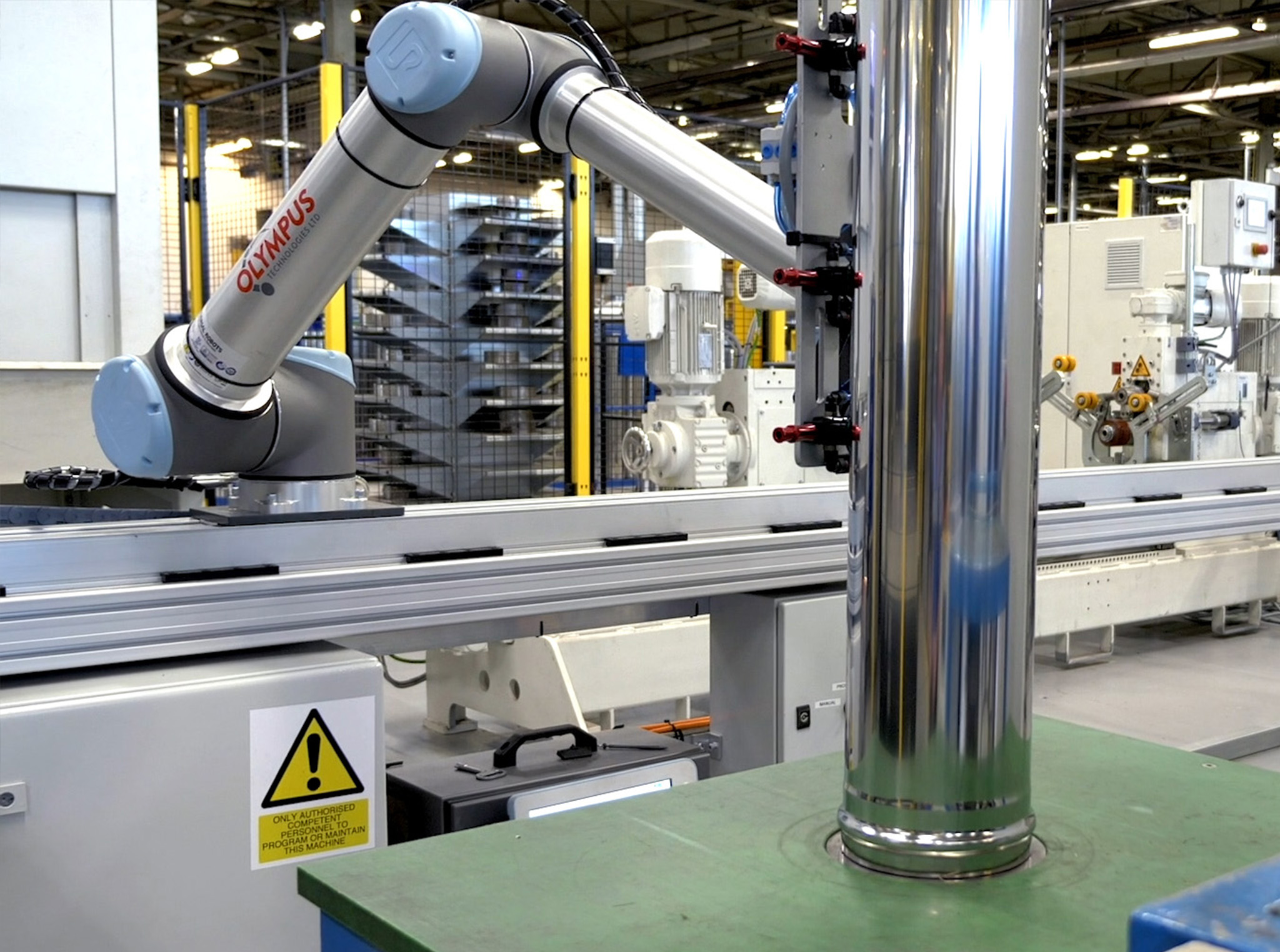













At Olympus Technologies, we design and deliver cobot depalletising systems for manufacturers, logistics operators, warehouses, and distribution centres that need to unstack cases reliably without disrupting the wider production line.
When people search for cobot depalletising how to unstack cases, they are usually trying to solve a real operational problem. Manual depalletising is labour-intensive, inconsistent, and increasingly difficult to staff. At the same time, poorly engineered robotic depalletising systems can introduce downtime, safety risks, and hidden costs if they are not designed for real pallet variability.
Depalletising is rarely a standalone task. It sits at the front of a production line, feeding processes such as machine tending, case packing, palletising, welding, dispensing, or inspection. That is why we treat depalletising as part of a complete automation solution, not just a robotic arm lifting boxes from pallets.
Depalletising vs Palletising: Why the Challenges Are Different
Although depalletising and palletising are closely related, the technical challenges are not symmetrical.
Palletising creates order. Depalletising must cope with disorder caused by transport, storage, and handling.
Load Integrity and Pallet Consistency
Load integrity is one of the most important factors in successful depalletising automation. Understanding the consistency of inbound pallets is essential, because uniform stacking patterns simplify the automation process and improve reliability.
In practice, pallets often arrive with:
- Shifted layers
- Compressed boxes or bags
- Inconsistent pallet layouts
- Variations between single SKU and high mix loads
These variations directly affect the performance of depalletising systems. A system designed for ideal pallets will struggle in real operations.
Vision Systems and Adaptive Pick and Place
Modern robotic depalletising systems rely on vision to function reliably.
A 3D vision system is vital for depalletising, as it identifies the position and orientation of each case on the pallet, compensating for variations caused by shifting during transit. Cobot systems leverage vision systems to dynamically identify the positions and orientations of cases rather than assuming fixed coordinates.
AI-powered vision systems in cobots calculate precise pick-up points even when items have shifted, ensuring accurate object handling and placement. This enables adaptive pick-and-place, where the robot adjusts its movements based on real-time visual data and handles one case at a time when required.
This approach differs fundamentally from rigid, pre-programmed paths and is essential in high mix environments common in e commerce, warehousing, and distribution.
End-of-Arm Tooling and Handling Capability
The End-of-Arm Tooling (EOAT) determines what a depalletising system is capable of handling reliably.
Different types of grippers are used depending on case characteristics:
- Vacuum grippers for rigid boxes and cartons
- Mechanical clamps for deformable packages
- Multi-zone grippers for mixed sizes and weights
- Hybrid EOAT for bags, unstable loads, or layered products
The right end-of-arm tooling is critical for securely handling variations in case size, shape, weight, and material during depalletising operations. Tooling must also consider payload capacity, as the weight of items must not exceed the cobot arm’s capacity.
Proper EOAT selection ensures accuracy, reduces dropped cases, and maintains throughput across different configurations.
Handling Different Products and Configurations
Robotic depalletising solutions can be engineered to handle packages of all sizes and weights, adapting to different pallet configurations, box orientations, and product types.
This includes:
- Boxes and cartons
- Bags and sacks
- Mixed-SKU pallets
- Single SKU pallet layouts
Automated depalletising systems enable seamless handling of mixed-SKU loads, reducing manual intervention and improving operational logistics across industries.
Throughput, Speed, and Productivity Reality
In depalletising automation, robot speed is rarely the limiting factor.
Real throughput constraints typically come from:
- Slip sheets and layer handling
- Conveyor accumulation and downstream control
- Product detection and confirmation
- Line integration and handoff
Well-engineered robotic depalletising systems can achieve high throughput rates, significantly increasing efficiency in logistics operations while maintaining accuracy and reliability. However, throughput targets must be realistic and aligned with downstream equipment capabilities.
Safety, Risk Assessment, and Compliance
Safety is a fundamental part of every depalletising project.
The cobot arm includes inherent safety features such as power and force limiting and collision detection, allowing it to work alongside humans without extensive safety guarding when correctly applied.
However, implementing a thorough risk assessment before deployment is essential. This helps identify hazards such as pinch points, collision risks, and manual intervention zones.
Compliance with ISO 10218 and ISO/TS 15066 is essential for safe human-robot interaction in depalletising. Emergency stop buttons must be accessible and positioned prominently within the robotic cell.
Designing an optimal workspace layout ensures sufficient room for operation and can reduce the need for large protective barriers while maintaining safety.
Programming, Error Recovery, and Control
Modern cobot depalletising systems are designed for production teams, not robotics specialists.
Using user-friendly programming interfaces, operators with minimal expertise can adjust movement patterns, pallet layouts, and configurations without extensive programming knowledge.
Cobot systems include error recovery loops that detect improper case pickup, allow retries, or alert operators when manual intervention is required. This reduces downtime and improves system reliability.
Training and Operational Readiness
The implementation of cobots in depalletising operations requires comprehensive employee training before deployment.
Training typically covers:
- Cobot operation and safety protocols
- Vision system behaviour
- Troubleshooting and recovery procedures
- Safe restart and fault handling
Training ensures production teams can operate the system confidently and maintain efficiency without unnecessary stoppages.
Designing for Downstream Operations
The depalletising process must be designed with downstream operations in mind.
Cases must be placed in the correct orientation and sequence to feed the next stage of the line, whether that is packaging, inspection, machine tending, or assembly. This system-level approach ensures seamless integration and prevents bottlenecks further down the production line.
Where Cobot Depalletising Fits Best
Collaborative robots are particularly well suited to depalletising tasks where:
- Flexibility and adaptability are required
- Space is limited
- High mix production is common
- Payloads fall within cobot capacity
Cobot palletising and depalletising systems also offer a small footprint, allowing them to fit into tight production spaces while maintaining versatility.
Industry Context and Proven Capability
Across the wider automation industry, large-scale depalletising systems have demonstrated what is achievable. For example, some industrial depalletisers are capable of handling packages from a few hundred grams up to several tens of kilograms at high throughput rates in logistics and e commerce distribution centres.
These benchmarks show what is possible when depalletising systems are engineered correctly, with appropriate vision, tooling, control, and safety.
Our Approach at Olympus Technologies
At Olympus Technologies, we engineer robotic depalletising systems as part of a wider automation project, not as isolated equipment.
Our focus is on:
- Reliability over headline speed
- Adaptability to real pallet variability
- Safe operation alongside people
- Seamless integration into existing operations
Depalletising is an investment. Done properly, it improves productivity, reduces labour costs, improves safety, and creates a more efficient production and logistics operation.
If you are exploring cobot depalletising and want a practical, experience-led assessment of what will work in your environment, our team can support you from initial concept through design, implementation, and long-term support.
Frequently Asked Questions
How does cobot depalletising fit into a wider palletising solution?
Cobot depalletising is most effective when it forms part of a wider palletising solution, rather than being treated as a standalone task. In real operations, depalletising feeds downstream processes such as case packing, machine tending, or palletising for outbound distribution. At Olympus Technologies, we design depalletising as a complete solution, ensuring it seamlessly integrates with existing production lines, conveyors, and palletising equipment. This approach is particularly valuable in distribution centers, where handling multiple cases efficiently and consistently has a direct impact on throughput, labour costs, and overall logistics performance.
What software and sensors are used in robotic depalletising systems?
Modern robotic depalletising systems rely on specialist software and advanced sensors to operate reliably in real-world conditions. These systems are developed to detect case position, orientation, and height using 3D vision and AI-powered processing. The software manages pick logic, error recovery, and communication with upstream and downstream equipment, while sensors provide continuous feedback for accuracy and safety. This combination allows depalletising systems to handle a wide range of pallet layouts and product types, even when loads have shifted during transport.
Are cobot depalletising systems suitable for different businesses and applications?
Yes. Cobot depalletising systems are designed to be highly adaptable and can be equipped for use across many industries, including manufacturing, warehousing, logistics, and e commerce. They are suitable for businesses that need flexibility, whether handling single SKU pallets or high-mix loads. Systems can be configured specifically for different case sizes, weights, and materials, and integrated into existing operations with minimal disruption. When properly engineered and supported with the right training and management approach, cobot depalletising delivers reliable productivity gains across a broad range of applications.