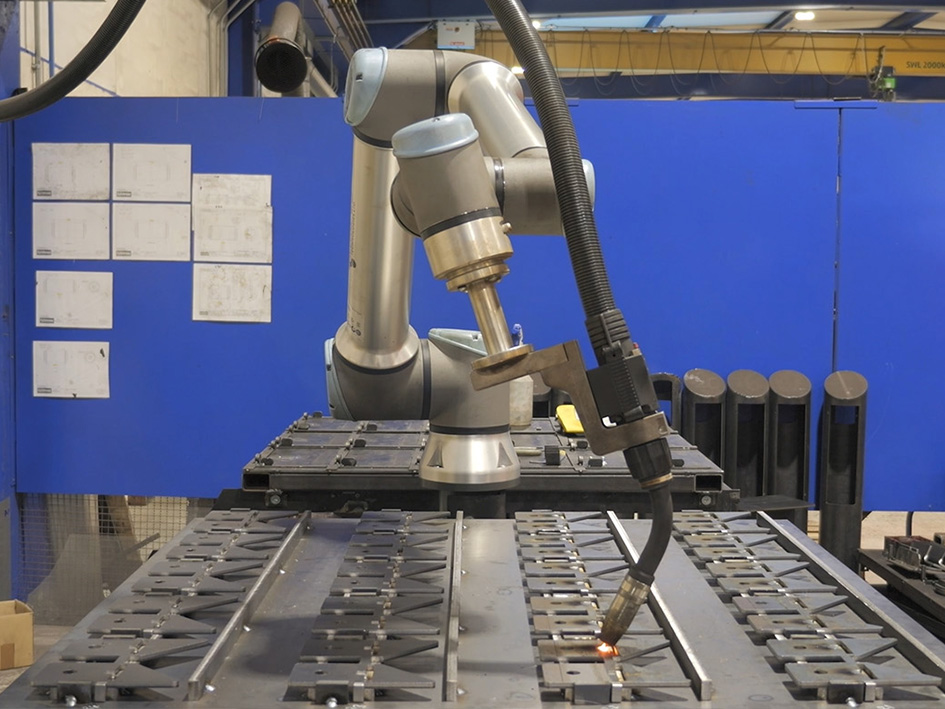













Inconsistent welds are one of the most common frustrations we see on the shop floor. When a robotic welding system produces good welds one day and poor welds the next, the issue is rarely the robot, the welding wire, or the program.
It is almost always the fixture.
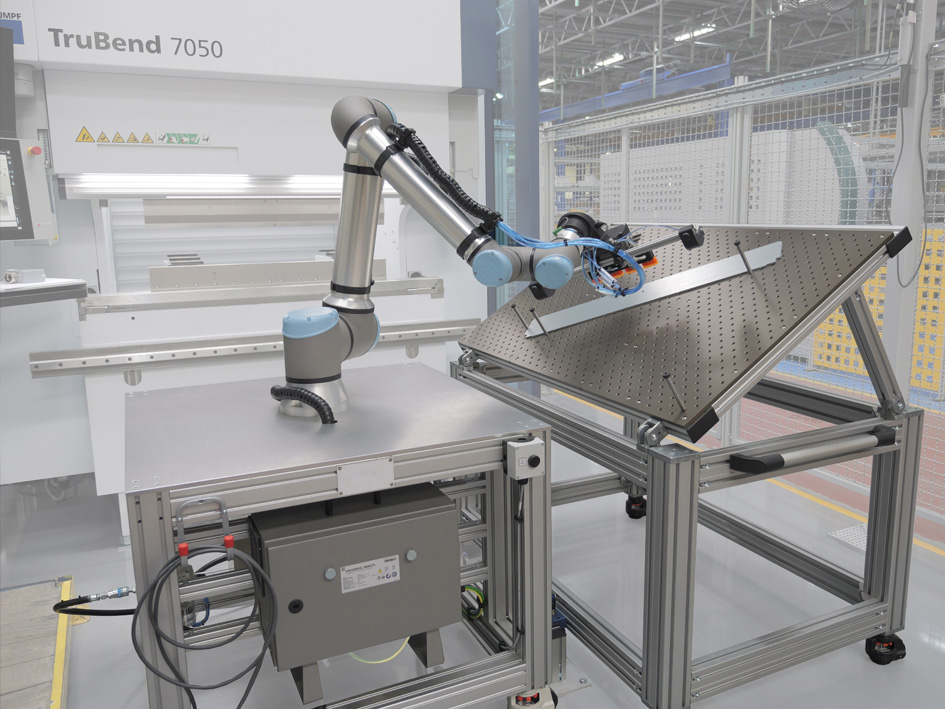
At Olympus Technologies, we design robotic welding fixtures as part of complete automation projects. Whether it is a cobot welding system or a larger robotic cell, fixture design is the foundation of weld quality, cycle time, and long-term reliability.
This guide sets out cobot welding fixture design: 9 rules for repeatable weld quality, based on real manufacturing environments, not idealised demos.
Why Fixture Design Controls Weld Quality
A robot will repeat a weld path accurately. What it cannot do is correct poor part location.
If the weld joint moves even slightly from cycle to cycle, the arc follows the program, not the part. That is how you lose dimensional accuracy, penetration, and appearance on a welded assembly.
Programming tweaks can fine tune motion. Fixtures determine whether the weld is consistent in the first place.
Rule 1 - Design for Part Variation, Not Nominal CAD
Real components are never perfect.
Whether parts come from machining, laser cutting, or fabrication, they arrive with tolerances and variation. Designing robotic welding fixtures around nominal CAD values is a guaranteed failure.
As a rule of thumb, position tolerance at the weld joint must repeat within half the diameter of the welding wire. If it does not, the arc will wander, especially on aluminum and thin steel.
This applies to every robotic welding project, from low volume prototypes to high mix production.
Rule 2 - Use a Proper Datum Strategy
Good fixture design starts with clear datums.
- Primary datums define location
- Secondary datums control orientation
- Tertiary datums prevent rotation
The goal is to locate the workpiece, not to fight it.
Over-constraining parts creates stress, which turns into distortion once heat is applied. Fixtures should allow controlled movement where necessary, especially during welding processes involving high heat input.
Rule 3 - Clamp for Location First, Force Second
Clamping is about control, not brute strength.
Too much force deforms parts. Too little allows movement. The right approach is:
- Locate accurately
- Apply only enough clamp force to hold position
- Sequence clamps so parts settle naturally
Heavy duty clamps are not always better. In many cases, simpler clamps give better repeatability and shorter setup time.
Rule 4 - Design Torch Access Before You Design the Fixture
Fixtures that block access are a common and costly mistake.
Torch geometry, cable routing, and approach angles must be considered early. A weld that “fits in CAD” often collides in reality.
Always design for:
- Torch width and stick-out
- Clearance on the left side and right side of the joint
- Variations in part orientation
Poor access increases cycle time, risks crashes, and compromises operator safety.
Rule 5 - Control Thermal Expansion and Heat Flow
Heat moves parts.
Fixtures must support parts while allowing controlled thermal expansion. Locking everything rigidly increases distortion, especially in aluminum assemblies.
Fixture materials also matter. Steel, aluminum, and composite fixtures behave differently under heat. The wrong material choice reduces accuracy over time.
Rule 6 - Lock the Joint With a Consistent Tack Strategy
Tacks are part of the fixturing system.
Random tack placement causes inconsistent geometry. Tacks should:
- Hold the joint in position
- Match the weld sequence
- Be consistent in size and location
This is critical for maintaining geometry in multi-pass or multi-direction welds.
Rule 7 - Design for High Mix Without Sacrificing Accuracy
High mix production demands flexibility, but not at the expense of quality.
Modular fixturing can reduce setup time and support faster changeovers, but excessive adjustability introduces human error.
Good fixtures balance:
- Speed of changeover
- Structural rigidity
- Repeatable location
That balance directly affects cycle time, quality, and overall efficiency.
Rule 8 - Measure Fixture Performance, Not Just Weld Appearance
A fixture is successful when it improves operations.
Key metrics include:
- First-pass yield
- Rework time
- Operator intervention
- Spatter cleanup effort
These metrics directly impact increased profitability, especially in automated welding cells.
Rule 9 - Design Fixtures to Be Maintained and Blamed
Fixtures will be blamed. Design accordingly.
Include:
- Wear surfaces
- Replaceable components
- Clear documentation of datum intent
This prevents well-meaning adjustments from destroying accuracy and repeatability.
What to Specify When Designing Robotic Welding Fixtures
When planning a project, always define:
- Material type (steel, aluminum, mixed)
- Part shape, width, and diameter
- Acceptable offsets and tolerances
- Required access for the robot and torch
- Target setup time and cycle time
- Safety requirements for human operators
This ensures the fixture supports the robotic welding system, not limits it.
When Fixture Problems Signal a Bigger Issue
Sometimes fixture design is not enough.
If upstream processes produce inconsistent parts, or if the joint location varies excessively, the real problem may be:
- Poor part design for automation
- Excessive variation in machining or fabrication
- The need for repositioners or additional axes
In those cases, the fixture is not the root cause.
Olympus Technologies: Fixture Design as Part of the Whole System
At Olympus Technologies, we do not treat fixtures as standalone tooling. They are part of a complete automation system that includes the robot, safety, process control, and installation.
Whether the project involves cobot welding, robotic welding, or integration into a wider manufacturing line, fixture design is where quality is either created or lost.
Good fixtures reduce cost, improve quality, protect operators, and make automation an advantage instead of a frustration.
Final Thought
Robots repeat. Fixtures decide what they repeat.
If you want consistent weld quality, predictable cycle times, and reliable automation, invest in fixture design first. Everything else depends on it.