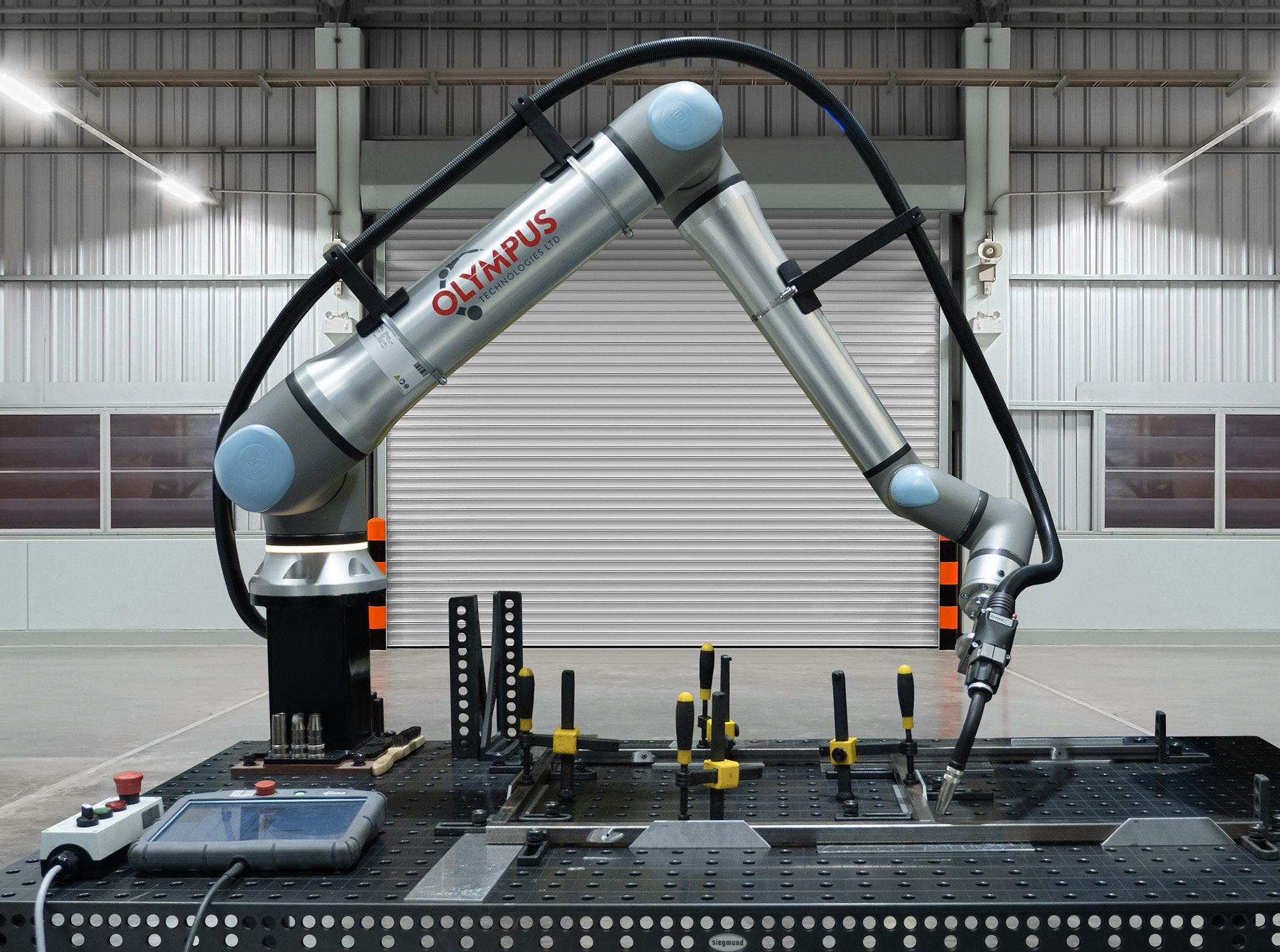















Collaborative robots are often sold as low-maintenance, almost plug-and-play automation. In reality, most unplanned downtime on cobot systems has very little to do with the robot arm itself.
At Olympus Technologies, we are usually called in after handover, when production teams inherit a cobot cell that is technically sound but operationally fragile. The robot is fine. The cell is not.
This guide breaks down preventive maintenance for cobot cells the way it works in practice. No vendor fluff. No unrealistic “maintenance-free” claims. Just the checks that actually reduce equipment downtime, avoid costly repairs, and keep collaborative robots running safely and consistently.
If your cobot stops, it is rarely the arm.
It is usually air, cables, sensors, or something bolted to it.
Maintenance Is Not Just the Robot Arm
A cobot cell is a system, not a single device. Effective industrial robot maintenance means maintaining every layer that supports the robot’s operation.
The Cobot Arm
The robot arm itself is generally reliable if properly maintained. Routine checks focus on:
- Joint health and brake behaviour
- Cooling fans and internal temperature
- Software updates and fault history
- Collision detection and force torque sensors
True arm failures are rare compared to peripheral faults.
End Effectors and Tooling
Most equipment failures start here:
- Worn gripper fingers or vacuum cups
- Seal degradation causing pressure loss
- Loose mounting hardware causing position deviation
- EOAT sensors drifting out of tolerance
This is where preventive maintenance tasks deliver the biggest return.
Utilities: Air, Power and Network
Compressed air is one of the biggest contributors to unexpected breakdowns:
- Moisture and oil contamination
- Regulator creep
- Gradual pressure loss under load
Electrical connections, data cords and Ethernet cables also cause intermittent faults that are hard to trace without a maintenance plan.
Peripherals
Vision systems, conveyors, prox sensors and light curtains all introduce failure points. They often look fine during commissioning, then drift quietly over time.
Safety Systems
Safety scanners, emergency stop circuits, interlocks and collision detection must be maintained just like mechanical components. Safety faults frequently present as “random robot stops”.
Typical Cobot Cell Failure Sources
| Cell component | Failure frequency | Typical symptom | Preventable with PM? |
|---|---|---|---|
| End effector | High | Missed picks, dropped parts | Yes |
| Compressed air | High | Random faults, slow cycles | Yes |
| Cables & dress packs | Medium | Intermittent stops | Yes |
| Vision systems | Medium | Position errors | Yes |
| Safety devices | Medium | Sudden safe stops | Yes |
| Robot arm | Low | Protective stop | Limited |
Daily, Weekly and Monthly Cobot Maintenance Checklists
These routine maintenance procedures are designed to be copied straight into a CMMS or SOP.
Daily Checks (Operator Level)
These take minutes and prevent hours of downtime:
- Visual inspection of EOAT for damage or looseness
- Confirm compressed air pressure is within range
- Check vacuum level stability during operation
- Ensure cables are not snagging or rubbing
- Review fault log for awareness only
No adjustments. Just awareness.
Weekly Checks (Maintenance Team)
This is where regular maintenance starts paying off:
- Verify gripper open/close repeatability
- Perform a vacuum leak test
- Check air filter bowls for water or oil
- Clean safety scanner lenses and light curtains
- Inspect conveyors for buildup and tracking
Monthly Checks (Preventive)
These reduce costly downtime and repair costs:
- Torque check EOAT mounting hardware
- Inspect cable strain relief and bend radius
- Verify vision system calibration
- Test safety stop response and reset behaviour
- Backup robot programs, parameters and recipes
A missed backup often turns a minor fault into emergency repairs.
Air Quality, Vacuum Leaks and Regulator Creep
This is where most “it worked yesterday” failures come from.
Why These Failures Are So Common
- Oil mist contaminates seals
- Moisture changes air behaviour
- Regulators drift slowly, not suddenly
Operators compensate manually until the cobot becomes unreliable.
What to Measure
Do not rely on visual checks alone:
- Vacuum recovery time
- Pressure drop under load
- Air consumption per cycle
Simple Improvements That Pay Back Fast
- Better filtration close to the cell
- Local gauges operators can see
- Clear responsibility for leak detection
These changes alone can dramatically reduce unplanned downtime.
Cable Management and Wear Points You Cannot Ignore
Cable damage causes more intermittent faults than any other issue.
Robot Dress Packs and EOAT Cables
Watch for:
- Tight bend radius
- Accumulated twist
- Cable movement during cycle peaks
Vision, IO and Ethernet Cables
These fail quietly:
- Dropped packets
- Intermittent signals
- Random safety trips
Temporary routing becomes permanent far more often than planned.
Safety Devices Still Need Maintenance
Cobots are safe, not maintenance-free.
Regular checks must include:
- Scanner lens contamination
- Muting sensor alignment
- Interlock wear and actuation force
- Emergency stop responsiveness
Many safety faults are misdiagnosed as robot faults.
Spares Strategy: What to Keep on the Shelf
A small, smart spares strategy reduces equipment downtime and maintenance costs.
High-Impact Spare Parts
| Part | Failure impact | Typical lead time | Stock or not? |
|---|---|---|---|
| Vacuum cups & seals | High | Short | Yes |
| EOAT fingers | High | Medium | Yes |
| Solenoid valves | Medium | Medium | Yes |
| Sensors & prox switches | Medium | Short | Yes |
| Ethernet cables | Medium | Short | Yes |
| Scanner mounts | Low | Long | Optional |
Logging, Remote Support and Data to Capture
Memory is unreliable. Data is not.
Robot-Level Data
- Protective stops
- Collision detection events
- Cycle counts
Cell-Level Data
- Air pressure trends
- Vacuum alarms
- Safety stop frequency
Over time, this helps identify patterns and move from reactive to predictive maintenance.
Common Preventive Maintenance Mistakes
We see these repeatedly:
- Only maintaining the robot arm
- No ownership between ops and maintenance
- Treating vision systems as “set and forget”
- No baseline measurements after commissioning
These mistakes turn small issues into costly downtime.
When Maintenance Issues Signal a Design Problem
Preventive maintenance cannot compensate for:
- Chronic air supply issues
- Excessive cable motion
- Safety faults tied to throughput
- Poor cell layout or integration
At that point, the issue is not maintenance. It is system design.
Final Word from Olympus Technologies
Good preventive maintenance for cobot cells is not about doing more work. It is about doing the right work, at the right interval, on the right components.
When cobot systems are properly maintained, they deliver:
- Consistent performance
- Safer operation
- Longer equipment lifespan
- Lower total cost of ownership
If you are fighting nuisance faults, rising maintenance costs, or unexpected failures, the answer is rarely a new robot. It is usually a better maintenance plan for the cell you already have.
And if preventive maintenance cannot stabilise the system, it is often a sign that the integration itself needs reviewing, something Olympus Technologies deals with every day.