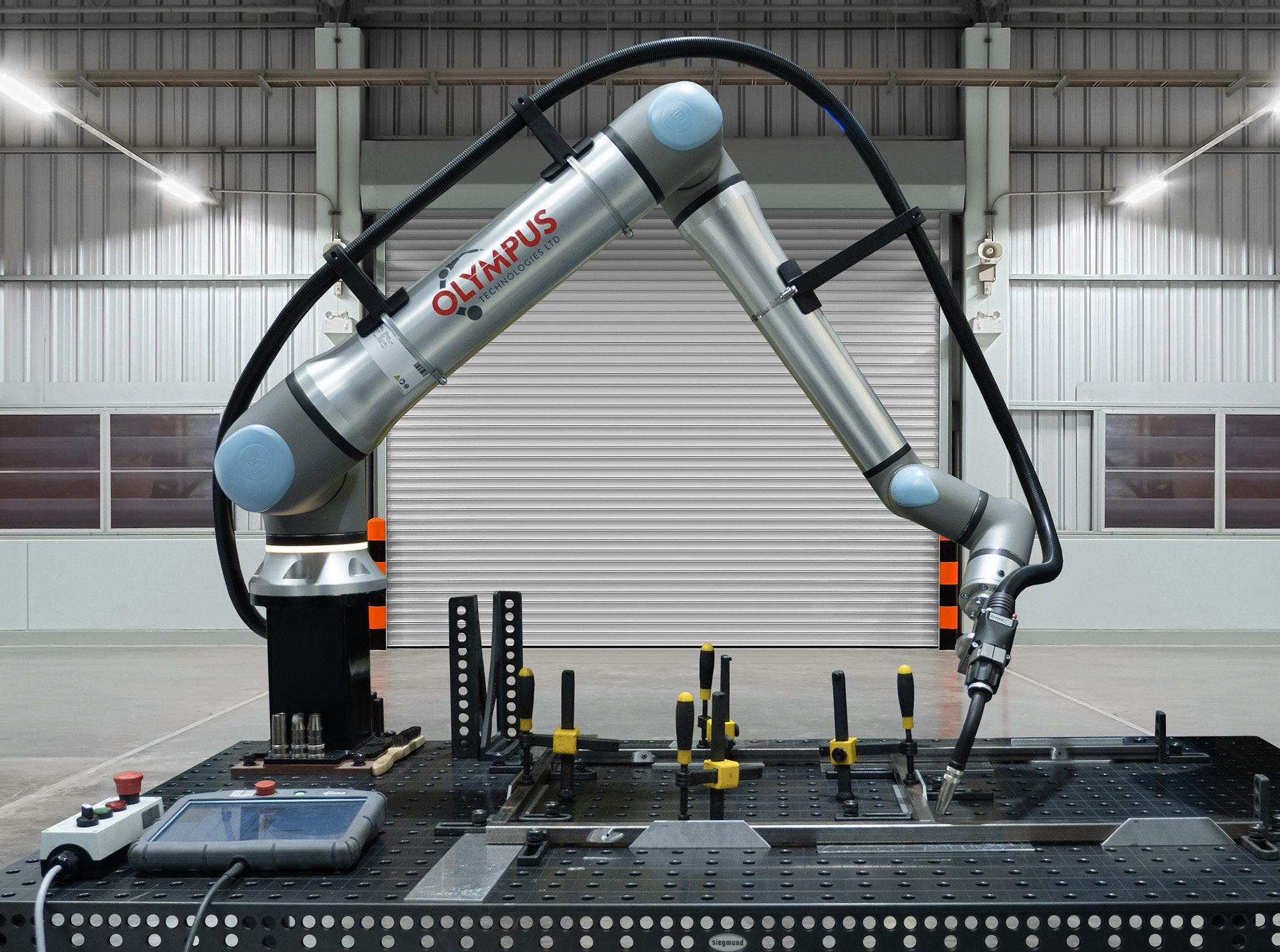














Seam tracking is one of the most misunderstood topics in cobot welding.
We regularly meet teams who already have welding cobots running, yet are still battling inconsistent welds, variable weld bead formation, or too much manual intervention. Someone eventually suggests seam tracking, usually framed as the silver bullet.
It is not.
At Olympus Technologies, we design and integrate robotic welding systems across fabrication, manufacturing, and high-mix environments. Seam tracking can absolutely improve weld quality, but only when it is applied for the right reason, with the right technology.
This guide explains when seam tracking actually helps, when it does not, and how to choose between vision, through-arc, and touch sensing without paying for complexity you do not need.
If your joint moves 3 mm every cycle, no sensor will save you.
The Three Seam Tracking Approaches (What Each Can - and Can’t - Correct)
All seam tracking technologies do one thing: they provide position data so the robot arm can adapt the weld path.
What differs is how, when, and what type of variation they can correct.
Vision-Based Seam Tracking
Vision-based systems use a vision system or laser seam tracking sensor, often with laser triangulation, to identify the weld seam before or during welding.
They are strong at:
- Detecting joint location on irregular surfaces
- Handling complex geometry and sheet metal
- Supporting high precision applications
They struggle with:
- Shiny material, reflective surfaces, and arc glare
- Ambient light variation on the shop floor
- Line-of-sight obstructions from fixtures or clamps
2D systems can struggle with depth, especially on lap joints and V-grooves. 3D laser systems perform better but add cost and integration effort.
Through-Arc Seam Tracking (Arc Seam Tracking / TAST)
Arc seam tracking monitors the electrical characteristics of the welding arc, typically voltage, while weaving across the joint.
It works well for:
- Thicker material (generally >2 mm)
- Long, continuous weld seams
- Stable processes like metal inert gas or metal active gas
Limitations:
- No look-ahead capability
- Requires weaving motion
- Less suitable for thin material or aluminum
- Cannot find joints, only correct drift once welding has started
Through-arc tracking is fast and effective, but it depends heavily on process stability.
Touch Sensing
Touch sensing uses the welding wire or torch nozzle to physically contact the workpiece and close a low-voltage circuit.
It is:
- Low cost
- Simple to implement
- Useful for fillet joints and basic butt joints
- Common in high-mix, low-volume welding applications
Trade-offs:
- Adds cycle time due to probing routines
- Sensitive to dirt, spatter, and surface condition
- Cannot adapt during welding, only finds initial position
Touch sensing is often underestimated, but it is slow and should be chosen deliberately.
Seam Tracking Method Comparison
| Method | What it corrects | What it cannot fix | Typical accuracy | Best use case |
|---|---|---|---|---|
| Vision | Joint position, seam geometry | Poor fixturing, large gaps | High | Complex seams, variable parts |
| Through-Arc | Real-time drift | Joint finding, thin material | Medium | Long welds on thick steel |
| Touch Sensing | Initial joint location | In-process variation | Medium | High-mix, low-volume |
What Seam Tracking Solves - and What Fixtures Must Still Solve
This is the critical distinction.
Seam Tracking Can Handle:
- Minor joint offset
- Small part-to-part variation
- Thermal movement during welding
- Adaptive control of travel speed, wire feed, and arc position
Seam Tracking Cannot Fix:
- Poor datum control
- Inconsistent gaps
- Part flex under clamp force
- Fixtures that do not repeat location
A good fixture design often removes the need for complex tracking entirely.
Accuracy Expectations (And the Calibration Reality No One Mentions)
Vendor demos quote sensor resolution. Production reality is different.
Nominal vs Production Accuracy
- Sensor resolution ≠ system accuracy
- Robot repeatability still limits final weld accuracy
- Cable movement, heat, and vibration all degrade performance
Calibration Drift
All tracking systems drift:
- Torch wear changes geometry
- Sensor alignment moves over time
- Cable strain quietly shifts reference points
In real production, recalibration is not annual. It is routine maintenance.
Cost, Complexity & Payback: When Seam Tracking Is Worth It
Seam tracking adds:
- Sensors
- Interfaces
- Software licences
- Integration effort
- Maintenance overhead
It also adds cycle time, especially with touch sensing or pre-scan vision.
Where Payback Is Real
- Long weld seams
- Variable upstream processes
- Reduced rework and scrap
- Improved first-pass yield
- Fewer manual interventions
For many customers, improving fixturing delivers a better ROI than adding tracking.
Deployment Reality Check (What Breaks Tracking Systems)
Lighting and Reflectivity
Vision struggles with reflective materials and arc glare. This is physics, not tuning.
Spatter, Smoke, and Lens Contamination
Optical systems need cleaning. Air knives help, but they are not magic.
Cable Routing and Strain
Poor routing kills repeatability. Temporary fixes always become permanent.
A Practical Decision Flow: Do You Need Seam Tracking?
Ask these questions in order:
- Can fixturing alone solve the variation?
- Is the variation predictable or random?
- Is the weld seam long enough to justify tracking?
- Is the material thin or thick?
- Do you need real-time correction or just joint finding?
Only then choose the tracking method.
Common Seam Tracking Mistakes in Cobot Welding
- Adding tracking too early
- Expecting sensors to replace process setup
- Mixing ownership between PLC and robot
- Ignoring long-term maintenance
- Assuming tracking equals higher speed
Tracking improves quality, not raw throughput.
How Seam Tracking Changes Cobot Welding Cost & Throughput
Tracking can:
- Increase cycle time
- Reduce rework
- Improve high quality weld consistency
- Lower material waste
- Improve reliability in automated welding
It must be evaluated as part of the whole system.
Final Word from Olympus Technologies
Seam tracking is a tool, not a cure-all.
In many cases, welding cobots already deliver repeatable results with good fixtures, sensible programming, and stable processes. Adding sensors should be a deliberate engineering decision, not a reaction to poor fundamentals.
If you are unsure whether you need seam tracking, or which solution is the right solution for your joint types, materials, and production goals, Olympus Technologies can help you evaluate it properly as part of a complete welding system.
Because fixing the real problem is always cheaper than masking it with technology.